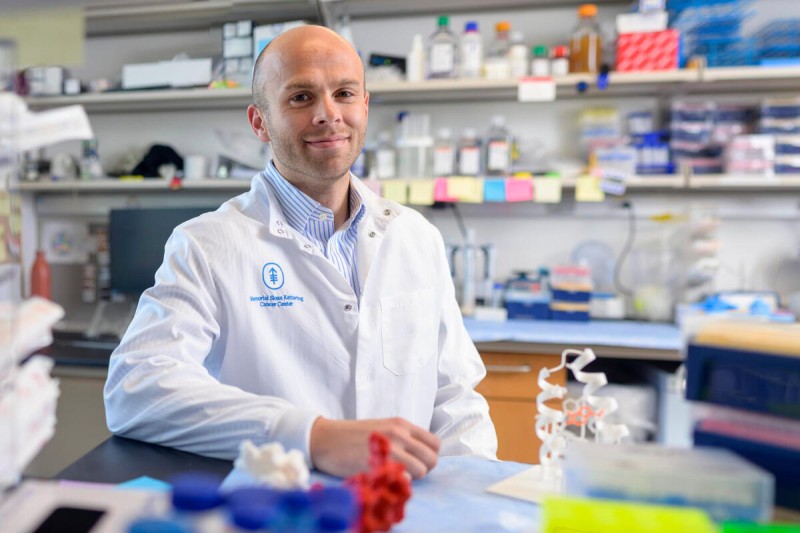
CAR T cell therapy, which involves genetically modifying a patient’s own immune cells to fight their cancer, is a technique that has shown great promise, especially against blood cancers. But currently, only about 4% of patients with advanced or metastatic cancer in the United States are candidates for CAR T therapy, and closer to 3% will actually benefit, according to one recent analysis.
The lab of computational biologist Caleb Lareau, PhD, at Memorial Sloan Kettering Cancer Center (MSK), aims to broaden the impact of CAR T cell therapy and other cancer treatments by using generative artificial intelligence (AI) to design better “binders” — proteins that recognize and latch onto cancer cells, allowing the immune system to destroy them.
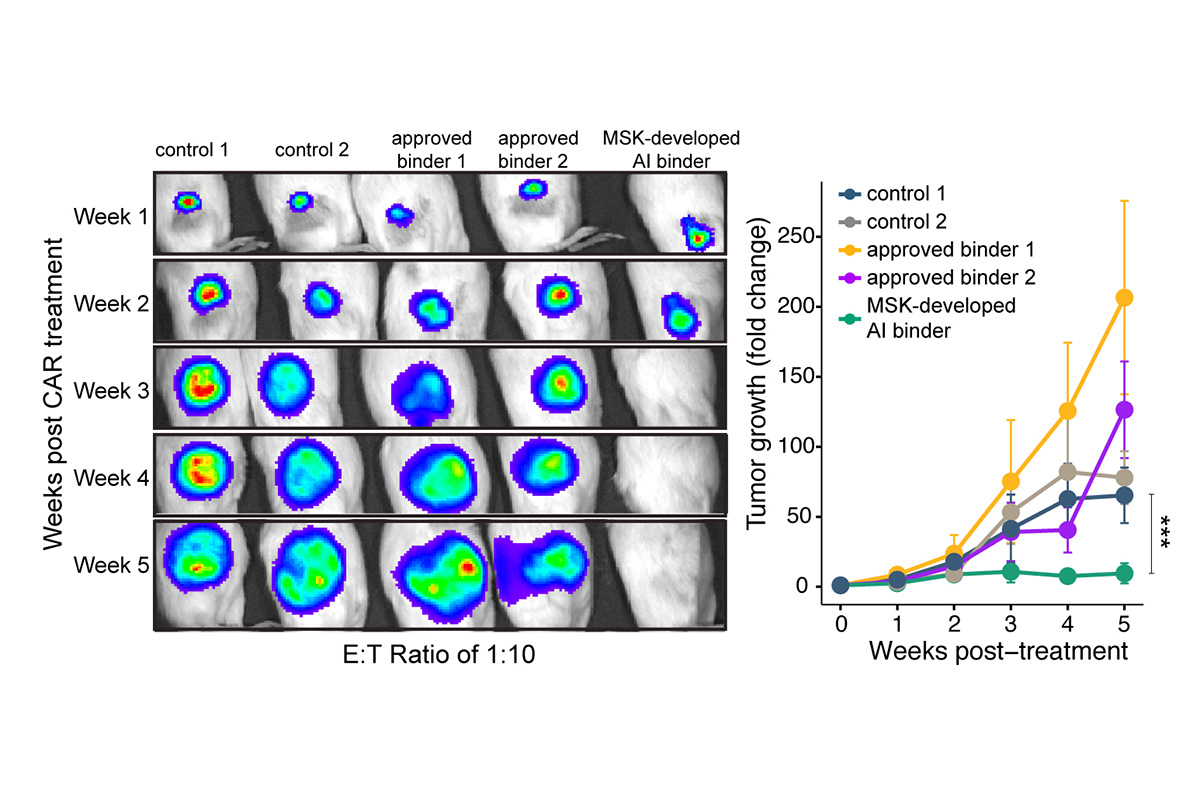
A proof-of-concept study, conducted in mouse models and published September 9 in Nature Biomedical Engineering, found MSK’s AI-driven approach significantly outperformed binders found on existing CAR Ts approved by the U.S. Food and Drug Administration (FDA) to target a protein called BCMA.
The study also reveals why AI models have struggled to effectively design binders against a blood cancer target called CD19 and why CAR T cells sometimes activate prematurely, when no cancer cells are present. Early activation can exhaust the cells before they encounter a tumor and reduce the therapy’s effectiveness.
The ultimate vision is to replace the field’s traditional “guess and check” approach with a more nuanced, evidence-based understanding of why some cancer-targeting proteins work well and others fail.
The approach could also be used to develop individualized treatments for rare cancers on the fly, Dr. Lareau says.
“You can imagine a patient coming in with a rare blood cancer or sarcoma or even a rare pediatric cancer, where nothing off the shelf is going to work — and we’ll be able to use AI to make a therapy that will recognize their cancer within a matter of weeks,” he says.
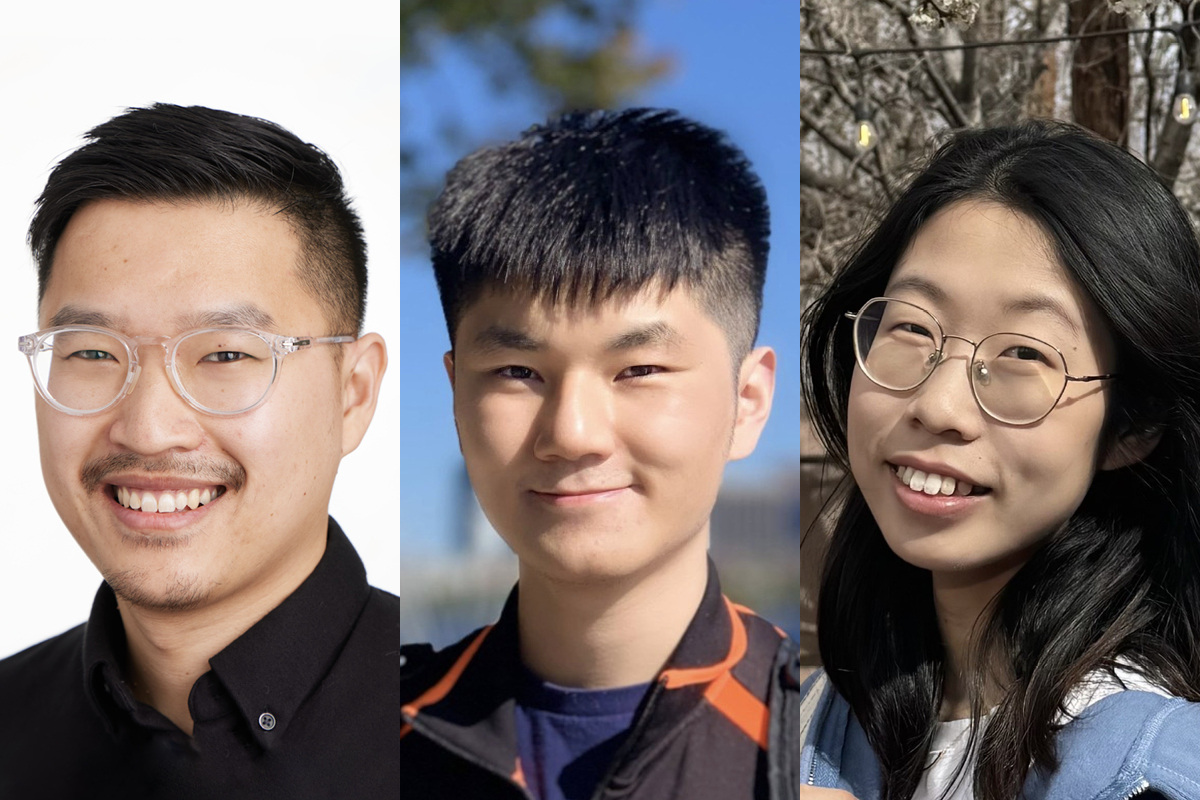
The study was led by three co-first authors: postdoctoral researcher Arthur Chow, PhD; graduate student Hoyin Chu, and research technician Ruofan “Betty” Li.
Using AI to develop new binding proteins from scratch
To develop effective CAR T cells, you need a couple of things.
First, you need a target — a specific protein that sits on the surface of cancer cells and acts like a flag. Ideally, that flag would appear only on cancer cells. If it also shows up on healthy cells, the engineered T cells will attack them too.
Next, you need a binder — a protein that sits on the surface of a T cell, ready to recognize the flag, grab hold, and destroy the cell carrying it.
Current FDA-approved CAR T therapies use a type of binder called single-chain variable fragments (scFvs). These are essentially repurposed pieces of existing antibodies that are used by the immune system to fight invaders.
AI-designed binders work differently. Rather than borrowing from existing antibodies, they are totally new proteins, built from scratch, and can be designed to latch onto a specific section of the target protein. They are also smaller and more compact than scFvs — a difference that can be used to overcome some of the limitations of current therapies, the researchers say.
From 1 million possibilities to 100 candidates
Once the research team has identified a target — a flag carried by a particular cancer cell — they use two existing AI tools to generate about 1 million potential binders and then filter them down to just the top candidates.
These binders all use the same three-dimensional shapes inspired by natural proteins, as a starting point but use different genetic sequences to build, giving them each distinct physical properties.
The results from the first program are then fed into a second AI model, which ranks them based on a variety of criteria.
“You could think of it like generating a million answers to a question in ChatGPT and then asking a different AI model, like Claude, to evaluate them,” Dr. Lareau says.
The process leaves the team with 100 to 200 strong candidates that are worth testing in the real world — a small enough number to be manageable for experiments, but still large enough to provide meaningful variety.
The DNA sequences encoding the candidate binders are then sent off to an outside lab to be synthesized, and the results arrive in the mail within about a week, Dr. Lareau says.
“These binders are proteins,” Dr. Lareau says. “There are exactly 20 building blocks, 20 amino acids, that can create them. And while the overall structures of these candidate proteins will be very similar, we found that tweaks in the amino acid sequences affect how they perform.”
Still, generating the candidates is only half of the process. The team still needs to test how the new binders perform in laboratory models of cancer. More than just figuring out which binders work and which don’t, the bigger goal is to understand why.
Using AI to Design Better Cancer Therapies
CARPNN: An AI tool that can learn
Enter CARPNN — a custom AI tool the team developed to learn from laboratory tests how subtle differences between binder sequences influence the performance of CAR Ts. The acronym stands for CAR Protein Neural Network
Small differences in a binder’s properties can have a big impact on performance — properties like electrical charge, amino acid composition, and which spot on the target the binder grabs onto, the researchers found.
“This ability to actually say, ‘This is why a binder does or doesn’t work,’ is a level of understanding that hasn’t been achievable in the CAR field to date,” Dr. Lareau says.
Learning from successes — and failures
The researchers tested the new approach against several targets of existing FDA-approved CAR T therapies: BCMA, which is found on multiple myeloma cells, and CD19 and CD22, which are associated with other blood cancers.
The results against BCMA were the most striking: The MSK-developed binder controlled tumor growth in mice significantly better than the FDA-approved version.
“We basically saw complete control of the cancer using our AI-designed binder, whereas the existing clinical product could not limit tumor growth,” Dr. Lareau says.
But several other important lessons emerged from less successful experiments as well:
- The AI models failed to produce effective CD19 binders. But the failure was instructive, revealing how the current tools struggled to move beyond existing binding patterns to generate truly novel solutions.
- The CD22 experiments revealed one of their best binders was also prone to activating against healthy cells — a problem they were able to correct using CARPNN to modify the binder.
- The team also found that binders with too much of a positive charge were likely to trigger prematurely, when no cancer cell was present.
- The researchers noted that AI models tended to favor an amino acid called alanine — and that high alanine content led to binding problems.
These discoveries enabled a new set of design rules — covering things like electrical charge, amino acid composition, and other key factors — that CARPNN could learn from and apply to future candidate evaluations.
“We’re changing what was traditionally educated guesswork with more informed, evidence-based design,” Dr. Lareau says.
From computer to bedside
For Dr. Lareau, the work points beyond the individual successes and failures against the various targets. Rather than testing a variety of candidates and picking among the ones that seem to work best, the team’s approach makes it possible to develop new CARs more systematically and to generate generalizable rules that can inform successive waves of development.
And the approach isn’t limited to just CAR T development, Dr. Lareau notes. It could be used to design binders for other therapeutic applications, including precision drug conjugates and other cancer treatments.
“A major goal of our group is to use these generative models to develop new cancer drugs, conduct clinical trials, and see them used to help patients at MSK and beyond,” he says. “And the lab is about three years into that 10-year plan.”
The generative AI work marks a new direction for the lab — the kind of timely, higher-risk, higher-reward science that MSK champions.
“This is a big intellectual bet that I’m making as a young faculty member, and MSK has been incredibly supportive,” Dr. Lareau says. “And the remarkable BCMA results, I think, show we’re on the right track.”
Additional authors, funding, and disclosures
Additional authors on the paper include Benan Nalbant, Abdul Vehab Dozic, Laura Kida, Zeyu Tang, and Joseph Palmeri, all of MSK.
MSK’s High Performance Computing Group provided critical computational resources for the research.
The work was supported by the National Institutes of Health (R00HG012579, R33CA302491), MSK’s Cancer Center Support Grant (P30CA008748), a Pershing Square Sohn Prize for Cancer Research, and an AML SPORE award from the National Cancer Institute (P50CA254838). Additional support was provided by a Basic and Translational Immunology Postdoctoral Award from the Ludwig Center for Cancer Immunotherapy at MSK, a Boehringer Ingelheim Fonds fellowship, a National Academy of Medicine Catalyst award, the Michelson Prize for Immunology, and the Geoffrey Beene Cancer Research Center at MSK.
MSK has filed a provisional patent based on the work, with Dr. Lareau and four of the other authors named as inventors. Dr. Lareau is also a consultant to Cartography Biosciences.
Read the study: “Sequence and structural determinants of efficacious de novo chimaeric antigen receptors,” Nature Biomedical Engineering. DOI: 10.1038/s41551-026-01790-9
Read the related Research Briefing: Defining attributes of effective binders for AI-assisted CAR design