This resource explains what an electroencephalogram (ee-LEK-troh-en-SEH-fuh-loh-gram) is. It also explains how to get ready for your electroencephalogram at MSK. An electroencephalogram is most often called an EEG.
What is an EEG?
An EEG is a non-invasive test used to measure and record the electrical activity in your brain. Non-invasive means nothing is put inside your body. An EEG can help diagnose health problems, such as seizures.
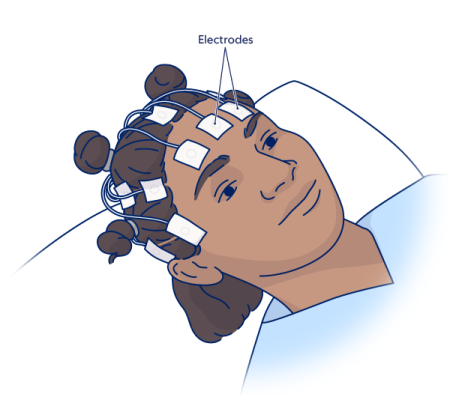
An EEG technician will place electrodes (sensors) on your scalp with a special adhesive (glue). The electrodes are attached to a monitor that tracks your brain activity over a set period (see Figure 1).
There are 2 types of EEGs:
- A routine EEG. With this type, the EEG technician will place and remove the electrodes during the same appointment. You do not need to go home with the device. This visit will take about 90 minutes.
- An ambulatory EEG, also called a home EEG. With this type, the EEG technician will place the electrodes during the appointment. This will take about 2 hours.
Then you’ll go home with the electrodes and EEG equipment. The device will collect data for 48 hours (2 days). You’ll wear the device at all times, including while you’re sleeping. After 48 hours, you’ll go back to the clinic to have the electrodes removed.
Talk with your healthcare provider if you have any questions. If you need to cancel your appointment, call the office of the healthcare provider who scheduled your appointment.
What to do the day of your EEG appointment
If you’re running late, please call us as soon as possible.
- Call (212) 639-3718 Monday through Friday from 9 a.m. to 5 p.m.
- On weekends, call (212) 639-2100. Ask to talk with the M4 front desk for help.
Things to remember
- Wear clean, comfortable clothes. Wear a button-down or zip-up shirt. Once the electrodes are placed, it will be hard to take off clothes over your head.
- Shower and wash your hair before the test. Clean, dry hair helps the electrodes stick better.
- Do not use any hair gel, hairspray, or other hair products on the day of your procedure.
- Take off any wigs, weaves, or hairpieces, if you wear them. If you wear a religious head covering, you can keep it in place until your appointment.
- Keep taking your medicine as prescribed. If your doctor gives you different instructions, follow their directions.
- Tell us if you are taking any sedatives or medicine for seizures.
- Avoid having caffeine the day of your procedure. Other than that, you can eat and drink as you usually would.
- Do not chew gum during the test. This can make the readings unclear.
What to bring with you
Bring a cap or hat with you if you’d like to cover your head on the way home.
Where to go
Your EEG will be done at:
Memorial Hospital (MSK’s main hospital) on the 4th floor
1275 York Avenue (between East 67th and East 68th Streets)
New York, NY 10065
Take the C elevator to M4. Check in at the front desk.
What to expect during your EEG appointment
An EEG technician will measure your head. They’ll use adhesive or an elastic cap to attach electrodes onto your scalp.
If you’re having a routine EEG
An EEG technician will do your EEG. When your EEG is done, they’ll take off the electrodes. You do not need to come back for a second visit.
Your routine EEG will take about 90 minutes. This is from the time the EEG technician places the electrodes until they take them off.
If you’re having an ambulatory EEG
It will take about 2 hours to place the electrodes. You’ll go home with the EEG device. After 48 hours, you’ll come back to the clinic so we can take off the electrodes.
What to do for your ambulatory EEG
At home
The device will record your brain activity for 48 hours. Keep the electrodes in place for the full 48 hours. Do not take them off or adjust them yourself. You can sleep in your usual position while they’re on.
Do not get the electrodes wet. If the electrodes get wet, the test will not be accurate. Do not swim or shower during your EEG. If you need to clean your body, avoid getting your head or hair wet. It’s OK to sponge bathe from the neck down.
Record events and symptoms
Your care team will give you an EEG event log. If you have any events or symptoms during the study, push the red button on the device and fill out the event log. Examples of events or symptoms include:
- Feeling dizzy.
- Fainting (passing out).
- Having a seizure.
- Any other symptoms that are not normal, or symptoms that worry you.
Describe the event with as many details as possible, including the date and time. This will help your doctor find specific activity on your EEG event log and read your results.
After your ambulatory EEG
After 48 hours, you’ll come back to the clinic so we can take off the electrodes. This will take about 30 minutes.
Getting your results
Your results will be ready in about 1 week. You’ll have a follow-up visit to go over your results. Your doctor will talk with you about your results and any next steps.
If you have not scheduled a follow-up visit, call your doctor’s office.
When to call your healthcare provider
If you’re having an ambulatory EEG, call the healthcare provider who ordered your EEG if:
- The electrodes fall off.
- If you have problems with the battery pack.
- If you have any discomfort during the EEG.
- You have any symptoms that concern you.
Learn about our Health Information Policy.