This resource explains what an implantable loop recorder is and why you may need one. It also explains the procedure to place an ILR and what to expect while you have one. An ILR is also called an insertable cardiac monitor (ICM).
What is an implantable loop recorder?
An ILR is a device that measures and records your heartbeat. It’s placed under your skin on your chest, near your heart (see Figure 1).
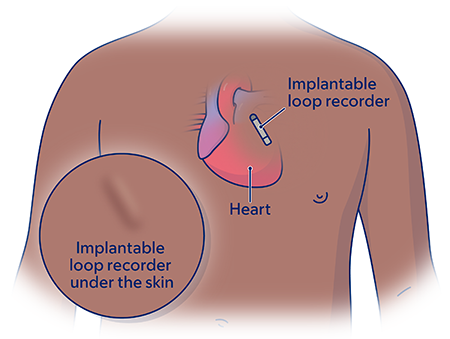
An ILR can measure and record your heartbeat for 3 to 5 years. Your ILR will measure your heartbeat all the time while it’s in place. If your heart rate gets too fast or too slow, it will automatically start recording your heartbeats. Your ILR will send the recording wirelessly to your care team.
You can also use an app on your smartphone to tell your ILR when to start recording. Talk with your care team to learn more about using the app.
Once you don’t need your ILR anymore, you can choose to leave it in place or have it taken out.
Why may you need an implantable loop recorder?
You may need an ILR if you have problems with:
- Fainting.
- A very slow or very fast heartbeat.
- Heart palpitations (feeling like your heart is fluttering, pounding, or skipping beats).
- Strokes.
Before you get an ILR, your healthcare provider will do other tests to check your heart. Other tests only measure your heartbeat for up to 30 days at a time. If those tests cannot explain your health issue, they may recommend getting an ILR. This is because an ILR can measure your heartbeat all the time for up to 5 years.
Your healthcare provider will use the recordings from your ILR to see if your heart is causing your health issues. Once they know the cause, they can plan the best way to treat it.
What to do before the procedure to get your ILR
Your healthcare provider will talk with you about the risks and benefits of getting an ILR. Your risks will depend on things such as your age and your other health conditions. Most people have their ILR placed without any problems.
Arrange for someone to take you home
You must have a responsible care partner take you home after your procedure. A responsible care partner is someone who can help you get home safely. They should be able to contact your care team if they have any concerns. Make sure to plan this before the day of your procedure.
If you don’t have a responsible care partner to take you home, call one of the agencies below. They’ll send someone to go home with you. There’s a charge for this service, and you’ll need to provide transportation. It’s OK to use a taxi or car service, but you still need a responsible care partner with you.
| Agencies in New York | Agencies in New Jersey |
| VNS Health: 888-735-8913 | Caring People: 877-227-4649 |
| Caring People: 877-227-4649 |
Follow your healthcare provider’s instructions for eating and drinking
You may need to avoid eating or drinking anything for 4 hours before your procedure. Follow your healthcare provider’s instructions.
Follow your healthcare provider’s instructions for taking medicine
Your healthcare provider will tell you which medicine to take before your procedure. Follow their instructions. Do not stop taking any medicine unless your healthcare provider tells you to.
What to expect during your ILR procedure
First, your healthcare provider will give you an injection (shot) of local anesthesia (A-nes-THEE-zhuh). Local anesthesia is medicine that numbs an area of your body.
Once the area is numb, your healthcare provider will make a small incision (cut) in your skin. For most people, the incision is on the left upper chest. They’ll make a small space for the ILR under your skin and place the ILR there. Then, they’ll close the incision with sutures (stitches) or Dermabond® (surgical glue). They’ll put a small bandage over the incision.
The procedure will take about 30 to 60 minutes.
What to expect after your ILR procedure
Your healthcare provider will ask you if you have any pain. If you do, they will give you medicine to help manage it. You can also take an over-the-counter pain medicine (pain medicine you buy without a prescription). Your healthcare provider will give you more specific instructions if you need them.
You’ll be able to go home the same day as your procedure. You’ll need a responsible care partner to take you home.
What to do while you have an ILR
Leave the bandage over your incision for 2 to 3 days. After 2 to 3 days, you can take the bandage off and leave your incision uncovered.
Do not get your bandage wet. If it gets wet, change it. If you need to shower while your bandage is in place, cover it before your shower. Use a waterproof cover, such as AquaGuard®. Do not take a bath while your bandage is in place.
If your healthcare provider closed your incision with sutures, the sutures will dissolve on their own. If they used Dermabond, the glue will probably peel off on its own. If it has not peeled off after 7 days, you can gently rub it off.
You don’t need to follow any special precautions while you have an ILR. You can do all your normal activities.
Your ILR may set off some security detectors. Your care team will give you a wallet card that says you have an implanted medical device. Always carry it with you.
If you need to have a magnetic resonance imaging (MRI) test, talk with your heart healthcare provider first. An MRI may cause your ILR to show a false reading.
When to call your healthcare provider
Call your healthcare provider if:
- You have a fever above 100.3 °F (38 °C).
- Your incision is bleeding.
-
The area around your ILR is:
- Swollen.
- Tender or painful.
- Very red or getting redder.
- You have any questions or concerns.
Learn about our Health Information Policy.