This information explains what a full-thickness skin graft is. It also explains how to care for your donor and recipient sites after your full-thickness skin graft.
During a full-thickness skin graft, your surgeon will take the entire thickness of skin from part of your body. They’ll use the piece of skin to close a wound somewhere else on your body.
- The donor site is the place your surgeon takes the skin from. For a full-thickness skin graft, the donor site can be an area on your neck, your upper chest, your abdomen (belly), your groin, or another area.
- The recipient site is the place your surgeon puts the skin. The grafted skin in the recipient site may look different from the skin around it after it heals.
You may have a full-thickness skin graft if you lost a small area of skin. You may have lost the skin due to an infection, burn, or surgery to take out cancer.
Your care team may tell you to limit some movements or physical activities. If they do, follow their instructions or you may damage the skin graft as it’s healing.
About your donor site
For most people, the donor site is a straight incision (surgical cut) that’s closed with sutures (stitches). Some people also have Steri-Strips™ (surgical tape) or Dermabond® (liquid skin glue) over their donor site incision.
You may have some discomfort or pain in the area for 1 to 2 weeks.
About your recipient site
Your recipient site will look different depending on which dressing you have. You may have some discomfort or pain in the area for 1 to 2 weeks.
You’ll have 1 of these types of dressings over your recipient site:
- A bolster (pressure dressing)
- A negative pressure wound therapy (wound VAC) system
Your surgeon may also place a skin substitute called Integra® under the pressure dressing or negative pressure wound therapy system.
These special dressings will help the recipient site heal.
Integra®
Integra is an artificial (man-made) skin substitute made from bovine (cow) and shark cartilage. It’s placed over a wound to help new skin grow.
Your surgeon may place Integra over your recipient site instead of a full thickness skin graft. Integra is placed under the bolster or negative pressure wound therapy dressing.
Bolster (pressure dressing)

A bolster is a bulky, cushion-like dressing held in place with sutures (see Figure 1). Bolsters are often yellow and can be covered with gauze.
Bolsters work by putting gentle pressure on your recipient site to keep fluid from building up. This helps the skin graft stick to your body and keeps it from moving.
You may also have a splint, cast, or sling to help hold the bolster in place. This depends on where the bolster is on your body. If you have a cast, your surgeon will cut out the part above your recipient site. This will help them look at your graft.
Negative pressure wound therapy (wound VAC) system
A negative pressure wound therapy system is an airtight dressing connected to a small machine by a tube (see Figure 2).
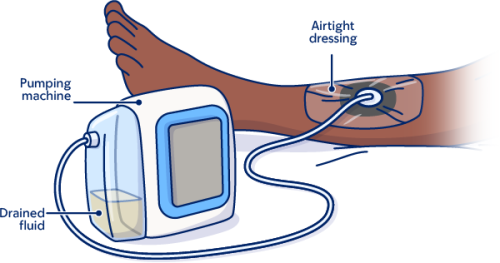
Negative pressure wound therapy uses gentle suction to pull fluid away from your wound. This helps keep the graft from moving. It can also help new tissue grow faster and attach to the skin underneath. These things can help the wound heal.
How to care for your donor and recipient sites
During the first 5 to 7 days after surgery
- Keep your dressings dry.
- Leave the dressing on your recipient site unless your surgeon tells you to change it.
- If you have a dressing over your donor site, take it off after 48 hours (2 days). After that, you can leave your donor site incision open to air.
- Do not shower or take a bath until your surgeon tells you it’s OK. This will be based on how fast your sites are healing.
- You can take sponge baths, but do not get your recipient site wet. Your care team will tell you when it’s safe to get your donor site wet. This is usually 48 hours (2 days) after your surgery.
- If you see bloody drainage or blood oozing from your donor site, put pressure (press) on the area for 15 minutes. Call your surgeon’s office if there’s still bloody drainage or blood oozing after 15 minutes. Put clean, dry gauze over the area. If you still had a dressing over your donor site, take off the bloody dressing before placing the clean gauze.
After your first dressing change 5 to 7 days after surgery
Your surgeon or nurse will take off your dressing to check your recipient site about 5 to 7 days after your surgery. They will see how the area is healing.
Your donor site
If your donor site is closed with sutures, they may dissolve (melt away) on their own. Or, your care team may need to take them out 1 to 2 weeks after your surgery. Your care team will tell you which type of sutures you have.
If your donor site is covered with Steri-Strips, leave them in place. They usually fall off on their own after about 14 days. If they have not fallen off after 14 days, you can take them off.
If your donor site is covered with skin glue, it will have a purple tint. Your skin glue will flake off over several weeks. Do not pick or pull it off unless your care team tells you to.
Do not soak your donor site underwater (such as in a pool or bath) until it’s fully healed.
Your recipient site if you have a bolster
Your surgeon or nurse may place a new dressing over your recipient site. This may be a Xeroform dressing, Adaptic dressing, or gauze. Less often, the area may be left open to air.
Change this dressing once a day until your graft has fully healed. Your nurse will teach you and your caregiver how.
Keep your recipient site dry until your care team gives you other instructions.
Your recipient site if you have a negative pressure wound therapy system
If the graft isn’t fully healed, your surgeon or nurse may put the negative pressure wound therapy system back on for longer. Or, they may put a different dressing on your wound. Your care team will talk with you about what to expect and how to care for the area.
Your recipient site if you have Integra
After they take off the bolster or negative pressure wound therapy system, your care team may tell you to put Silvadene® cream and a nonstick dressing on the area 1 time per day. Follow their instructions. Less often, the area may be left open to air.
Change the dressing once a day until your graft has fully healed. Your nurse will teach you and your caregiver how.
Keep your recipient site dry until your care team gives you other instructions.
3 weeks after your surgery, your surgeon or nurse will take off a remaining layer of silicone holding the Integra in place. At this time, they’ll give you more instructions for how to care for your recipient site. They may tell you to wash it gently and put on other ointments. Follow their instructions.
After your wounds are healed
Your care team will tell you when your wounds are healed. Usually, this is when there’s no more scabbing or open areas.
- Do not let the sun hit the sites. Use a sunscreen with a sun protection factor (SPF) of 30 or higher on the sites once they have healed.
- Put moisturizer on the sites once a day after showering. Keep doing this for 1 to 3 months, depending on your doctor’s instructions. You can also use scar creams or silicone gel sheeting.
- At first, your recipient and donor sites will look dark pink. This color will change and get lighter over the next few months. Once your sites have fully healed, you can use makeup to cover any scarring.
When to call your care team
Call your care team if you have:
- A fever of 101 °F (38.3 °C) or higher
- Shaking chills
- Thick, yellow (pus-like) drainage from your donor or recipient site
- Bad-smelling drainage from your donor or recipient site
- New redness or warmth around your donor or recipient site
- More or spreading redness or warmth around your donor or recipient site
- New tenderness (such as soreness or pain) around your donor or recipient site
- Bleeding that does not stop after applying pressure for 15 minutes
Learn about our Health Information Policy.