This information will help teach you and your caregiver how to give total parenteral nutrition (TPN) at home.
About TPN
TPN provides nutrients directly into your bloodstream through a central venous catheter (CVC). A CVC is a thin, flexible tube placed in a large vein near your collarbone. It is used when you can’t get enough nutrients by mouth or tube feeding. Your nurse will teach you about your CVC when you have it placed.
You’ll get TPN with an infusion pump during the night. This usually takes 12 to 18 hours.
How to check and store your TPN
Your TPN is shipped to you. Store it in the refrigerator at a temperature of 35° F (1.6° C). When you get your TPN:
- Check the label to make sure your name and TPN mixture are correct. Call your healthcare provider if there is a mistake.
- Check the expiration date on the TPN bag. Call the company who sent your TPN if it’s expired.
How to get your TPN mixture ready
Follow these steps to get your TPN mixture ready.
- Take your TPN out of the refrigerator 2 hours before you need to use it so that it can come to room temperature.
- Clean your workspace. Choose a smooth, clutter-free table or countertop. Do not prepare your TPN in the bathroom or near the kitchen sink. Keep pets out of the room. Clean the surface with soap and water and dry it with a paper towel.
- Remove drafts. Close nearby windows and turn off fans.
- Gather your supplies. You will need:
- Your TPN bag
- Filtered administration set (IV tubing)
- 10 mL saline (0.9% NaCl) flushes
- Alcohol wipes
- Infusion pump
- Multivitamin (MVI)
- A regular garbage can
- A sharps container
- Check your TPN bag. Make sure your name, TPN formula, and expiration date are correct. The solution should look consistent throughout the bag. Do not use it if you see:
- Leaks or cracks
- Cloudiness
- Separation
- Floating particles
- Wash your hands.Wash your hands with soap and warm water for at least 20 seconds. Dry them well with a clean paper towel.If you need to stop at any point during the steps below, wash your hands again before you start. To learn more, read Hand Hygiene and Preventing Infection
How to add multivitamins to your TPN bag
Follow these steps to add your multivitamins to your TPN bag.
- Assemble the syringe. Take the cap off the syringe (see Figure 1).
- If the needle is already attached, gently twist it to make sure it’s tight.
- If the needle is not attached, remove it from its package and attach it to the syringe. Twist it to lock it in place.
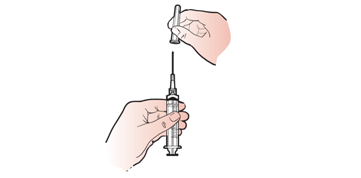
Do not touch the sterile ends. If the syringe needle touches another surface, throw it away and use a new one.
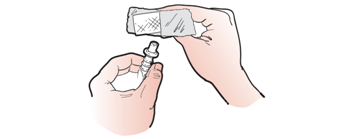
- Clean the medicine port. Scrub the medicine port on the TPN bag with an alcohol wipe for 15 seconds (see Figure 2). Let it air dry completely. Do not let the sterile port touch anything.
- Clean the vitamin vials. Take the caps off both vitamin vials. Scrub each rubber stopper with a new alcohol wipe for 15 seconds (see Figure 3). Let it air dry completely. Do not let the sterile surface/stopper touch anything.

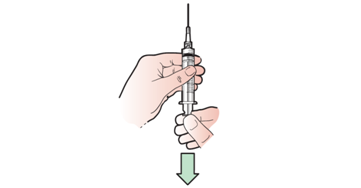
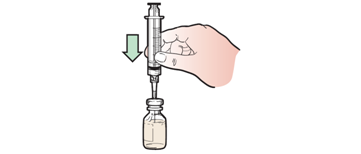
- Draw up vitamins. Pull 2 to 3 mL of air into the syringe (see Figure 4). Push the needle into the first vial and inject the air (see Figure 5). Turn the vial upside down and withdraw medicine as instructed (see Figure 6). Using the same syringe, repeat these steps with the second vial.
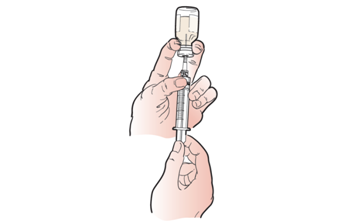
- Add the vitamins to the TPN bag. Insert the needle straight into the medicine port of the TPN bag (see Figure 7). Slowly push the plunger to inject the vitamins into the bag. Gently swirl the TPN bag until the vitamins are fully mixed and the color is even. Do not shake the bag.
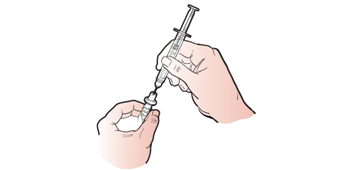
You may need to add other vitamins or medicines to your TPN right before your infusion. If so, follow your home infusion nurse’s instructions.
Never recap a used needle. Put all used needles and syringes in your sharps container.
How to spike and prime the tubing
- Close the clamp. Take the filtered tubing out of its package. Close the tubing clamp right away.
- Connect the tubing. Remove the protective covers from the TPN bag port and the tubing spike (see Figure 8). Do not touch the sterile ends. Push and twist the spike firmly into the TPN bag port (see Figure 9).
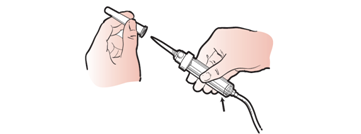
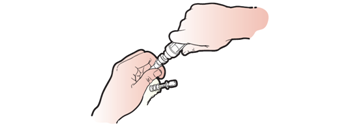
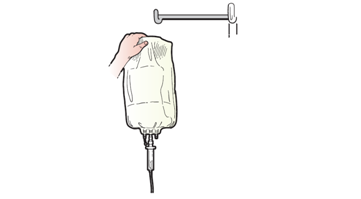
- Prime tubing. Hang the bag (see Figure 10). Follow your home infusion nurse’s instructions for loading the tubing into your pump and priming the entire line. Make sure there are no air bubbles in the tubing.
How to prepare your CVC and connect the TPN
- Clean the CVC connection. Scrub the end of your CVC lumen with an alcohol wipe for 15 seconds and let it dry.
- Prepare the saline flush. Tap the side of a 10 mL normal saline syringe with the tip pointing up. Gently tap the side of the syringe to release any air bubbles, then remove the cap. Gently press the plunger on the syringe until the air is pushed out. Do not let the sterile tip touch anything.
- Flush your CVC with 10 mL saline. Attach the syringe to your CVC. Use the push-pause method:
- Quickly inject ⅓ of the saline. Pause.
- Inject another ⅓ of the saline. Pause.
- Inject the last ⅓ of the saline.
Clamp your catheter after the last injection (shot).
If you feel resistance, stop. Check the tubing for kinks. Call your home infusion nurse or pharmacist if you can’t flush your catheter.
- Connect TPN. Remove the protective cap from the TPN tubing (see Figure 11). Carefully twist the tubing onto your CVC lumen.Do not touch the sterile ends. If the sterile ends of the tubing touches another surface, throw the tubing away and use new tubing.Start your infusion pump.

How to disconnect your TPN and flush your CVC
Your TPN infusion will usually take 12 to 18 hours. Your pump will sound an alarm when your infusion is done.
Follow these steps to disconnect your TPN and flush your CVC.
- Gather your supplies. You’ll need:
- A 10 mL normal saline flush
- Alcohol wipes
- A new disinfection cap
- A regular garbage can
- Wash your hands. Wash your hands with soap and warm water for at least 20 seconds. Dry them well with a clean paper towel.
- Turn off the pump. Turn off your infusion pump and close the clamp on the TPN tubing.
- Disconnect the TPN tubing.
- Clean the CVC connection. Scrub the end of your CVC lumen with an alcohol wipe for 15 seconds and let it dry.
- Prepare the saline flush.Hold the 10 mL saline syringe with the tip pointing up. Gently tap the side of the syringe to move the air bubbles to the top.Remove the cap. Gently press the plunger until all the air is pushed out.Do not let the sterile tip touch anything.
- Flush your CVC. Attach the syringe and flush your CVC with the 10 mL of saline using the push-pause method:
- Quickly inject ⅓ of the saline. Pause.
- Inject another ⅓ of the saline. Pause.
- Inject the last ⅓ of the saline.
- Clamp and cap your CVC: Clamp your catheter right after flushing it. Untwist and remove the empty syringe. Attach a new disinfection cap to the connector.
If your TPN has insulin
If your TPN has insulin, check your blood glucose (blood sugar) at least 2 times each day:
- 2 hours after starting your TPN
- 1 hour after stopping your TPN
If your glucose drops below 70 mg/dL, follow the 15/15 rule or infuse IV dextrose as prescribed.
To learn more, read About Hypoglycemia (Low Blood Sugar)
When to call your healthcare provider
Call your healthcare provider if you have:
- A fever of 100.4° F (38° C) or higher
- Chills
- Dizziness or heart palpitations (a fast, fluttering, or pounding heartbeat)
- Severe (very bad) pain around your catheter
- Shortness of breath
- Increased swelling in your legs or feet
- Severe pain around your catheter
- Redness, swelling, or pain at your catheter insertion site
- Trouble flushing your catheter
- Trouble infusing your TPN
- Blood or fluid leaking from your catheter or tubing
- Catheter tubing that is broken or damaged
You may urinate (pee) more often while getting TPN. Call your healthcare provider if you:
- Have pain while you urinate.
- Notice blood, a foul odor (smell), or pus in your urine.
- Have a sudden or strong urge to urinate.
Contact information
Contact your home infusion nurse or pharmacist if you have problems with your TPN supplies.
For clinical nutrition APP questions, call 212-639-5041. You can reach them Monday to Friday from to
For GI/clinical nutrition attending questions, call 212-639-3148 or 212-639-8152 You can reach them Monday to Friday from to
For urgent clinical questions during evenings, weekends, and holidays, call the Main Hospital at 212-639-2000. Ask to speak with the GI or Clinical Nutrition fellow on call.
Learn about our Health Information Policy.