Facial Paralysis Reconstruction
Our Care Advisors will connect you with the best healthcare provider for your needs. We're here 24 hours a day, 7 days a week.
Overview of facial paralysis reconstruction
This page explains facial paralysis (puh-RAL-uh-sis) and how treatment from MSK experts can help restore your face. Facial paralysis reconstruction is also called facial reanimation. Treatment can help you smile, blink, eat, speak, and show emotion.
We explain why it's important to have good eye protection and mouth movement. It's important to have symmetry in your face, so both sides look the same. We also cover how rehab can support your recovery.
Facial paralysis is when you cannot move all or 1 side of your face. Your face does not look or work as it should. These changes can be very hard to cope with.
Facial paralysis can make it hard to smile and show your feelings. It makes it harder to communicate with your family and friends.
You may not be able to close your eye or lift your mouth. This can lead to infections in your eyes or saliva (spit) leaking from your mouth.
Facial paralysis can happen because of:
- Tumors
- Harm to your head or neck
- Infections such as Ramsay Hunt syndrome (herpes zoster)
- Bell’s palsy
- Surgery
- Radiation
Talk with an MSK Care Advisor. We're here 24 hours a day, 7 days a week.
Why choose MSK for facial nerve reconstruction?
MSK has very strong experience with facial reanimation surgery to treat facial paralysis caused by tumors, cancer surgery, or radiation.
MSK has a team of experts in rebuilding facial nerves. This team includes plastic surgeons, head and neck surgeons, neurosurgeons, eye doctors, and rehabilitation (rehab) experts. They work together to plan your care around your treatment.
Our treatments include nerve reconstruction, muscle transplants, and other procedures that help restore how your face moves and looks.
As one of the world’s top cancer centers, our patients have access to new treatments not offered at many other hospitals. MSK may have research studies, also known as clinical trials, for people with facial nerve problems and paralysis.
MSK's reconstructive surgeons are experts in the latest microsurgery methods for facial reanimation and nerve and muscle reconstruction. They helped pioneer many of these approaches.
MSK supportive care services help you recover with nutrition, speech therapy, physical therapy, occupational therapy, social work, and integrative medicine services.
What is facial reanimation?
The facial nerve controls the muscles that move your face. When the nerve is injured or does not work as it should, it can cause muscle weakness. It can affect your face’s symmetry (how the 2 sides of your face match).
Based on how it started and how bad it is, facial paralysis can affect how well you can:
- Smile
- Close your eyes
- Speak
- Breathe through your nose
- Show emotions (feelings) with your face
MSK experts can help fix these problems with facial paralysis reconstruction and facial reanimation.
Facial reconstruction surgery repairs or replaces the part of your face that’s not working or is missing.
Facial reanimation surgery helps your face move again. Your surgeon may move a healthy nerve, reconnect a nerve, or move muscle.
Our goal is to help you smile, blink, speak, and see as naturally as possible.
How facial paralysis affects your daily life
Facial paralysis means you may have trouble closing an eye, keeping food or drinks in your mouth, speaking clearly, or smiling.
It can make your face look uneven.
These changes can affect how you feel about yourself and how comfortable you feel around other people.
The symptoms of facial paralysis may last a lifetime if they're not treated. The causes of facial paralysis can affect your comfort, safety, and quality of life. We’ll work with you closely to manage the symptoms as best we can.

What can cause facial paralysis?
Facial paralysis can happen for many reasons, such as tumors, infection, injury, and harm to the facial nerve. Treatment is based on the cause. Your care team will talk with you about what kind of surgery may help and when you should have treatment.
MSK surgeons are experts in dealing with complex cases of facial paralysis. This includes preventing and treating paralysis linked to head and neck tumors or cancer treatment.
It’s important to know that treatment for head and neck cancer does not always cause facial paralysis. But if it does happen to you, our expert reconstructive surgeons can help.
We also treat benign (not cancer) facial nerve problems that need complex surgery.
MSK experts treat these common causes of facial paralysis:
- Salivary gland (parotid) cancer
-
Most salivary gland tumors can be removed while sparing the facial nerve and its many parts. MSK head and neck cancer surgeons use the latest surgery methods to find and protect your facial nerve.
If you have cancer of the salivary glands, the tumor can grow into or around the facial nerve. If so, we may have to remove the facial nerve and the tumor with cancer.
When possible, MSK experts in facial nerve reconstruction and facial reanimation will rebuild the facial nerve during the same surgery. This gives you the best chance for restoring your facial movement.
- Skull base tumors and acoustic neuroma
-
Some tumors can be near or involve the facial nerve. Examples are acoustic neuromas (vestibular schwannomas), facial nerve schwannomas, meningiomas, and other tumors in the skull base. Our neurosurgeons and neurotologists use the latest methods to keep the facial nerve safe when possible.
In rare cases, you may have facial paralysis after treatment for skull base tumors. Our reconstructive surgeons will work closely with the skull base surgery team and the head and neck cancer team. They'll make a facial reanimation plan just for you. Sometimes we can do facial nerve reconstruction very soon after surgery to restore your facial movement.
- Head and neck cancer surgery
-
We can remove most head and neck cancers during surgery while sparing your facial nerve. MSK head and neck cancer surgeons use the latest imaging and surgery methods to find and protect your facial nerve. But if there's cancer in your facial nerve, we may need to remove part of the nerve.
If you need facial nerve reconstruction, our reconstructive surgeons work closely with the head and neck cancer team. When possible, we rebuild your facial nerve during the same surgery to give you the best chance of restoring facial movement.
- Radiation therapy
-
Radiation therapy for head and neck cancer can sometimes harm the facial nerve. Facial paralysis can happen months or even years later.
If you had radiation therapy in the past, it can be harder to heal. Your nerves do not grow as fast, for example. Planning your surgery takes extra care.
Treatment options depend on how bad the paralysis is and how many muscles still work. They include:
- Taking muscles from near your temples to fix the paralysis.
- Transferring a fascia sling (taking tissue from your thigh) to restore your face’s symmetry.
You’ll often have treatment along with facial neuromuscular training, a type of physical therapy.
- Post-paretic facial nerve synkinesis
-
Facial synkinesis (syn kuh-NEE-sis) is when a nerve grows back but some fibers connect to the wrong muscles. When you try to move one part, another moves instead. For example, when you try to blink, your mouth moves.
Synkinesis can happen:
- After facial paralysis.
- After facial nerve repair.
- During traction (pulling) of the facial nerve during a procedure.
Synkinesis does not go away over time. If you have face movements you can’t control, you may need:
- Physical therapy for facial muscle retraining.
- Botulinum toxin (Botox) injections to help relax the muscle.
- Surgery to disconnect nerve branches or muscle. Selective neurectomy cuts away small nerve branches, while selective myectomy removes muscle. We may transfer muscle from your leg if you have synkinesis and a weak smile.
- Bell's palsy and other benign (not cancer) facial nerve problems
-
MSK is a cancer center, but our experts help some people who do not have cancer but need advanced facial reanimation.
You may have:
- Bell’s palsy
- Ramsay Hunt syndrome
- Facial nerve injury from trauma
- Facial paralysis at birth
- Other causes of long-term facial paralysis or synkinesis
We offer nerve repair, nerve transfers, free muscle transplant, static facial support, and other treatments to manage long-term facial paralysis.

How is facial paralysis treated?
Facial paralysis treatment depends on the cause and how soon treatment can start after nerves are harmed. The sooner treatment starts, the more treatment choices you have.
The longer paralysis goes on, the harder it is to fully restore movement. Facial nerves regrow very slowly. They connect to muscles that can only "wait" so long for a nerve signal before they lose their ability to respond.
If the facial muscles are still healthy, doctors may try to reconnect the nerve.
If you had paralysis for a long time, we may need to replace muscle that stopped working.
Early treatments
When facial paralysis happens after surgery to remove a tumor, we coordinate reconstruction with your cancer or trauma surgeon. Reconstruction planning starts right away, not months later.
These early treatments work best when facial muscles can still respond.
Nerve grafting: We connect the facial nerve trunk to facial nerve branches using bridging nerve grafts. We can use nerve grafts from your legs, with few side effects. Nerve grafting surgery restores movement, symmetry, and your ability to show emotions. It works best within about a year after facial paralysis started.
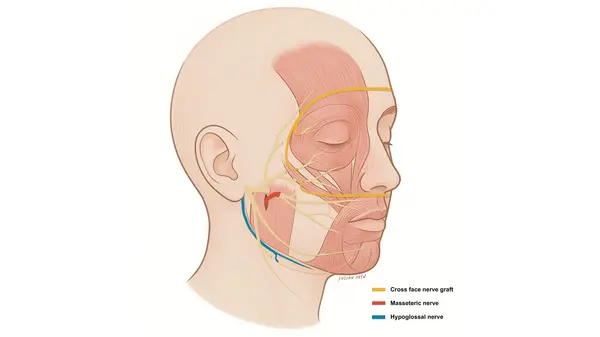
Facial nerve reconstruction using cross-face grafts and masseteric and hypoglossal nerve transfers.
Nerve transfer surgery: We transfer a healthy nerve to the paralyzed facial nerve branches to restore movement or facial symmetry.
- A masseteric nerve transfer uses a nerve that makes you smile or close your eyes when you bite down. It’s a fast way to fix facial nerves, and works in less than 6 months.
- A hypoglossal nerve transfer uses a nerve that lets your tongue move. It’s most often done along with a masseteric transfer to repair nerves that control lip muscles.
- A cross-face nerve graft connects a nerve from the healthy side of your face to the paralyzed facial nerve branches. It can take more than 6 months to work.
Facial reanimation when facial muscles are weak for a long time
Sometimes facial muscles have been weak for so long that nerve repair does not work. Instead, we use new muscle to replace the chronic (long-term) atrophied (weak) muscle. Most often, we use leg muscle to replace the face muscle that controls smiling or closing your eye.
Functioning free muscle transplantation (FFMT): We move a new muscle along with its artery, vein, and motor nerve. Most often, we transfer your thigh's gracilis muscle. We move the muscle flap and connect it to the paralyzed face’s nerves and blood vessels.
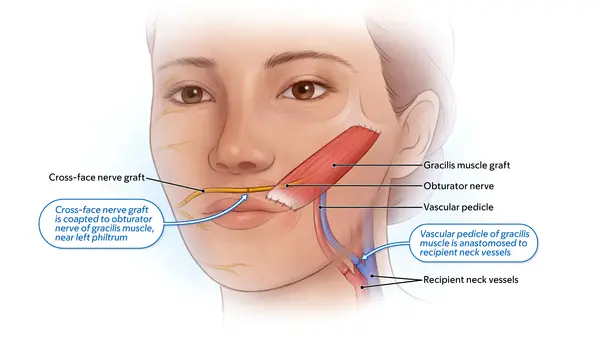
Image showing gracilis muscle transfer for facial reanimation.
Eye and eyelid care
Facial paralysis often affects both eyelids. It can cause lagophthalmos or ectropion, which are problems with fully closing your eye. There are treatment options that can protect your vision and comfort. They include low-profile platinum eyelid weights, lower eyelid tightening, and blepharoplasty (eyelid surgery).
Eye care is very important if you have facial paralysis. It can be hard to fully close your eyelid. That can dry the eye and harm the cornea, the clear front part of the eye.
Eye doctors and eyelid surgeons can help protect your vision.
Eye treatments:
- Eye drops or eye ointment to lubricate (moisten) the eye.
- Taping the eye at night.
- Surgery to add a platinum weight to the upper eyelid so your eye can blink and close.
- Surgery to tighten or correct the lower eyelid.
Rehab and supportive care
Rehabilitation (rehab) is part of treatment for facial paralysis. Our experts will show you how to retrain your facial muscles.
Physical therapy can help you control how your face moves.
Speech therapy helps you speak and swallow as you did before facial paralysis.
Botulinum toxin (Botox) injections help with facial symmetry and unwanted movement from synkinesis.
Facial paralysis takes a toll on your emotions and daily life. Our supportive care team will help you cope with emotional stress from facial paralysis during and after cancer treatment.
The MSK Head and Neck Cancer Reconstruction Program has experts in complex head and neck reconstruction. We use the latest reconstructive surgery methods to restore how you look, feel, and function.
Common questions
See a facial palsy reanimation expert as soon as possible when you have facial paralysis. This is most important if the paralysis started after surgery to remove a tumor, you had trauma, or you had radiation.
Nerve reconstruction works best within 6 to 12 months after the paralysis starts. The earlier the better.
Recovery depends on the kind of facial reanimation procedure you had. Some treatments are outpatient (not in the hospital), such as eyelid surgery. More complex procedures need a hospital stay and a longer recovery.
During your follow-up visits, we’ll closely monitor your healing, facial movement, nerve recovery, and overall progress. Your treatment plan may change over time to get the best results.
If you had nerve repair, nerve grafting, or nerve transfer surgery, you’ll start facial neuromuscular retraining in about 1 month. You’ll work with physical therapists to retrain your face muscles.
Recovery after facial reanimation takes time. Your surgeon and rehab team will guide you and explain what to expect.
If you have trouble closing your eye, talk to your healthcare provider right away.
An eye that does not close fully can dry out and hurt the cornea. Treatments include drops or ointment to keep your eye wet, tape, moisture shields, eyelid weights, or other eyelid procedures.
See your doctor right away if you have new eye pain, redness, light sensitivity, vision changes, or worse dryness.
There’s not one treatment for facial paralysis that’s right for everyone. Your surgeon will recommend the procedure best for you based on:
- What caused the paralysis.
- How long the paralysis has lasted.
- How well your facial muscles and nerves are working.
- Any other treatments you had, such as surgery or radiation.
- Your overall health and goals after reconstruction.
A team of many kinds of experts will review your information and make a treatment plan that’s right for you.
Yes, sometimes we can do facial nerve reconstruction at the same time as cancer surgery to remove a tumor.
Our reconstructive surgeons work closely with your head and neck cancer surgeons. This approach can greatly raise your chances of getting your facial movement back. Paralysis may last a shorter time.
Sometimes it’s not possible to do reconstruction at the same time as your surgery. We have many facial reanimation options to try after cancer treatment. Your care team will talk with you about the timing and treatments that are best for you.
Facial reconstruction repairs or replaces the part of your face that’s harmed, missing, or not working as it should.
Facial reanimation helps your face move again by repairing or moving nerves, or by moving healthy muscles. Reanimation surgery helps your face smile, blink, speak, and show emotion.
For many people with facial paralysis, treatment can restore some or much of the movement and function you lost.
How much movement you get back depends on a few things:
- How the paralysis started.
- How long the paralysis has lasted.
- How well your facial muscles and nerves are working.
Treatment may include nerve repair or transfer, muscle transfer, other surgery, and rehabilitation. In general, you have more options if you start treatment earlier.
