This information explains what female pelvic floor exercises are and how to do them.
About pelvic floor exercises
Pelvic floor exercises can strengthen your pelvic floor muscles. These muscles support your uterus, bladder, and bowel (see Figure 1). These are also called your pelvic organs.
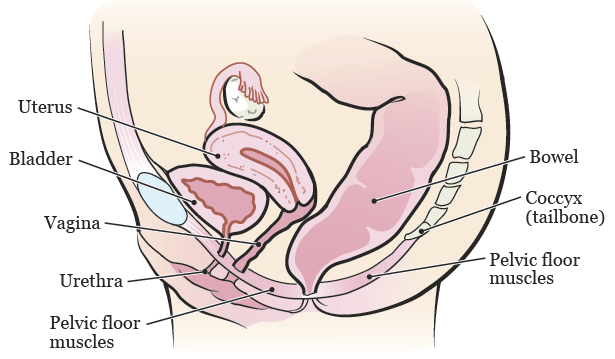
How pelvic floor exercises can help you
These exercises can help you:
- Manage or prevent incontinence. Incontinence is when your urine (pee) or stool (poop) leak and you cannot control it.
- Support your pelvic organs. This helps decrease incontinence and pain.
How to find your pelvic floor muscles
It’s important to find your pelvic floor muscles when doing these exercises to make sure you’re working out the right muscles.
To feel your pelvic floor muscles, try:
-
Imagining you’re urinating (peeing). Tighten the muscles you would use to stop the stream of urine. Those are your pelvic floor muscles.
- Do not stop your urine stream when you urinate. This can keep your bladder from emptying fully. This can also increase your risk for a urinary tract infection (UTI).
- Tightening the muscles you would use to hold back a bowel movement or keep yourself from passing gas.
- Placing the tip of a clean finger into your vagina. Tighten your pelvic floor muscles around your finger. You should feel your vagina tighten and your pelvic floor move upward.
How to know if you’re using the wrong muscles
Do not tighten your abdomen (belly), leg, or buttock (butt) muscles when you contract your pelvic floor muscles.
- To find out if you’re also contracting your leg or buttock muscles, place one hand underneath your buttocks or on the inside of your upper leg. Squeeze your pelvic floor muscles. If you feel your leg or buttocks move, you’re using the wrong muscles.
- If you’re sitting in a chair, your body should not lift from the chair when doing pelvic floor exercises. If you notice that your body lifts slightly, you’re using your buttock muscles.
How to know if pelvic floor exercises are not for you
Pelvic floor exercises may not work for everyone. They may not be the right exercise for you if:
- You have any pain or discomfort while doing these exercises.
- You are doing these exercises consistently for 6 to 8 weeks and your symptoms are not getting better. If this happens, call your healthcare provider.
How to do pelvic floor exercises
Get comfortable before you start
Before you start your exercises, get into a comfortable position so your body is relaxed. Most people prefer doing them while lying down on a bed or sitting in a chair. You can do them in any position you feel comfortable in.
Once you’re familiar with the exercises, you should be able to do them in any position and in any place. This includes standing and waiting in a line, which can be a good way to do them more often.
Follow these steps
- Breathe in deeply through your nose and let your abdomen expand as it fills with air. Keep your pelvic floor muscles relaxed as you breathe in.
- Breathe out slowly through your mouth as if you’re blowing through a straw. Do this as you gently tighten your pelvic floor muscles.
- Keep your pelvic floor muscles tightened for 3 to 6 seconds while you breathe out. This is called a contraction.
- Breathe in again and release the contraction. This relaxes your muscles.
- Relax your muscles completely for 6 to 10 seconds. It’s very important that you relax your muscles fully between each contraction.
Do not hold your breath when doing pelvic floor exercises. If you feel yourself holding your breath, then count out loud when doing these exercises.
Repeat this exercise 10 times a session. Do 2 to 3 sessions of exercises every day to get the best results. Spread the sessions out during the day.
When to hold your exercises for longer
You can start to hold your pelvic floor exercises for longer if:
- Your pelvic floor muscles don’t start to get tired after contracting them for 3 to 6 seconds.
- Your pelvic floor muscles don’t start to get tired after doing 10 exercises in a row.
If this happens, try holding your contractions for 6 to 10 seconds. Then, relax your muscles completely for 10 seconds. Make sure you keep breathing while you hold the contractions.
Your goal should be to hold a strong contraction for 10 seconds 10 times in a row.
What to do if you have pain
Pelvic floor exercises should not hurt. If you have pain during or after these exercises, stop doing them right away and call your healthcare provider. You may not be doing the exercise correctly or they may not be right for you.
Sexual health and intimacy support at MSK
If you need more support or information about sexual health or intimacy, talk with your healthcare provider. You can also make an appointment with MSK’s Female Sexual Medicine and Women’s Health Program. To learn more, call 646-888-5076.
The Female Sexual Medicine and Women’s Health Program provides services at the following locations:
|
|
When to call your healthcare provider
Call your healthcare provider if you:
- Have concerns about your bowel, bladder, or sexual function.
- Are having trouble feeling your pelvic floor muscles.
- Have pain when you do pelvic floor exercises.
- Have trouble doing pelvic floor exercises.
- Have pelvic pain.
- Want a referral to a physical therapist who specializes in pelvic health.
Learn about our Health Information Policy.