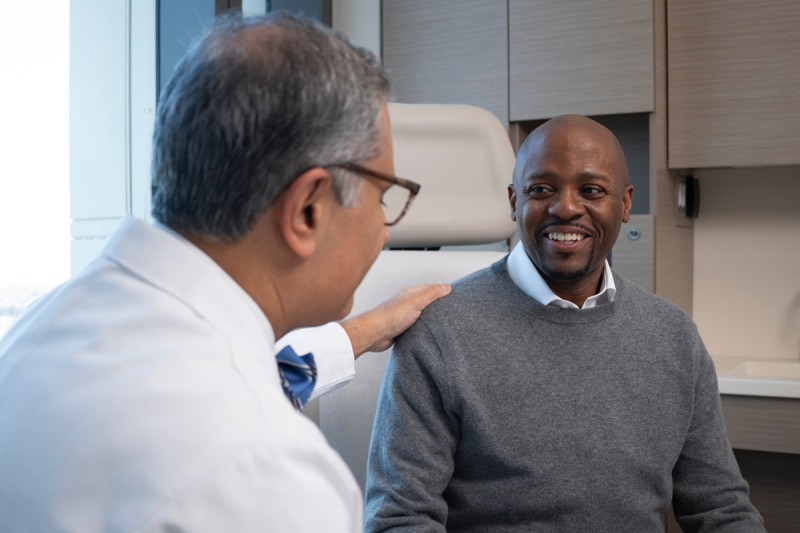
It started with a simple blood test.
Eddie Baynes, a finance executive at Verizon and a proud Morehouse College graduate, joined a prostate cancer awareness drive with his fraternity brothers of Alpha Phi Alpha Fraternity, Inc. One of them, Derrick Butts, had survived the disease and urged every member of their chapter to get screened with a test measuring their level of PSA (prostate cancer antigen).
Eddie listened and heeded the advice. That decision not only saved his life, it propelled him into a new role advocating prostate cancer awareness in the Black community, where prostate cancer rates are disproportionately high.
“I want men to know they can take control,” Eddie says. “You can advocate for yourself and then for others. That’s how you fight fear.”
Eddie’s PSA numbers were normal for the first two years, under 4.0 ng/mL. But in 2023, his levels began creeping up, and by early 2024, they had climbed to 5.9 — a number high enough to concern his doctor at a Manhattan hospital. An MRI revealed a tumor, and a biopsy confirmed it: Eddie, then 54, had prostate cancer.
Connecting in Harlem to prostate cancer care
The diagnosis hit hard, but Eddie didn’t waste any time. Within an hour of getting the news, he was on the phone seeking a second opinion. A friend suggested he reach out to the MSK Ralph Lauren Center cancer clinic right around the corner from his home in Harlem — neither knew that the clinic is part of the Memorial Sloan Kettering Cancer Center (MSK).
“We thought it was an independent cancer clinic, but the staff member said they could connect me with an MSK doctor,” Eddie says. “I started Googling on my iPad and realized, ‘Oh my God, this is a leading cancer hospital.’ ”
Talking through treatment options with four experts
From his first phone call to MSK, Eddie says the staff responded with urgency and compassion. They scheduled him for an appointment the very next week.
Eddie’s first meeting was with urologic surgeon Jonathan S. Fainberg, MD, who walked him through the available treatment options, including:
- Destroying the tumor with high-intensity ultrasound (HIFU) to avoid surgery.
- Brachytherapy (a type of radiation).
- Hormonal therapy.
- Radical prostatectomy (surgical removal of the prostate).
Eddie says what impressed him most was that Dr. Fainberg didn’t rush him. Instead, he arranged for Eddie to meet with specialists in each area so he could fully understand his choices. Eddie had the opportunity to speak with four doctors with varying expertise:
- Urologic surgeon Behfar Ehdaie, MD
- Radiation oncologist Marisa A. Kollmeier, MD
- Radiation oncologist James Robert Janopaul-Naylor, MD
- Urologic surgeon Jose M. Flores, MD, who specializes in sexual health
Every conversation felt thorough and respectful, says Eddie.
“They had a comprehensive approach that reassured me I wasn’t just a diagnosis — I was a whole person,” he says.
A difficult turn
After doing his own research, Eddie had his heart set on the procedure called HIFU, which uses ultrasound waves to break up and eliminate the tumor. It is a minimally invasive treatment that would enable him to recover quickly and avoid potential side effects from surgery. Because his cancer was localized, HIFU seemed like a possibility.
But MSK’s team wanted to be thorough and not rely on the initial scans from another hospital. Dr. Fainberg recommended that Eddie get an MRI at MSK, using the latest imaging technology to provide the clearest picture of the tumor.
When the results came back, the news wasn’t what he wanted to hear. Dr. Ehdaie explained that because of the tumor’s characteristics and location, HIFU might not be effective. His recommended treatment options were now brachytherapy or surgery to remove his prostate.
At first, Eddie was disappointed and worried about the potential side effects of having surgery. He had spent months preparing mentally for a less-invasive treatment. Now the path forward looked very different. But a more in-depth conversation with Dr. Ehdaie reassured him he could have a positive outcome from the procedure.
The conversation that made a difference
As Eddie contemplated surgery, his fraternity brother Derrick Butts gave him a piece of advice: Ask for a patient reference — someone who had already been through what Eddie was facing. Taking that advice to heart, Eddie asked an MSK nurse who had provided emotional support if she could connect him with a former patient, specifically another Black man in his 50s.
She put Eddie in touch with Michael, a Black prostate cancer survivor living in Philadelphia who had also been treated by Dr. Ehdaie. That conversation put Eddie at ease: Michael told Eddie about his own surgery, his recovery, and his experience with Dr. Flores’ sexual health program. He reassured Eddie that the MSK team would look after him every step of the way.
Within 48 hours of speaking with Michael, Eddie called Dr. Ehdaie’s office. “Let’s proceed,” he said.
By preparing for surgery, a better-than-expected recovery
Even before the operation, MSK took steps to preserve Eddie’s quality of life. Weeks before surgery, Dr. Flores started Eddie on a treatment plan to protect his sexual health, including medication and Kegel exercises to strengthen pelvic muscles that control urine flow. By being proactive, Eddie would go into the operating room with the best possible chance of getting back to himself.
Eddie scheduled his surgery for December 17, 2024.
“That was a significant date for me because you have to wear a catheter for seven days afterward, and I wanted it out before Christmas,” he says. “I called MSK, and they told me they would be open on Christmas Eve, so I was very happy about that.”
The surgery took about three hours. That same night, the staff had him up and walking around the floor. He felt well enough to go home the next day. He had pain for a day or two, but it disappeared.
The recovery that followed was better than Eddie had expected. The side effects he had feared — incontinence and erectile dysfunction — were manageable. With ongoing Kegel exercises, physical therapy, and continued care from Dr. Flores, Eddie has regained most of his sexual health. He can no longer ejaculate (it’s now a dry orgasm), but his erectile function is back to about 75-80% of what it was before.
And most important: No cancer can be detected.
Back on his feet and giving back
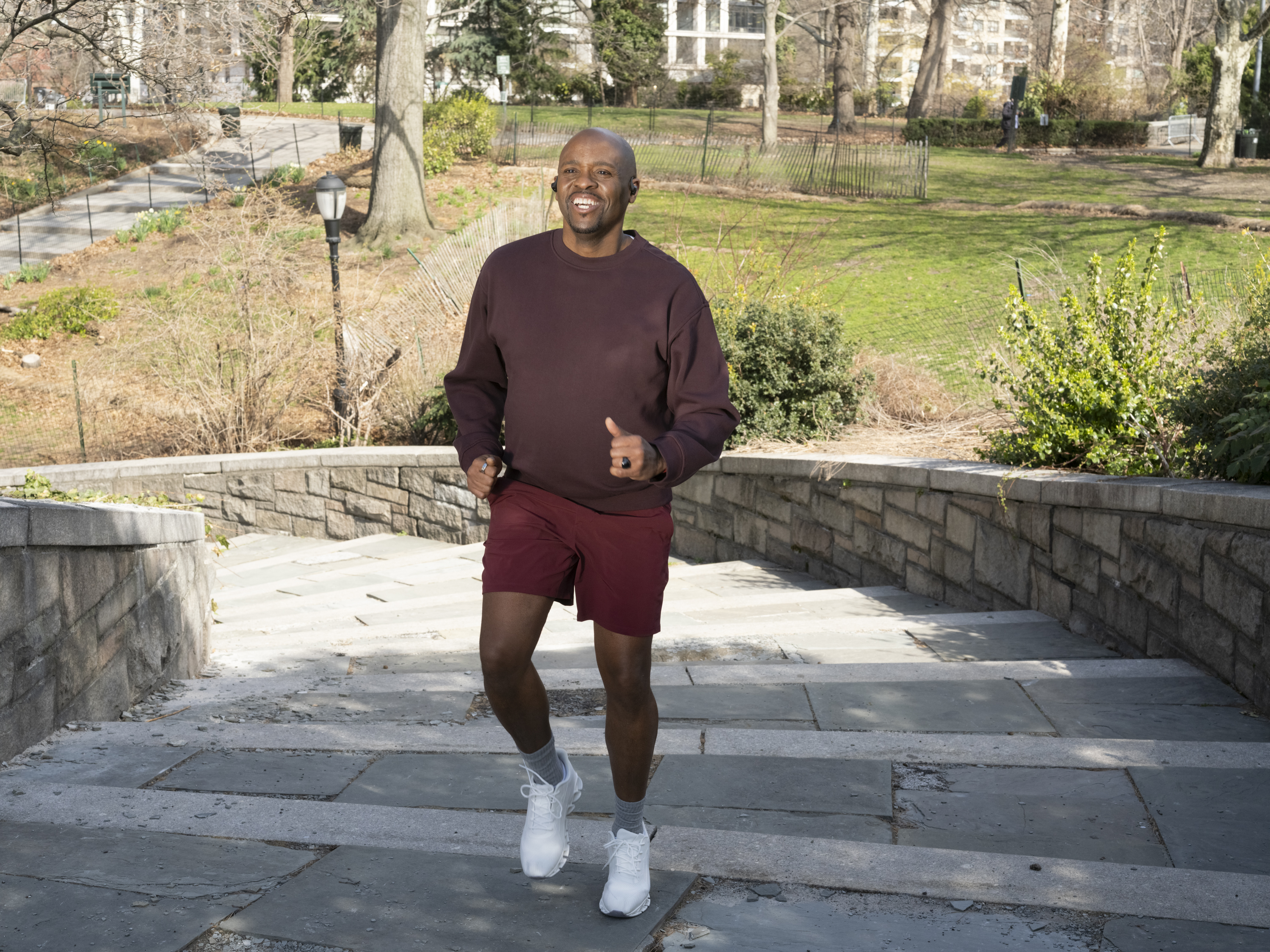
A year and a half after surgery, Eddie is now back to running five miles three to four times a week. He participated in his first Cycle for Survival event, an MSK fundraiser supporting rare cancer research. And he has become a passionate advocate for early detection, especially in the Black community.
After sharing his diagnosis with his fraternity chapter, Eddie challenged every member to get their PSA checked within three months. About 80 percent followed through. He’s had the same conversations with male friends and family members, friends at his alma mater Morehouse College, coworkers, and men of all backgrounds.
“I tell them that I’m a living reminder that early detection saves lives, that asking for help is a sign of strength, and that the right care team can make all the difference,” he says.
Key takeaways:
- Black men have a higher risk of prostate cancer.
- Surgery is sometimes the best treatment option for certain tumors.
- MSK experts will minimize side effects of prostate cancer surgery.
- Patients can take part in helping ensure good quality of life after treatment.