https://www.accessdata.fda.gov/drugsatfda_docs/label/2026/761352s010lbl.pdfThis story was published on May 21, 2026. It was updated on July 8, 2026.
Cancer of the bile duct, called cholangiocarcinoma, is a rare, aggressive type of tumor in the liver that has a notoriously poor prognosis. But a newly approved drug will give patients another option to treat cancer that is inoperable, has spread, and is caused by a particular genetic mutation.
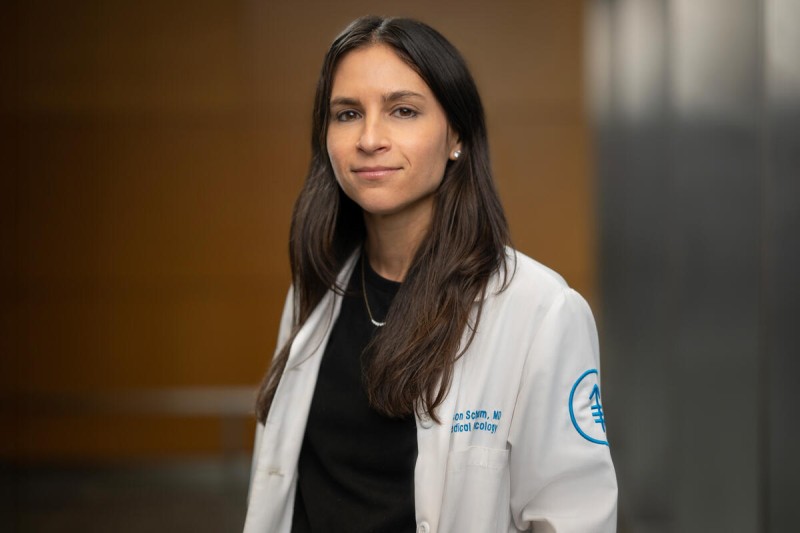
On May 8, 2026, the U.S. Food and Drug Administration (FDA) approved zenocutuzumab (Bizengri®) for adults with advanced, unresectable, or metastatic cholangiocarcinoma driven by a molecular change called an NRG1 gene fusion. The clinical trial that resulted in the drug’s approval was led by early drug development specialist and gynecologic medical oncologist Alison Schram, MD, of Memorial Sloan Kettering Cancer Center (MSK).
- 19 patients in the trial had cholangiocarcinoma with an NRG1 fusion.
- Most patients with all types of cancer had some degree of tumor shrinkage.
- For cholangiocarcinoma, 36.8% of patients responded.
- A full list of side effects is available here.
Dr. Schram and her colleagues reported the findings on cholangiocarcinoma and zenocutuzumab in the Journal of Clinical Oncology on July 1, 2026.
Zenocutuzumab is a type of drug called a bispecific antibody. It works by preventing cancer cells from sending the signals that boost their growth. It also makes cancer cells more visible to the immune system, drawing immune cells in to destroy the tumor.
“Patients with bile duct cancer caused by an NRG1 fusion have very limited treatment options,” Dr. Schram explains. “Zenocutuzumab can make a meaningful difference for these patients, shrinking their tumors with remarkably few side effects — preserving quality of life.”
Why ‘basket trials’ matter for rare cancers
Zenocutuzumab was previously granted accelerated approval to help patients with advanced pancreatic cancer and a type of lung cancer called non-small cell lung cancer (NSCLC) when the cancers are caused by a change in the NRG1 gene. That approval came from results of the same clinical trial that led to the cholangiocarcinoma approval.
The study, named eNRGy, was what scientists call a “basket trial.” In a basket trial, patients can join based on specific changes in their tumor’s genes — not just on where the cancer is located in their body. This type of trial is critical for finding treatments for rare cancers like cholangiocarcinoma.
The NRG1 gene change that zenocutuzumab treats is very rare. It causes less than 1% of most cancer types. Also, this gene change is not always detectable on DNA-based tumor genetic tests like MSK-IMPACT®. A different test called RNA profiling is more reliable for detecting NRG1 fusions.
“This research shows how important it is to do comprehensive genetic testing on tumors, including RNA testing,” says Dr. Schram. “We hope now that zenocutuzumab is approved for cholangiocarcinoma, more patients with this cancer will get the tests they need to find the right treatment.”
Learn more about zenocutumab and MSK’s role in developing this drug for NRG1 gene fusions.
Key Takeaways
- The FDA has approved a drug called zenocutuzumab for the treatment of cholangiocarcinoma — or bile duct cancer — which has a notoriously poor prognosis.
- The FDA approved zenocutuzumab to treat inoperable, metastatic bile duct cancer with a particular mutation in the NRG1 gene. The drug was previously approved to treat pancreatic and lung cancers with an NRG1 gene fusion.
- The clinical trial that resulted in the drug’s approval was led by Dr. Alison Schram at MSK.
- The trial was a basket trial — a study where patients join based on genetic changes in their tumor, not cancer location.