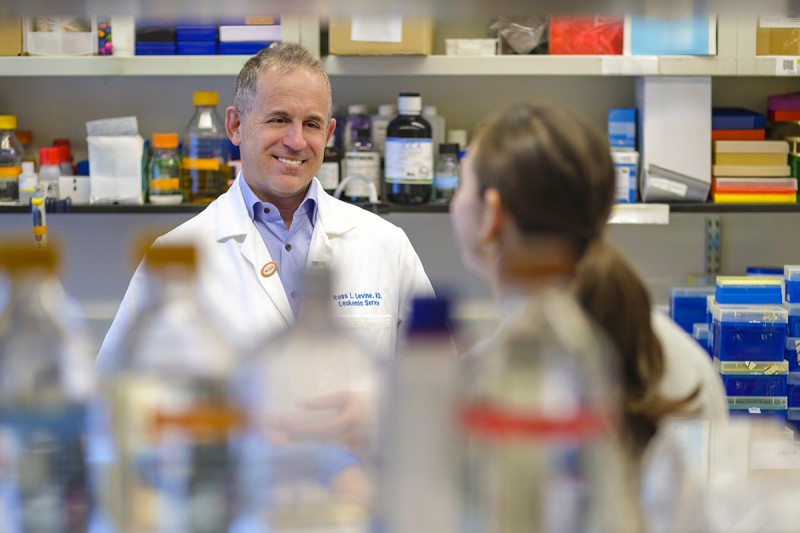
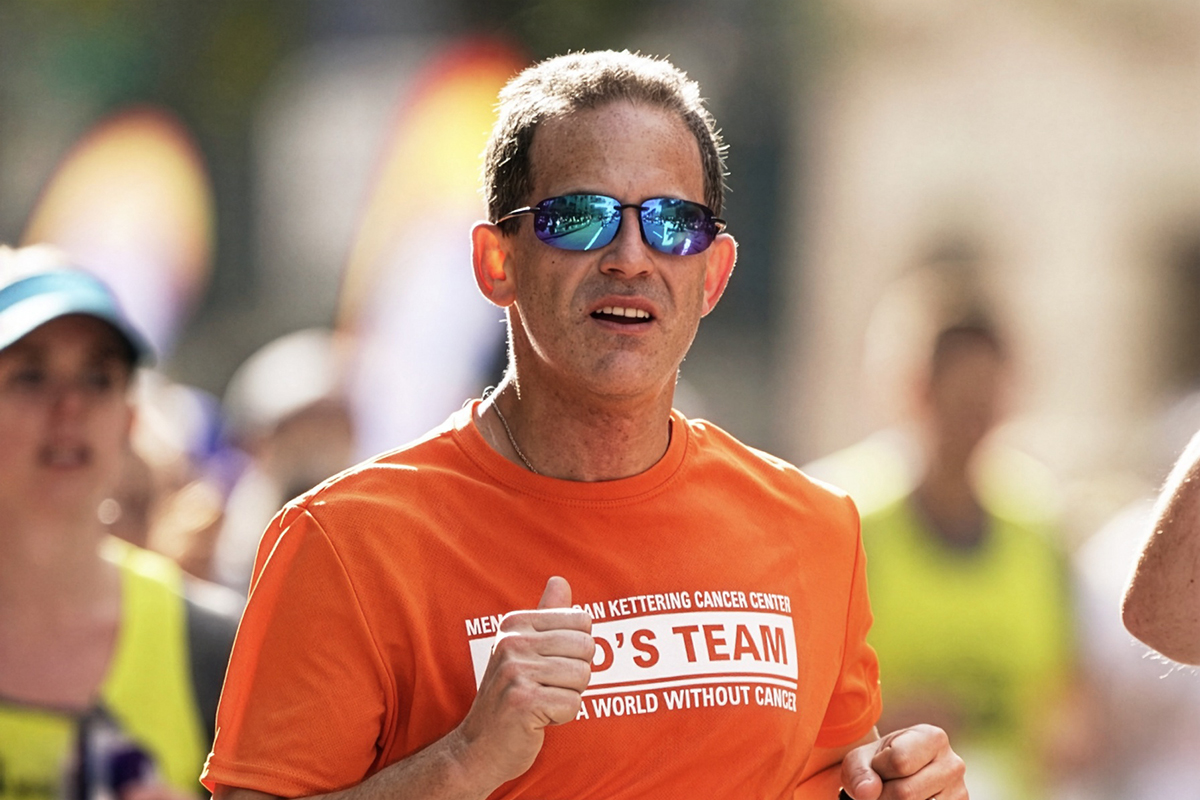
When Ross Levine, MD, walks into a meeting, his passion for science lights up the room. He’s known for his ability to articulate an inspired vision for research, and he stops at nothing to achieve ambitious goals — including running the New York City Marathon every year with Fred’s Team, the official running program of MSK.
As the new Chief Scientific Officer for Memorial Sloan Kettering Cancer Center (MSK), Dr. Levine is responsible for preclinical research, which provides the foundation for the discovery of better cancer treatments. Since joining MSK in 2007, Dr. Levine has distinguished himself as a physician-scientist studying the genetic basis of blood cancers and other blood disorders. As a young trainee, he was devastated when treatments failed to save patients with aggressive leukemia. He decided to dedicate his life to research, driven by the belief that hope starts in the lab — by creating new pathways for diagnosing and treating cancer.
Looking back on his 25 years as a scientist, Dr. Levine says, “I believe there has never been a more exciting time for cancer science.”
What have we learned about cancer so far?
The way we understand cancer now is dramatically different from the way we did 20 years ago. We now have the technology to understand that every cancer is different. Even when it’s classified by where it originates — the lung, the brain, the breast — there are molecularly defined subtypes. It’s like looking at snow and then realizing that every snowflake is different.
Years of lab research now enables us to diagnose cancer with extreme precision, and that means in many cases we can tell patients, “We’re going to tailor your treatment according to the unique molecular aspects of your cancer.” The more we’re able to do that, the more effective and better tolerated our treatments are becoming. And that’s what gives us cause for optimism. We have lots to do, but cancer is a very different story than it was 25 years ago.
Will it ever be possible to stop cancer from developing in the first place?
This is an area where we’re really in the early phases of what could be a transformative opportunity. It’s finding cancer at the earliest stages and then intercepting it.
Cancer happens when abnormal cells are dividing uncontrollably. We probably all have them, especially as we age. But if we can identify the ones that are picking up steam and discover ways to stop them, that could change the whole game. I believe we need to really double down on that idea. There are groups at MSK and other institutions around the world using new technologies to analyze databases with hundreds of thousands of people to study what we call “precancer.”
Our goal is to be able to better detect and intercept abnormal cells before there is an actual cancer and to give patients treatments before they would have ever gotten sick.
How can we speed up the process of taking a discovery in the lab and getting it to the clinic to help patients?
The pace of innovation in science has never been faster. Between new technology and new treatment approaches, we’re seeing in real time the impact of advances in computing and artificial intelligence. Almost every day I pick up a journal and read that something amazing has happened based on advances in data science. There are two things that stand out about MSK and make me so excited to take on this role. Number one, we have an amazing group of remarkably bright, fearless, creative people that are trying to do things others might say are impossible. The number of times that five years later their brainstorm idea actually works gives me tremendous hope.
The other part of what makes MSK so special is that we have teams that work extremely well together across the entire spectrum of research. We have preclinical scientists that have never met a patient but have uncovered incredible insights into the behavior of cells and why they become cancerous. We have people who are at the bedside who’ve never been in a research lab but then make the connection for how a recent scientific discovery might be able to make a difference.
I’ve seen personally how this all-encompassing approach saves lives. My sister is now an MSK patient living with multiple myeloma, which has become a highly treatable blood cancer thanks to years of research supported by Cycle for Survival and other generous giving.
People come to work and train at MSK knowing that at some point, their discoveries, whether it’s today, tomorrow, or in 10 years, will actually help a patient. At MSK, it’s team science. The sum is greater than the parts.
Despite all of the challenges that confront us these days, I am confident our journey is just beginning and our progress will continue to accelerate.