Doctors on our team explain our approach and why coming to Memorial Sloan-Kettering as soon as you are diagnosed may give you better treatment options.
A term for diseases in which abnormal cells divide without control and can invade nearby tissues. Cancer cells can also spread to other parts of the body through the blood and lymph systems. There are several main types of cancer. Carcinoma is a cancer that begins in the skin or in tissues that line or cover internal organs. Sarcoma is a cancer that begins in bone, cartilage, fat, muscle, blood vessels, or other connective or supportive tissue. Leukemia is a cancer that starts in blood-forming tissue such as the bone marrow, and causes large numbers of abnormal blood cells to be produced and enter the blood. Lymphoma and multiple myeloma are cancers that begin in the cells of the immune system. Central nervous system cancers are cancers that begin in the tissues of the brain and spinal cord. Also called malignancy.
Source: The National Cancer Institute's Dictionary of Cancer Terms (http://www.cancer.gov/dictionary)
colon (KOH-lun)
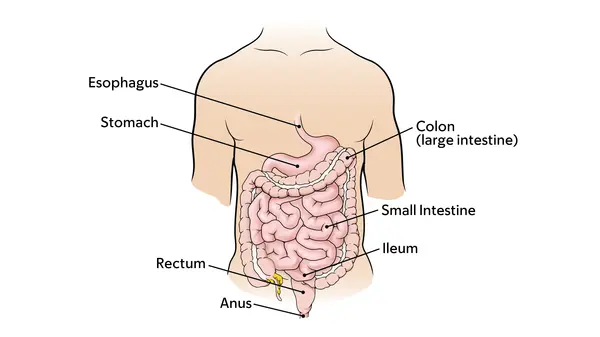
The longest part of the large intestine, which is a tube-like organ connected to the small intestine at one end and the anus at the other. The colon removes water and some nutrients and electrolytes from partially digested food. The remaining material, solid waste called stool, moves through the colon to the rectum and leaves the body through the anus.
Source: The National Cancer Institute's Dictionary of Cancer Terms (http://www.cancer.gov/dictionary)
colorectal (KOH-loh-REK-tul)
Having to do with the colon or the rectum.
Source: The National Cancer Institute's Dictionary of Cancer Terms (http://www.cancer.gov/dictionary)
colorectal cancer (KOH-loh-REK-tul KAN-ser)
Cancer that develops in the colon (the longest part of the large intestine) and/or the rectum (the last several inches of the large intestine before the anus).
Source: The National Cancer Institute's Dictionary of Cancer Terms (http://www.cancer.gov/dictionary)
diagnosis (DY-ug-NOH-sis)
The process of identifying a disease, such as cancer, from its signs and symptoms.
Source: The National Cancer Institute's Dictionary of Cancer Terms (http://www.cancer.gov/dictionary)
rectal (REK-tul)
By or having to do with the rectum. The rectum is the last several inches of the large intestine closest to the anus.
Source: The National Cancer Institute's Dictionary of Cancer Terms (http://www.cancer.gov/dictionary)
Contact our Physician Referral Service to schedule a consultation with a Memorial Sloan-Kettering physician in Manhattan or at one of our suburban regional cancer centers.