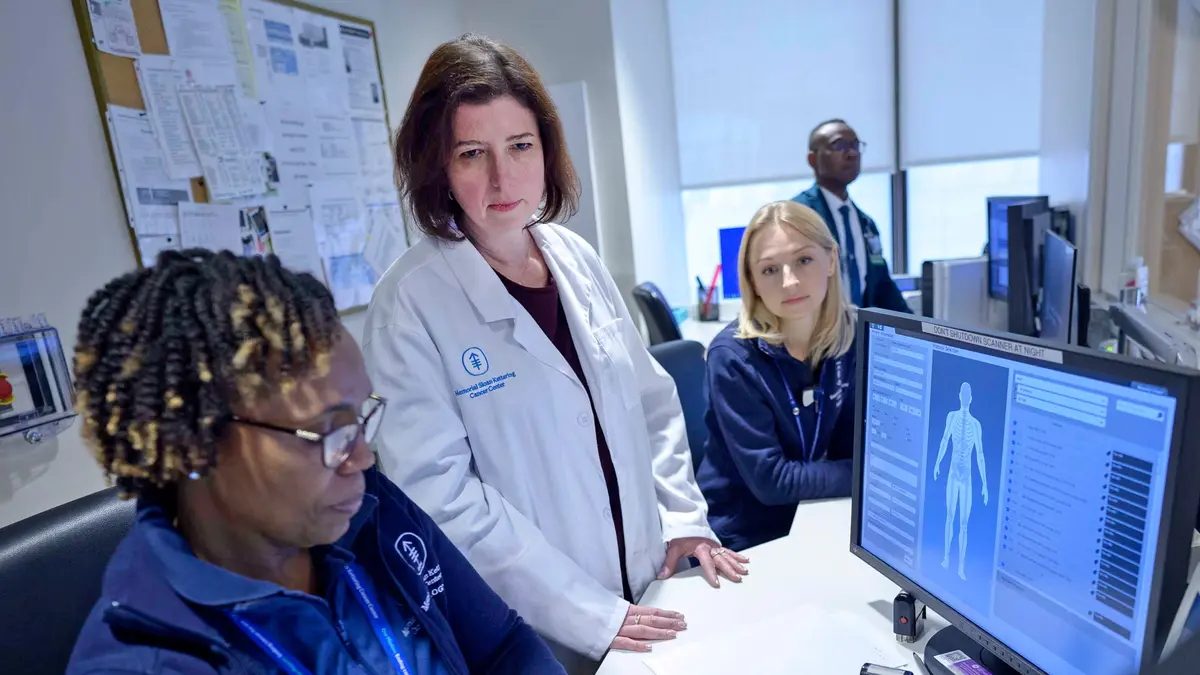
Bhuvanesh Singh, a head and neck surgeon and director of the Laboratory of EpithelialCancer Biology, discusses the treatment team’s desire to cure patients and help them return to their everyday lives.
Runtime: 02:00 minutes Published: 12/27/2012 - 9:58 AM
When head and neck surgeon Snehal Patel meets with patients and their families, he walks them step-by-step through the treatment plan and ensures that they receive the most-effective surgery, when that is the best approach for the patient.
Runtime: 02:00 minutes Published: 11/05/2012 - 8:59 AM
Jatin Shah, Chief of the Head and Neck Service, discusses how Memorial Sloan-Kettering’s world-renowned head and neck surgeons partner with patients to select the most appropriate treatment plan.
Runtime: 03:00 minutes Published: 07/05/2012 - 9:58 AM
Runtime: 5:00 minutes Published: 01/01/2009 - 12:00 AM
cancer (KAN-ser)
A term for diseases in which abnormal cells divide without control and can invade nearby tissues. Cancer cells can also spread to other parts of the body through the blood and lymph systems. There are several main types of cancer. Carcinoma is a cancer that begins in the skin or in tissues that line or cover internal organs. Sarcoma is a cancer that begins in bone, cartilage, fat, muscle, blood vessels, or other connective or supportive tissue. Leukemia is a cancer that starts in blood-forming tissue such as the bone marrow, and causes large numbers of abnormal blood cells to be produced and enter the blood. Lymphoma and multiple myeloma are cancers that begin in the cells of the immune system. Central nervous system cancers are cancers that begin in the tissues of the brain and spinal cord. Also called malignancy.
Source: The National Cancer Institute's Dictionary of Cancer Terms (http://www.cancer.gov/dictionary)
cure (kyoor)
To heal or restore health; a treatment to restore health.
Source: The National Cancer Institute's Dictionary of Cancer Terms (http://www.cancer.gov/dictionary)
diagnosis (DY-ug-NOH-sis)
The process of identifying a disease, such as cancer, from its signs and symptoms.
Source: The National Cancer Institute's Dictionary of Cancer Terms (http://www.cancer.gov/dictionary)
epithelial (eh-pih-THEE-lee-ul)
Refers to the cells that line the internal and external surfaces of the body.
Source: The National Cancer Institute's Dictionary of Cancer Terms (http://www.cancer.gov/dictionary)
head and neck cancer (... KAN-ser)
Cancer that arises in the head or neck region (in the nasal cavity, sinuses, lips, mouth, salivary glands, throat, or larynx [voice box]).
Source: The National Cancer Institute's Dictionary of Cancer Terms (http://www.cancer.gov/dictionary)
human papillomavirus (HYOO-mun PA-pih-LOH-muh-VY-rus)
A type of virus that can cause abnormal tissue growth (for example, warts) and other changes to cells. Infection for a long time with certain types of human papillomavirus can cause cervical cancer. Human papillomavirus may also play a role in some other types of cancer, such as anal, vaginal, vulvar, penile, oropharyngeal, and squamous cell skin cancers. Also called HPV.
Source: The National Cancer Institute's Dictionary of Cancer Terms (http://www.cancer.gov/dictionary)
medical oncologist (MEH-dih-kul on-KAH-loh-jist)
A doctor who specializes in diagnosing and treating cancer using chemotherapy, hormonal therapy, biological therapy, and targeted therapy. A medical oncologist often is the main health care provider for someone who has cancer. A medical oncologist also gives supportive care and may coordinate treatment given by other specialists.
Source: The National Cancer Institute's Dictionary of Cancer Terms (http://www.cancer.gov/dictionary)
oncologist (on-KAH-loh-jist)
A doctor who specializes in treating cancer. Some oncologists specialize in a particular type of cancer treatment. For example, a radiation oncologist specializes in treating cancer with radiation.
Source: The National Cancer Institute's Dictionary of Cancer Terms (http://www.cancer.gov/dictionary)
quality of life (KWAH-lih-tee ... life)
The overall enjoyment of life. Many clinical trials assess the effects of cancer and its treatment on the quality of life. These studies measure aspects of an individual’s sense of well-being and ability to carry out various activities.
Source: The National Cancer Institute's Dictionary of Cancer Terms (http://www.cancer.gov/dictionary)
radiation (RAY-dee-AY-shun)
Energy released in the form of particle or electromagnetic waves. Common sources of radiation include radon gas, cosmic rays from outer space, medical x-rays, and energy given off by a radioisotope (unstable form of a chemical element that releases radiation as it breaks down and becomes more stable).
Source: The National Cancer Institute's Dictionary of Cancer Terms (http://www.cancer.gov/dictionary)
surgeon (SER-jun)
A doctor who removes or repairs a part of the body by operating on the patient.
Source: The National Cancer Institute's Dictionary of Cancer Terms (http://www.cancer.gov/dictionary)
surgery (SER-juh-ree)
A procedure to remove or repair a part of the body or to find out whether disease is present. An operation.
Source: The National Cancer Institute's Dictionary of Cancer Terms (http://www.cancer.gov/dictionary)
tumor (TOO-mer)
An abnormal mass of tissue that results when cells divide more than they should or do not die when they should. Tumors may be benign (not cancer), or malignant (cancer). Also called neoplasm.
Source: The National Cancer Institute's Dictionary of Cancer Terms (http://www.cancer.gov/dictionary)
Contact our Physician Referral Service to schedule a consultation with a Memorial Sloan-Kettering physician in Manhattan or at one of our suburban regional cancer centers.