This information will help you get ready for your endorectal contact X-ray brachytherapy (BRAY-kee-THAYR-uh-pee) with anesthesia at MSK. It explains what to expect. It also explains how to care for yourself before, during, and after your brachytherapy.
Contact X-ray brachytherapy is also called Papillon (pah-pee-YAWN) brachytherapy. Anesthesia (A-nes-THEE-zhuh) is medicine to make you sleep during a procedure.
About brachytherapy
Brachytherapy is a type of radiation therapy. Radiation therapy uses high-energy beams to kill cancer cells.
Brachytherapy puts radioactive material close to or inside the tumor. The radioactive material is sealed inside a thin tube. The radiation does not travel far from the radioactive material. The tumor gets a high dose (amount) of radiation while nearby healthy tissue gets little or none.
About endorectal contact X-ray brachytherapy
With endorectal CXB, the radioactive source (called an applicator) is placed inside your rectum. Your rectum is the end of your large intestine, where stool (poop) is stored before it leaves your body.
The applicator gives off precise, high doses of low-energy X-rays that don’t travel far. They mostly target the tumor because they only travel a few millimeters to 1 centimeter (less than 0.4 inches).
Most people get a total of 3 endorectal CXB treatments. You’ll be in the treatment room for about 1 hour each time. Your care team will spend most of this time setting up and making sure you’re in the right position. The treatment time is only about 5 to 15 minutes.
You will not be radioactive during or after your treatments. It’s safe for you to be around other people, children, and pets.
Most people have their treatments 1 to 2 weeks apart. Your radiation oncologist may change the timing or the number of your treatments. They’ll talk with you about what to expect.
What to do before your endorectal contact X-ray brachytherapy
You’ll have an appointment with a radiation oncologist and radiation nurse before your endorectal CXB. They’ll tell you how to get ready for your procedure. A radiation oncologist is a cancer doctor with special training in using radiation therapy to treat cancer.
Within 30 days of your procedure
Presurgical testing (PST)
You’ll have a PST appointment before your procedure. You’ll get a reminder from your healthcare provider’s office with the appointment date, time, and location. Visit www.msk.org/parking for parking information and directions to all MSK locations.
You can eat and take your usual medicines on the day of your PST appointment.
It’s important to bring these things to your appointment:
- A list of all the medicines you’re taking, including prescription and over-the-counter medicines, patches, and creams.
- Results of any medical tests done outside of MSK in the past year, if you have them. Examples include results from a cardiac stress test, echocardiogram, or carotid doppler study.
- Results of recent blood tests done outside of MSK
- The names and telephone numbers of your healthcare providers.
You’ll meet with an advance practice provider (APP) during your PST appointment. They work closely with MSK’s anesthesiology (A-nes-THEE-zee-AH-loh-jee) staff. An anesthesiologist is a doctor with special training in medicine to make you drowsy or sleep during your surgery or procedure.
Your APP will review your health history and surgical history with you. You may have tests to plan your care, such as:
- An electrocardiogram (EKG) to check your heart rhythm
- Blood tests
- A chest X-ray, if needed
Your APP may recommend you see other healthcare providers. They’ll also talk with you about which medicine to take the morning of your procedure.
About sleep apnea
Sleep apnea is a common breathing problem. If you have sleep apnea, you stop breathing for short lengths of time while you’re asleep. The most common type is obstructive sleep apnea (OSA). With OSA, your airway becomes fully blocked during sleep.
OSA can cause serious problems during and after a procedure. Tell us if you have or think you might have sleep apnea. If you use a breathing device, such as a CPAP machine, bring it on the day of your procedure.
Arrange for someone to take you home
You must have a responsible care partner take you home after your procedure. A responsible care partner is someone who can help you get home safely. They should be able to contact your care team if they have any concerns. Make sure to plan this before the day of your procedure.
If you don’t have a responsible care partner to take you home, call one of the agencies below. They’ll send someone to go home with you. There’s a charge for this service, and you’ll need to provide transportation. It’s OK to use a taxi or car service, but you still need a responsible care partner with you.
| Agencies in New York | Agencies in New Jersey |
| VNS Health: 888-735-8913 | Caring People: 877-227-4649 |
| Caring People: 877-227-4649 |
The night before your procedure
You’ll need to clear extra poop from your rectum before your procedure. This lets your radiation oncologist see the tumor more clearly to direct the radiation.
Give yourself a saline enema (such as a Fleet® saline enema) 2 hours before you go to bed. Follow the instructions in the package. You can buy a saline enema at your local pharmacy without a prescription.
The enema will make you have a bowel movement (poop) within a few minutes after you use it. It’s best to stay near a bathroom for about an hour after using the enema. You may need to poop more than once.
Only have clear liquids (liquids you can see through) after giving yourself the enema. Read Clear Liquid Diet to learn more about what you can and cannot have after using the enema. Avoid having anything red, orange, or purple.
Instructions for eating
Stop eating at midnight (12 a.m.) the night before your surgery or procedure. This includes hard candy and gum.
Your healthcare provider may have given you different instructions for when to stop eating. If so, follow their instructions. Some people need to fast (not eat) for longer before their surgery or procedure.
What to do the day of your endorectal contact X-ray brachytherapy
Instructions for drinking
Between midnight (12 a.m.) and 2 hours before your arrival time, only drink the liquids on the list below. Do not eat or drink anything else. Stop drinking 2 hours before your arrival time.
- Water.
- Clear apple juice, clear grape juice, or clear cranberry juice.
- Gatorade or Powerade. Do not have red, orange, or purple Gatorade or Powerade. These colors can look like blood inside your rectum.
-
Black coffee or plain tea. It’s OK to add sugar. Do not add anything else.
- Do not add any amount of any type of milk or creamer. This includes plant-based milks and creamers.
- Do not add flavored syrup.
If you have diabetes, pay attention to the amount of sugar in your drinks. It will be easier to control your blood sugar levels if you include sugar-free, low-sugar, or no added sugar versions of these drinks.
It’s helpful to stay hydrated before surgeries and procedures, so drink if you are thirsty. Do not drink more than you need. You will get intravenous (IV) fluids during your surgery or procedure.
Stop drinking 2 hours before your arrival time. This includes water.
Your healthcare provider may have given you different instructions for when to stop drinking. If so, follow their instructions.
What to expect during your procedure
When you arrive for your treatment appointments, check in at the front desk. A staff member will ask you to take off any clothing below your waist. They’ll give you a hospital gown and special shorts to change into. They’ll also ask you to empty your bladder. Then, they’ll bring you into the treatment room.
You’ll meet with a nurse before your procedure. Your nurse may place an IV line in one of your veins, most often in your arm or hand. If your nurse does not place the IV, your anesthesiologist will do it.
In the treatment room, you’ll lie on your back with your legs raised and placed into stirrups (see Figure 1). Your care team will help you get into position.
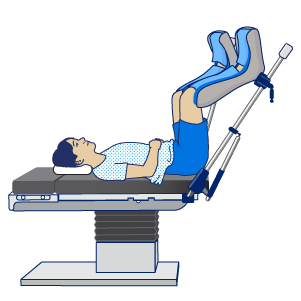
Once you’re comfortable, the anesthesiologist will give you anesthesia through your IV line and you’ll fall asleep. You’ll also get fluids through your IV line during and after your procedure.
Once you’re asleep, your radiation oncologist will put a rigid (stiff) tube into your rectum to see the tumor. Then they’ll put the applicator into your rectum. The applicator is shaped like a cylinder.
Your radiation oncologist will adjust the applicator’s position until the end is over the tumor. Then they’ll pass an X-ray tube through the applicator. Once the tube is as close to the tumor as possible, X-rays will travel through it to the tumor.
Your radiation oncologist will take the tube and applicator out of your rectum once your treatment is finished. You do not need to follow any special precautions after your treatments. You can leave the hospital after your treatments. You should plan to be in the hospital for 1 to 3 hours for the procedure.
What to expect after your endorectal contact X-ray brachytherapy
Side effects of CXB
You may have side effects after your treatment. You may have some, all, or none of the side effects listed in this section.
Your care team will help you prevent and manage side effects. Talk with a member of your care team if you have questions about side effects.
Pain
You may have mild (not bad) to moderate (somewhat bad) pain in your rectum after each treatment. If you do, you can take an over-the-counter pain medicine. Ibuprofen (Advil®, Motrin®) and acetaminophen (Tylenol®) are examples of over-the-counter pain medicines.
Rectal bleeding and discharge
Most people have mild bleeding (spotting) from their rectum after each treatment. You may also have mucous discharge (a thick, jelly-like substance) from your rectum. Most often, it’s a small enough amount that you do not need a pad or diaper.
Delayed rectal bleeding
Some people have rectal bleeding that starts after they finish treatment. If this happens, it most often starts about 3 to 6 months after treatment. Some people may start to have bleeding months or even years later. The bleeding is from small, dilated (widened) blood vessels in the treated area.
Delayed rectal bleeding is often mild and comes and goes. It often looks like light spotting. It can also appear as small streaks of bright red blood on your poop, toilet paper, or underwear. Some people choose to wear a light pad or liner if the bleeding happens often.
Bowel changes
After starting treatment, you may:
- Have diarrhea (loose, watery poop) or softer poop than usual.
- Need to poop more often than usual.
- Feel urgency (a sudden, strong need to go) before bowel movements (pooping).
- Feel like you need to poop when you don’t have to.
These bowel changes most often get better within a few weeks to months after you finish treatment. Very rarely, inflammation from treatment makes some people have long-lasting bowel changes.
Contact your care team if you’re having any of these symptoms. They may suggest taking medicine or changing your diet to help manage them. Follow your care team’s instructions.
At home
You are not radioactive after your treatments. You do not need to follow any radiation precautions. It’s safe to be around people, children, and animals.
You can go back to moving around and eating normally as soon as you leave the hospital. You can do all your usual activities, including physical activity.
Follow these guidelines after you leave the hospital:
- Do not drive for the rest of the day after your treatment. You can start driving again the day after treatment, unless you’re taking prescription pain medicine that makes you sleepy. Do not drive if your medicine makes you sleepy.
- Do not put anything in your rectum for 6 weeks after your treatment.
When to call your healthcare provider
Call your healthcare provider if you:
- Have a fever of 100.4 °F (38 °C) or higher.
- Have chills.
- Have pain that does not get better after you take over-the-counter pain medicine.
- Have diarrhea more than 3 times in 1 day that does not get better after you take medicine for diarrhea.
- Do not poop for 3 days.
- Have heavy bleeding from your rectum that soaks through pads or underwear.
- Pass blood clots from your rectum.
- Feel dizzy, unusually weak, or short of breath (like it’s hard to breathe).
Learn about our Health Information Policy.