This information explains what peripheral (peh-RIH-feh-rul) IV access is. It also answers common questions about peripheral IV lines.
What is peripheral IV access?
Peripheral IV access is the process of placing an IV line (thin, flexible tube) into a peripheral vein. This IV line is called a peripheral IV line or a peripheral IV catheter.
- Peripheral veins are the smaller veins close to the surface of your skin. They’re in your arms, hands, legs, and feet. Peripheral IV lines are often placed in peripheral veins on the top of your hand or in your forearm. Your forearm is the part of your arm between your wrist and elbow.
- IV stands for intravenous (IN-truh-VEE-nus), which means “into a vein.” When something is given intravenously, it goes right into your bloodstream through your peripheral IV line.
You can have peripheral IV access whether you’re inpatient or outpatient. Inpatient is when you stay in the hospital. Outpatient is when you do not stay in the hospital but come in for treatments.
What is a peripheral IV line used for?
Your care team can use a peripheral IV line to:
- Take blood samples.
- Give you IV fluids, such as normal saline (sterile salt water).
-
Give you IV medicine, such as:
- Chemotherapy (chemo). This is a treatment that uses medicine to stop or slow cancer cells from growing.
- Immunotherapy (IH-myoo-noh-THAYR-uh-pee). This is a treatment that uses your immune system to stop or slow cancer cells from growing.
- Antibiotics (medicine to prevent or treat infections).
- Pain medicine.
- Antinausea medicine (medicine to keep you from feeling like you’re going to throw up).
- Give you blood products (different parts of donated blood used for your treatment).
How long can I have a peripheral IV line?
Peripheral IV lines are used for short-term treatments, often no more than a few days. A nurse will place the IV line. They’ll tell you how long your treatment will take and how long your IV line will stay in.
If you’re inpatient, your IV line may stay in for a few days while you’re in the hospital.
If you’re outpatient, how long your IV line stays in depends on your treatment. Some treatments can take only a few minutes, while others may take a few hours. Your nurse may put in and take out your IV line the same day. If you’re coming back for treatment over the next few days, you may go home with it in place.
Where does my nurse place a peripheral IV line?
The place where your peripheral IV line goes into your body is called an IV site (see Figure 1).
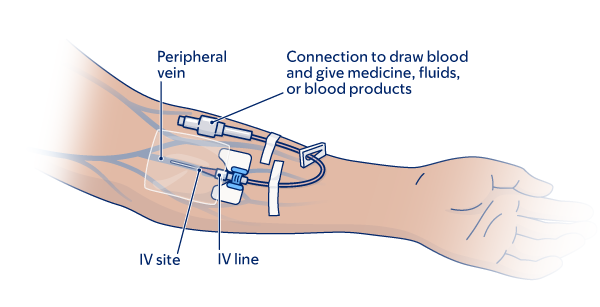
The most common IV sites are your forearm and the top of your hand. Your nurse will likely choose one of these IV sites because:
- The veins are easy to access. Peripheral veins are close to the surface of your skin. This makes it easier for your nurse to see and reach them when placing your IV line.
- There are many veins to choose from. There are a few peripheral veins in these IV sites. If your nurse cannot place your IV line in one vein, they can try another vein nearby.
- They help your IV line stay in place better. These IV sites are away from joints that bend (such as your elbow or wrist). This means your IV line is less likely to shift or fall out when you move.
How does my nurse place a peripheral IV line?
Your nurse will help you get into position to place your IV line. If you’re inpatient, they’ll have you lie in your hospital bed with the head of your bed raised. If you’re outpatient, they’ll have you sit in a chair or lie in a reclining chair.
Your nurse will wash their hands and put on a pair of gloves. Then, they’ll wrap a stretchy band called a tourniquet (TOOR-nih-ket) tightly around your upper arm. Your nurse may also have you make a fist. This helps them see and feel for a good peripheral vein to place the IV line.
Once your nurse finds a good vein, they’ll clean the area with an antiseptic solution. This is a liquid that kills bacteria and other germs.
Your nurse will tell you when they’re ready to place the IV line. They’ll use a small needle attached to the IV line to help guide it into your vein. You may feel a quick pinch, sting, or ache when the needle goes in. Your nurse will then slide the IV line over the needle and into your vein. Once the IV line is in place, they’ll take out the needle. The IV line will stay in your vein.
Your nurse will take off the tourniquet and put a transparent (clear) dressing over the IV site. This dressing lets your nurse see the IV site easily. It also helps keep the IV site clean and dry, and your IV line secure so it doesn’t move.
The last thing your nurse will do is to make sure your IV line is working. They’ll connect a syringe filled with normal saline to your IV line. They’ll gently push the saline through your IV line and into your vein. The saline should flow in easily, without causing pain, discomfort, swelling, or leaking at the IV site. This is called flushing. Flushing your IV line helps make sure it’s open and working.
After flushing, your nurse will gently pull back on the syringe. A small amount of blood should flow back into it. This is called blood return. Checking for blood return shows your IV line is in the right place in your vein and safe to use.
If there are any problems with flushing or there’s no blood return, your nurse will adjust or replace your IV line.
What happens after my peripheral IV line is placed?
You’ll start your treatment. Your nurse will monitor (closely watch) your IV line, IV site, and veins during your treatment.
If there’s a problem, your nurse may:
-
Check the IV site. They’ll look at the IV site and the veins around it for signs of:
- Phlebitis (fleh-BY-tis). This is inflammation of a vein. It can cause swelling, redness, warmth, and tenderness along your vein.
- Infiltration (IN-fil-TRAY-shun). This is when a fluid or medicine that does not irritate you leaks from your IV line. It goes into the tissue around the IV site. It can cause swelling and discomfort but most often does not cause serious (very bad) harm to the tissue. Normal saline is an IV fluid that can cause infiltration.
- Extravasation (ek-STRA-vuh-SAY-shun). This is when a fluid or medicine that can harm you leaks from your IV line. It goes into the tissue around the IV site. It can cause burning pain, blisters, skin sores, and serious harm to the tissue. Chemo drugs are IV medicines that can cause extravasation.
- Pause your treatment. They’ll pause your treatment by stopping the flow of medicine, fluids, or blood through your IV line. Once your nurse safely treats the problem, they’ll restart your treatment.
-
Place a new IV line. They’ll take out your IV line and put in a new one, if:
- Your IV line is causing irritation, pain, or discomfort.
- Your IV line is not working right (for example, if there’s a leak or blockage).
How do I care for my peripheral IV line while it’s in place?
- Do not pull or tug on your IV line.
- You can gently bend your arm or hand, but avoid twisting or putting pressure on the IV site.
- Keep the IV site clean and dry.
-
Tell your nurse right away if you notice:
- Your IV line is bent or twisted, gets knocked loose, or falls out.
- Pain, burning, or stinging at the IV site.
- The skin around the IV site is swollen or feels tight or hard.
- The skin around the IV site looks pale, red, or bruised.
- The skin around the IV site feels warm and tender to the touch.
- Fluid or blood leaking from the IV site or around the dressing.
- The dressing is loose or peeling off.
What happens if I’m not able to have peripheral IV access?
You may not be able to have peripheral IV access because:
- You’ve had problems with it before. If you’ve had phlebitis, infiltration, or extravasation before, you’re more likely to have these problems again. Another kind of IV access may be safer for you.
- Your veins are hard to find or use. Your peripheral veins may be too small, deep, or weak. This can happen if you’re dehydrated, obese, or have had past IV treatments (such as chemo).
- The peripheral IV line cannot be placed or does not stay in place. After a few tries, your nurse may not be able to safely place the IV line. In some cases, they can place the IV line, but it keeps shifting or falling out.
If you’re not able to have peripheral IV access, your nurse will tell your primary oncologist. This is the cancer doctor who prescribes your cancer treatment.
Your primary oncologist may recommend central venous (VEE-nus) access instead. This means placing a central line (also called a central venous catheter) into a large vein in your chest. Your care team can give you medicine, fluids, and blood products through a central line. They also can use it to take blood samples.
Your primary oncologist will talk with you about what to expect if you need central venous access.
Learn about our Health Information Policy.