This information explains what adrenal insufficiency (uh-DREE-nul IN-suh-FIH-shen-see) is. It also describes common causes, symptoms, and treatments.
About adrenal insufficiency
Adrenal insufficiency (AI) is a disorder that affects your adrenal glands. Your adrenal glands are small organs that sit on top of your kidneys (see Figure 1).
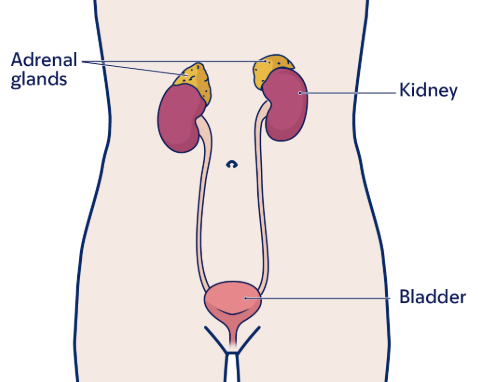
Your adrenal glands make the hormone cortisol (KOR-tih-sol).
Cortisol helps:
- Your body heal itself when you’re sick or when you get hurt.
- Control your blood pressure and keep your heart working normally.
- Control your blood sugar levels.
AI happens when your adrenal glands do not make enough cortisol. If you have AI, you must take medicine every day to replace the cortisol that’s missing.
Types of AI
There are 3 types of AI: primary, secondary (SEH-kun-dayr-ee), and tertiary (TER-shee-err-ee).
Primary AI
Primary AI happens when there’s a problem with the adrenal glands, and they cannot make enough cortisol.
Primary means “first” or “main.” The problem comes from the adrenal glands themselves, not from another part of your body.
Secondary AI
Secondary AI happens when there’s a problem with the pituitary (pih-TOO-ih-TAYR-ee) gland. This is a pea-sized organ at the bottom of your brain.
The pituitary gland makes a hormone called adrenocorticotropic hormone (ACTH). This hormone tells the adrenal glands to make cortisol. If the pituitary gland doesn’t make enough ACTH, the adrenal glands don’t get the message to make enough cortisol.
Secondary means “second.” The problem starts with the pituitary gland, which then leads to a second problem with the adrenal glands.
Tertiary AI
Tertiary AI happens when there’s a problem with the hypothalamus (HY-poh-THA-luh-mus). This part of the brain makes a hormone called corticotropin-releasing hormone (CRH). This hormone tells the pituitary gland to make ACTH. ACTH then tells the adrenal glands to make cortisol.
If the hypothalamus doesn’t make enough CRH, the pituitary gland doesn’t get the message to make enough ACTH. Without enough ACTH, the adrenal glands don’t get the message to make enough cortisol.
Tertiary means “third.” The problem starts with the hypothalamus, which then leads to a second problem with the pituitary gland. This then leads to a third problem with the adrenal glands.
Causes of AI
Some causes of primary AI are:
- Autoimmune diseases that attack the adrenal glands, such as Addison’s disease.
- Certain genetic diseases inherited (passed down) from a family member that affect the adrenal glands.
- Physical injury to the adrenal glands.
- Surgery to take out the adrenal glands.
- Radiation therapy, which can harm the adrenal glands.
- Certain medicines that can harm the adrenal glands. Examples are nivolumab (OPDIVO®) and morphine (MS Contin®).
Some causes of secondary and tertiary AI are:
- Certain steroid medicines that a doctor has prescribed for long-term use. Taking some steroid medicines for a long time can cause your body to stop making cortisol on its own. Examples of steroid medicines are prednisone, hydrocortisone, and dexamethasone.
- Tumors in the pituitary gland or hypothalamus.
- Surgery on the pituitary gland or hypothalamus.
- Certain cancer treatments, which can harm the pituitary gland or hypothalamus. Examples are radiation therapy, chemotherapy, and immunotherapy (IH-myoo-noh-THAYR-uh-pee).
Adrenal crisis
If your adrenal glands do not make enough cortisol, your body can go into adrenal crisis. An adrenal crisis is an emergency that can threaten your life (it can kill you).
If this happens, you must give yourself an emergency injection (shot) of a cortisol medicine called Solu-Cortef®. Your doctor will give you a prescription for Solu-Cortef.
Signs and symptoms to watch for in an adrenal crisis
Call your doctor’s office right away if you have any of these signs or symptoms:
- Very bad nausea (feeling like you’re going to throw up)
- Very bad vomiting (throwing up)
- Diarrhea (loose, watery poop)
- Feeling dizzy or lightheaded (like you might faint)
- Abdominal (belly) pain
- Confusion
- Low blood pressure
- Fainting (passing out)
Diagnosing AI
To find out if you have AI, your doctor may order 1 or more of these tests:
- A corticotropin (KOR-tih-koh-TROH-pin) stimulation test
- A morning cortisol test
- A morning ACTH blood test
Your doctor will give you instructions for the type of test you’re getting. You may need to stop taking some of your usual medicines before your test. Talk with your doctor about which medicines are safe for you to stop taking.
All 3 tests most often are done in the morning, around This is when your cortisol level is naturally at its highest. If you work the night shift or have an irregular sleep schedule, talk with your doctor. They’ll tell you the best time to take these tests.
Corticotropin stimulation test
A corticotropin stimulation test measures how well the hormone ACTH stimulates (tells) your adrenal glands to make cortisol.
Here are the steps of the test:
Step 1: A healthcare provider will take a blood sample from a vein in your arm or hand. The sample will be used as a baseline measurement. This measures the level of cortisol in your body before you start the test. Your doctor will compare it to later measurements to see if your cortisol level has changed.
Step 2: The healthcare provider will give you a dose of cosyntropin (ko-sin-TROH-pin) ordered by your doctor. This is a synthetic (man-made) version of the ACTH hormone that normally comes from your pituitary gland. Cosyntropin is meant to act like your body’s natural ACTH, stimulating your adrenal glands to make cortisol.
You’ll get the dose of cosyntropin through either:
- An intravenous (IV) line in one of your veins, usually in your arm or hand.
- An injection (shot) into your muscle, usually in your upper arm.
Step 3: After 30 minutes, the healthcare provider will take a second blood sample. The sample will be used to measure your cortisol level at this time (30 minutes after the dose).
Step 4: After another 30 minutes, the healthcare provider will take a third blood sample. The sample will be used to measure your cortisol level at this time (60 minutes after the dose).
Step 5: All 3 blood samples will be sent to a lab for testing. The lab will measure your cortisol level from each sample and compare them. This will let them see if there were any changes in your cortisol level after the dose of cosyntropin.
- If your cortisol level rose: This is a normal result. It means the cosyntropin stimulated your adrenal glands to make enough cortisol. Your adrenal glands are working like they should.
- If your cortisol level did not rise, or went up only a little: This is an abnormal (not normal) result. It means the cosyntropin did not stimulate your adrenal glands to make enough cortisol, and you may have AI. Your doctor may need to order more tests to make sure.
Morning cortisol test
A morning cortisol test measures the level of cortisol in your body.
A healthcare provider will take a blood sample from a vein in your arm or hand. The sample will be sent to a lab for testing. The lab will measure your cortisol level at the time your blood was drawn in the morning.
Your cortisol level may be too high or too low. That means you may have a problem with your adrenal glands or pituitary gland. Your doctor will talk with you about your results and what they mean.
Morning ACTH blood test
Doctors often order a morning ACTH blood test along with a morning cortisol test. An ACTH blood test measures the level of ACTH in your body.
A healthcare provider will take a blood sample from a vein in your arm or hand. The sample will be sent to a lab for testing. The lab will measure your ACTH level at the time your blood was drawn in the morning.
Your ACTH level may be too high or too low. That means you may have a problem with your adrenal glands or pituitary gland. Your doctor will talk with you about your results and what they mean.
Treatment for AI
Treatment for AI depends on a few things, including your stress level, type of AI, and overall health. Your doctor will talk with you about which treatment is right for you based on these things.
Daily medicine
Your doctor will prescribe medicine for your AI. You must take this medicine every day to replace the cortisol that your body cannot make on its own.
Follow these safety guidelines when taking your daily medicine for AI:
- Take your medicine as prescribed. Follow your doctor’s instructions when taking your medicine. Do not change the dose (amount) or stop taking your medicine without talking with your doctor.
- Only take the medicine prescribed for you. Never share your medicine with another person or take another person’s medicine.
- Manage your prescription. Be sure to keep track of how much medicine you have, so you do not run out. Talk with your care team if you have any questions about refills on your medicine.
- Tell all of your healthcare providers you’re taking medicine for AI. This includes everyone on your MSK care team. It also includes all your healthcare providers outside of MSK, such as doctors, nurses, pharmacists, and dentists.
Stress dosing
Stress dosing means raising the dose of your daily medicine for AI when your body needs extra cortisol. It’s often done when your body is under physical stress. Examples of physical stress are when you’re sick, have a serious injury, or have surgery.
People with AI cannot make enough cortisol on their own to handle some kinds of physical stress. They need to take extra medicine to prevent serious (very bad) health problems, such as an adrenal crisis.
You may need to stress dose if you have:
- A fever of 100.4 °F (38 °C) or higher.
-
Flu-like symptoms, such as:
- Nausea.
- Vomiting.
- Diarrhea.
- An infection that needs to be treated with antibiotics.
- Dizziness.
- A physical injury, such as a broken bone or an injury that needs stitches.
- A procedure under local anesthesia (A-nes-THEE-zhuh), such as a skin biopsy. Local anesthesia is medicine that makes an area of your body numb.
- A procedure under sedation (seh-DAY-shun), such as a colonoscopy or some dental procedures. When you’re under sedation, you’ll get a sedative. This is medicine that makes you sleepy and relaxed during your procedure.
- A surgery under general anesthesia, such as a hip replacement or a mastectomy (breast surgery). General anesthesia is medicine that makes you sleep during your surgery.
Tell your care team if you:
- Have an illness, infection, or injury. They’ll work with you to adjust (change) the dose of your daily medicine.
- Have any upcoming procedures or surgeries. They’ll talk with the healthcare providers doing your procedure or surgery about adjusting the dose of your daily medicine.
Your doctor will tell you how to stress dose. Follow their instructions. Do not raise the dose of your medicine without talking with your doctor.
Once you’re better, your doctor will tell you how to lower the dose back to your usual daily amount.
In an emergency
There may be times when you need to give yourself an emergency injection of Solu-Cortef. If you’re not able to give yourself the injection, your caregiver must give it to you.
You’ll need an emergency injection of Solu-Cortef if you:
- Have a serious injury, such as a broken bone or a lot of blood loss.
- Are vomiting.
- Feel faint or like you’re going to pass out.
- Lose consciousness (pass out).
There may be other times when you need to give yourself an emergency injection. Follow your doctor’s instructions. You can also read How To Give an Emergency Shot Using Solu-Cortef® Act-O-Vial®.
Call 911 or have your caregiver take you to the nearest emergency room after giving yourself the injection. You may need more medical care.
MedicAlert® jewelry
You should wear a MedicAlert bracelet or necklace that says “Adrenal Insufficiency” on it. This will help emergency services workers care for you if you’re badly ill or hurt and need an emergency injection.
You can buy MedicAlert jewelry at most drug stores. Visit www.medicalert.org to learn more.
MSK’s After-Hours Telephone Triage call center
The After-Hours Telephone Triage (AHTT) is a call center for MSK patients who have urgent symptoms related to their cancer care.
The AHTT is available 7 days a week when doctors’ offices are closed. You can call your doctor’s office and follow the prompts to reach the AHTT call center. You also can call the MSK operator at 212-639-7900.
Call when you have an urgent symptom or medical problem that needs attention right away. The AHTT lets you talk with a healthcare provider when your problem cannot wait until your care team is available. To learn more about the AHTT, read .
If you have a life-threatening emergency, always call 911 or go to the nearest emergency room.
Learn about our Health Information Policy.