This information will explain how to care for your drainage percutaneous endoscopic gastrostomy (dPEG), your skin, and your drainage bag.
About your dPEG
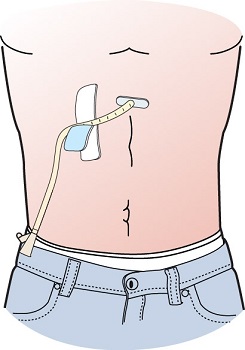
A dPEG is a tube that is put into your stomach to drain stomach fluids (see Figure 1). It helps to relieve nausea (feeling like you’re going to throw up), vomiting (throwing up), and stomach pain caused by a blockage in your bowel (intestines). It lets stomach fluid drain out so it doesn’t build up and make you feel sick.
These are the supplies you’ll need to care for your dPEG at home:
- 1 box of 4 x 4 gauze.
- 1 roll of 1-inch tape.
- 1 60 milliliter (mL) irrigation syringe.
- 2 drainage bags.
- 2 caps to fit your dPEG-tube
- 4 Cath-Secure® or tape
Your care team will give you these supplies. You can buy more supplies through your local medical supply store. Ask your care team for more information.
Your healthcare provider may also prescribe medicine to relieve discomfort you may have around your dPEG.
Caring for the skin around your dPEG
Check your skin every day
Look closely at the skin around your dPEG every day. If you see any redness, swelling, or pus (thick, yellow or white drainage), tell your healthcare provider.
Clean your skin
Clean your skin every day. Follow these steps:
- Wash your hands with soap and warm water for at least 20 seconds before touching your tube.
- Take off the old bandage around your dPEG. It’s normal to see fluid or mucus stains on the bandage. It’s also normal to see old blood or crusting around the tube.
- Wash the skin around your dPEG with soap and water. Clean off any fluids or crusting. Gently pat it dry.
- Cover your insertion site with a 4 x 4 gauze pad. Place it over the bumper. The bumper is the small plastic disc outside your abdomen (belly) that keeps your dPEG from sliding.
- Rotate the tube every day. Turn it 180° and 1 to 2 centimeters (cm) in and out.
- Loop the tube and secure it with tape or a Cath-Secure.
If your dPEG falls out, cover the opening with a couple of 4 x 4 gauzes. Call your healthcare provider right away. Do not eat or drink anything.
Caring for your drainage bag
Emptying your drainage bag
Empty the drainage bag when it is about ⅓ to ½ full or about every 8 hours, whichever comes first.
Cleaning and changing your drainage bag
Clean your drainage bag once a day if you’re eating soft food. If you’re not eating, clean the bag every 3 to 4 days.
To clean your bag:
- Mix 1-part white vinegar with 3 parts cool water.
- Soak your bag in this solution for 10 to 15 minutes.
- Allow the bag to dry.
You may feel nauseous or have some discomfort when your dPEG is capped (not open to drainage) while you clean and dry the bag. If so, attach another bag.
Place your drainage bag lower than your stomach to help fluids drain faster.
Flushing your tube
Flushing your tube keeps it from getting clogged with stomach fluids or mucus.
How often to flush
Flush your tube at least once a day. Use 30 to 60 (milliliters) mL of water.
- Flush before and after giving yourself any medicine through your dPEG.
-
Flush if you feel:
- Nauseous
- Full
- Uncomfortable
- The tube is slow to drain
- Flush more often if your stomach juices are thick or your drainage is sluggish.
How to flush
-
Gather your supplies. You will need:
- 30 to 60 mL of water (or the amount told by your healthcare provider).
- 1 60 mL syringe.
- 1 cap for the tube.
- 1 clean drainage bag.
- Paper towels.
- Empty the drainage bag.
- Wash your hands with soap and warm water for at least 20 seconds.
- Place the paper towels under your dPEG to absorb any drainage.
- Draw up 30 to 60 mL of water into the syringe. Follow your healthcare provider’s instructions.
- Clamp your dPEG.
- Disconnect your dPEG from the drainage bag and set the drainage bag to the side.
- Place the syringe into the opening of your dPEG.
- Unclamp your dPEG and push the plunger of the syringe quickly.
- Clamp your dPEG.
- Take out the syringe and reconnect your dPEG to the drainage bag.
- Unclamp your dPEG and let it drain.
If your dPEG isn’t draining anything, or if you were nauseous and it didn’t get better after flushing it, call your healthcare provider.
Eating and drinking with your dPEG
Clear liquid diet
Your healthcare provider will tell you if and when you can start drinking clear liquids after your procedure. A clear liquid diet includes mostly liquids you can see through, that don’t have any solids in them. These liquids are easy to digest and help keep you hydrated. include drinks such as ginger ale, apple juice, coffee, tea, broth, flavored ice, and gelatin (such as Jell-O®).
Your healthcare provider will give you more information about what you can and cannot drink. Read Clear Liquid Diet to learn more about clear liquid diets.
Full liquid diet
Your healthcare provider will tell you if and when you can start drinking full liquids.
A full liquid diet includes all clear liquids, some thicker liquids (such as broth or strained cream soups), and some liquids that are not clear (such as yogurt without any pieces of fruit).
Pureed or soft foods diet
Your healthcare provider will tell you if and when you can start eating a pureed (pure-AYD) or soft foods diet.
A pureed diet is when you only eat foods you do not need to bite or chew. On this diet, you can have all liquids and foods that you make soft in a blender or food processor.
A soft foods diet includes all full liquids, as well as foods that are soft. This means you can chew them less to get the food into a texture that’s smooth and easy to swallow.
If you eat food that isn’t puréed, you must eat it in tiny pieces and chew it very well. Eat very small portions at a time.
Your healthcare provider will tell you if and when you can start these diets. Do not change your diet without talking with your care team first.
Tips for eating with your dPEG
- Sit up when you drink or eat to allow the liquids to drain into the drainage bag. Stay seated for 20 to 30 minutes after you eat. If you don’t, you may feel nauseous. If you feel nauseous, check to make sure your dPEG is not kinked. This should make you feel better.
- Don’t eat more than 4 cups of food or drink more than 1 liter (33.8 ounces) of liquids in 24 hours.
- Each time you eat or drink, you will lose important nutrients. This is because they drain into the drainage bag with the food or liquid. A member of your healthcare team will teach you how to get the nutrition you need.
- Most of what you eat and drink will drain through the tube into the drainage bag. For example, if you eat red gelatin, the drainage in the bag will be red. Stomach juices will drain into the bag even if you haven’t eaten. The color of your stomach juices will range from green to dark yellow.
Clamping your dPEG
Always keep your dPEG open at night to prevent aspiration. Aspiration is when food, liquids, or saliva get into your airway.
Do not clamp your dPEG for the first week that you have it except for when you’re taking your medicine.
Taking medicine with your dPEG
You can swallow medicine, but you will need to clamp your tube first. You will also need to leave your tube clamped for 15 to 30 minutes after you take your medicine.
When to call your healthcare provider
Call your healthcare provider right away if:
- You have a fever of 101 °F (38.3 °C) or higher.
- You have shakes or chills.
- Your dPEG falls out of place.
- You have any signs of bleeding.
- You have pain where your dPEG goes into your stomach that doesn’t better with medicine.
- You have nausea and vomiting that is worse than usual.
- You have any signs of redness, swelling, oozing, or pus on your skin around the tube.
- You need to change your bandages more than 3 times a day or your dPEG keeps leaking.
Learn about our Health Information Policy.