Radiation Therapy for Salivary Gland Cancer
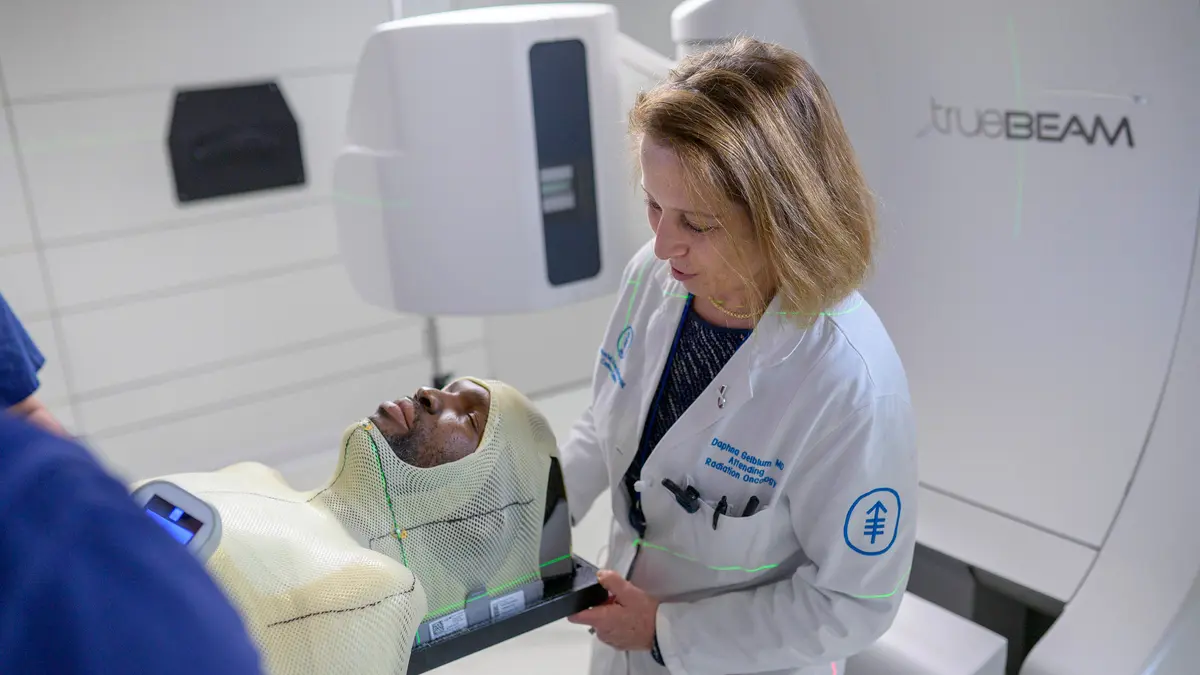
Radiation oncologist Dr. Daphna Y. Gelblum gives radiation therapy to her patient.
Overview of salivary gland cancer radiation therapy
Radiation therapy works by using high-energy X-rays to kill cancer cells. MSK offers precise radiation therapy that kills salivary gland cancer cells with fewer side effects from radiation. This keeps the healthy tissue safe.
Radiation is a common treatment for salivary gland cancer. You may have radiation for salivary gland cancer on its own or before, during, or after surgery or chemotherapy.
To understand how salivary gland cancer radiation therapy fits into your treatment, this is a good place to start.
Talk with an MSK Care Advisor. We're here 24 hours a day, 7 days a week.
How is radiation therapy used to treat salivary gland cancer?
Your doctor may recommend radiation therapy:
- After salivary gland cancer surgery, to lower the chance the cancer will come back.
- To treat salivary gland cancer that cannot be removed by surgery.
- To treat salivary gland cancer that comes back after surgery.
Your doctor may recommend chemoradiation, when we use chemotherapy together with radiation therapy. Chemoradiation may help the tumor respond better to treatment.
Radiation oncologists are cancer doctors with special training in using radiation to treat cancer. MSK’s radiation therapy experts deliver radiation to the tumor while keeping nearby healthy tissue safe. Radiation therapy aims to kill off salivary gland cancer cells with as few side effects as possible.
Salivary gland cancer may not respond to surgery or chemotherapy. If so, we use radiation therapy to relieve symptoms and improve your quality of life.
Types of radiation therapy for salivary gland cancer
External radiation therapy is delivered outside your body. External radiation therapy uses high-energy rays to harm cancer cells so they can no longer grow.
External beam radiation therapy (EBRT) uses a treatment machine called a linear accelerator to aim beams of radiation right at the tumor.
The beams pass through your body and harm cancer cells in their path. You will not see or feel the radiation.
Most energy rays used for EBRT are photons (X-rays or gamma rays). Another type of EBRT is proton therapy, which uses proton rays.
EBRT is the type of radiation used to treat salivary gland cancer.
Doctors at MSK are national experts in all methods of radiation therapy. They’ll recommend which is best for you, based on the cancer and your preferences.
Types of external beam radiation therapy
MSK is one of only a few hospitals to offer the most advanced proton therapy in New York City. MSK uses proton therapy, also called proton beam therapy, for some cases of salivary gland cancer. Proton therapy is an option for salivary gland cancer that came back after treatment.
Proton therapy uses charged particles called protons to kill cancer cells. A device called a cyclotron sends tiny, high-energy beams of protons to the tumor.
With proton therapy, the beams do not go past the tumor. Proton therapy can cause fewer side effects because healthy tissue near the tumor is more likely to be safe.
Image-guided radiation therapy, or IGRT, can treat tumors with even more accuracy than regular radiation therapy. This method gives a very precise dose of radiation right to the tumor.
Image-guided means we take images to help guide the radiation beams to the tumor. Imaging can include PET, MRI, and CT scans to locate the tumor before and during radiation therapy.
Most often, you’ll have IGRT 5 days a week for a few weeks. You may have as few as 3 treatments. You’ll have more imaging scans during IGRT to track changes in the tumor’s size or shape.
Intensity-modulated radiation therapy (IMRT) lets us change the radiation beams’ power during treatment using a special computer program. It lets us make a dose plan that can deliver high doses of radiation more precisely to the tumor area.
IMRT can have fewer side effects for some people because it’s so accurate.
You’ll have a CT scan before IMRT to make a 3D map of the tumor. Most treatment sessions take 10 to 30 minutes. You’ll have them 5 days a week for a few weeks.
The total number of treatments depends on things like the tumor’s size and location. You also may have chemotherapy to make radiation work better.
Chemotherapy with radiation (chemoradiotherapy) for salivary gland cancer
Chemoradiation is when chemotherapy is given together with radiation. It’s also called chemoradiotherapy.
Radiation alone can work very well on some cancers, but chemotherapy can help the radiation work better.
Chemoradiation works by using chemotherapy to first weaken cancer cells. Chemo makes the tumor more sensitive to radiation treatment, so radiation harms the tumor more easily.
Chemotherapy also can treat very tiny cancer cells that may have spread outside the area where the cancer started.
Quitting tobacco can help salivary gland cancer radiation therapy work better. Our Tobacco Treatment Program offers treatment options to help you quit, such as counseling and medicine. It’s open to people who never had cancer or a disease linked to tobacco. Learn why it’s never too late to quit using tobacco.

Side effects of salivary gland cancer radiation therapy
What are the short-term side effects of salivary gland cancer radiation therapy?
Radiation treatments are very precise and cause little harm to healthy tissues. Radiation treatment for salivary gland tumors most often does not cause hair loss. Many people report few lasting side effects.
In general, you can keep doing your daily activities or keep working through radiation treatment.
Some people do have side effects during or shortly after salivary gland cancer radiation. Short-term side effects of salivary gland cancer radiation include:
What are the long-term side effects of salivary gland cancer radiation therapy?
Side effects can start months or years after treatment ends. These are called long-term or late effects. Late effects of salivary gland cancer radiation are not common, but they can include:
- Dry mouth, because the salivary glands are unable to make saliva.
- Problems with hearing.
- Jawbone injury, which is more common if you have tooth decay or dental problems.
- Lymphedema.
- Hypothyroidism.
- Inflammation in the head or neck, most often with people who also had chemotherapy or immunotherapy.
- Injury to the head or neck, if there was a lot of exposure from radiation.
- Trismus, also known as lockjaw, which is when you have trouble opening your mouth all the way. Trismus can happen anytime during, right after, or even years after head and neck radiation therapy. Learn more about how to manage trismus.
It’s important to get enough nutrition before, during, and after head and neck cancer treatment. We have information about how to manage side effects during radiation therapy and chemotherapy. Watch this video to learn how to get enough nutrition during radiation treatment for head and neck cancer.
What is fibrosis (scarring) from salivary gland cancer radiation?
Radiation therapy can also cause fibrosis (fy-BROH-sis), which is tissue scarring that’s permanent (does not go away). The effects of radiation scarring depend on the head and neck area that was treated, and include:
- Trismus, or lockjaw, which is when you have trouble opening your mouth all the way.
- Your salivary glands may not make enough saliva. This can make it hard to swallow because your mouth is too dry.
How does MSK limit your exposure to radiation during treatment?
MSK radiation experts do everything possible to lower the chances of radiation harming your body and causing side effects. They use the most precise ways to deliver radiation to treat the tumors and not nearby healthy tissue.
For safety, we can take images each day to track the tumor and keep healthy tissue safe. These methods limit healthy tissue’s exposure to radiation.
How MSK helps you cope with salivary gland cancer radiation therapy side effects
We manage side effects to help you recover fast from salivary gland cancer radiation therapy.
MSK’s Integrative Medicine and Wellness Service offers acupuncture, meditation, massage therapy, yoga, and exercise. Integrative medicine is also called complementary, natural, or holistic therapies. Without using prescription drugs, integrative therapies can help improve and control side effects of cancer treatment.
At MSK, our speech and swallowing experts will work with you before, during, and after treatment. You’ll have exercises to prevent side effects. We’ll watch for any problems with swallowing. And we’ll make sure you keep the range of motion in your tongue, jaw, and neck.
Our dental and rehabilitation experts can also help manage side effects. They’ll support you with any dental problems. They can keep your throat working as it should, for eating, swallowing, and speaking.
Our nutrition experts will help you eat well during and after salivary gland cancer treatment. They’ll make a plan just for you.

Common questions
Before you start radiation therapy for salivary gland cancer, you’ll have a treatment planning procedure called a simulation. A radiation therapy simulation is done to make sure that:
- Your treatment site is mapped so the radiation is precise and targeted.
- You get the right dose (amount) of radiation.
- Nearby tissue gets the lowest amount of radiation possible.
Your radiation therapy simulation will take about 4 hours. You’ll have imaging scans, including a PET-CT scan for some people.
Your skin will be marked with little tattoo dots that tell us which area to treat. These tattoos are permanent (do not come off).
You’ll be lying in one position for a long time.
Your radiation oncologist and care team will carefully plan and check the angles and shapes of the radiation beams.
Radiation treatments take place Monday through Friday, for about 6 to 7 weeks.
Your radiation therapy team will tell you what to expect for your treatment schedules. You may have chemotherapy and radiation on the same day.
You must come to every appointment. Treatment may not work as well if you skip or miss appointments. If you need to change your schedule, talk with your radiation therapist.
Learn more about the set-up procedure and treatments.
Before your appointment, it’s helpful to write down questions you want to ask. Here are some examples. Write down the answers during your appointment so you can review them later.
- How will radiation to my head and neck make my body feel?
- What kind of radiation therapy will I get?
- How many radiation treatments will I get?
- What side effects should I expect during my radiation therapy?
- Will these side effects go away after I finish my radiation therapy?
- What kind of late side effects should I expect after my radiation therapy?
- What kind of follow-up care will I need after radiation therapy ends?
