This story was originally published July 29, 2026. It was most recently updated September 14, 2026.
A new drug that treats non-small cell lung cancer (NSCLC) carrying a mutation called a ROS1 fusion has been approved by the U.S. Food and Drug Administration (FDA).
The drug zidesamtinib (Jideytro) was approved for patients with advanced ROS1-positive NSCLC who have stopped responding to other drugs aimed at ROS1. It had previously received Breakthrough Status from the FDA, a designation that speeds up the review of treatments that are particularly crucial for patients.
“We had already shown that lung cancer patients can really benefit from older drugs that target ROS1,” says thoracic oncologist Alexander Drilon, MD, Chief of the Early Drug Development (EDD) Service at Memorial Sloan Kettering Cancer Center (MSK). “But because many patients eventually develop resistance to older ROS1 drugs, we have continued to help develop new versions. Zidesamtinib is the most advanced ROS1 inhibitor that is approved for patients.”
Dr. Drilon led the trial that resulted in zidesamtinib’s approval, which was announced on July 22, 2026. You can read more here about how he has been developing ROS1 inhibitors for more than a decade for lung cancer patients like Anthony Valente.
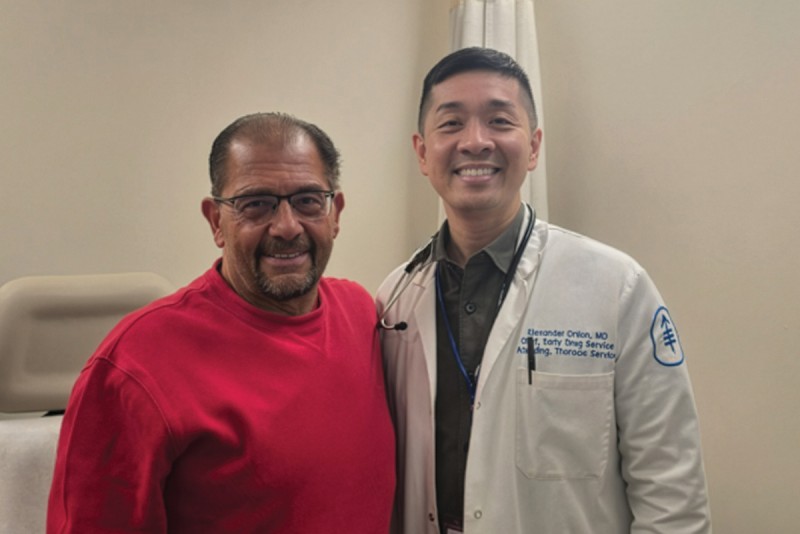
“Every time I see him, we give each other a high five,” says Anthony, who joined the clinical trial for zidesamtinib when his tumors developed resistance to standard therapy and began to grow. “After I started zidesamtinib, the cancer shrunk and shrunk.”
What is a ROS1 fusion?
The ROS1 defect occurs when a piece of one gene breaks off and attaches to another unrelated gene. This defect causes cells to grow out of control and form tumors. ROS1 fusions are found in 1% to 2% of non-small cell lung cancers. They also occur in other cancers, including glioblastoma, a type of brain cancer, and cholangiocarcinoma (bile duct cancer).
ROS1 fusions in lung cancer are more commonly found in women, in people who’ve never smoked, and in younger patients (those in their 30s, 40s, and 50s).
Tumor genetic tests like MSK-IMPACT® and MSK-ACCESS® reveal defects like the ROS1 fusion and other mutations driving a cancer. Identifying these defects can suggest which drugs are most likely to be effective.
How effective is zidesamtinib?
The phase 1/2 trial called ARROS-1, which resulted in zidesamtinib’s approval, enrolled 117 patients at several hospitals with a ROS1-positive lung cancer. All of them had cancer that was locally advanced (had spread significantly in the lungs and chest) or metastatic (had spread to another part of the body, including the brain) and had already received at least one other ROS1-blocking drug.
- Overall, 44% of patients responded to the drug — their tumors shrank substantially.
- This included patients who received older drugs like repotrectinib and taletrectinib.
- One patient had a complete response, meaning that their cancer completely disappeared.
- After six months, 82% of responding patients were still responding.
- After one year, 69% of responding patients were still responding.
- The most common side effects were predominantly mild and included swelling in the hands and feet, muscle enzyme increases, constipation, weight increase, liver enzyme increases, taste change, shortness of breath, joint pains, and numbness or tingling in the arms or legs.
- About 10% of patients had to lower their doses due to side effects, but only 2% had to stop taking the drug, showing how well tolerated the treatment is.
“This is a group of patients who have already received many other treatments,” Dr. Drilon says. “The responses that we saw in this study were truly meaningful and had a positive effect not only on their lifespans, but on their quality of life.”
How is zidesamtinib different from other ROS1 drugs?
Earlier drugs that target ROS1 include crizotinib, entrectinib, repotrectinib, and taletrectinib. Dr. Drilon, who is a widely recognized leader in the development of targeted therapies for lung cancer, also played a key role in the FDA’s approvals of entrectinib in 2019 and repotrectinib in November 2023.
Unfortunately, most patients taking these drugs eventually develop resistance to them — the tumors figure out a way to evade the drugs’ effects and start growing again.
Zidesamtinib — a third-generation ROS1 inhibitor — was designed to work in patients whose tumors have learned to get around the older drugs. It does this by binding to the protein in a tighter, more specific way. It also can penetrate the blood-brain barrier, making it effective at attacking cancer cells that have spread to the brain — a common site of metastasis for lung cancer. Many of the patients in the ARROS-1 trial (including 85% of those previously treated with crizotinib) had their brain metastases shrink after taking zidesamtinib.
Furthermore, the drug was designed to decrease the side effects experienced with older drugs. Entrectinib, repotrectinib, and taletrectinib all can cause neurological side effects like dizziness - because they inhibit a protein called TRK. Zidesamtinib was designed to avoid TRK inhibition, so its most common side effects do not include neurological consequences.
“This was the most precisely targeted ROS1 inhibitor that science could create, while decreasing side effects at the same time,” Dr. Drilon adds. “The results have been really good for many patients.”
The FDA’s approval means that zidesamtinib will be available to patients throughout the United States, whether or not they have access to a clinical trial. ROS1 fusions are rare, but because lung cancer is so common — more than 230,000 new cases in the U.S. every year —there are thousands of patients who could benefit.
Key Takeaways
- The FDA approved zidesamtinib, a third-generation ROS1 inhibitor, for patients with advanced ROS1-positive non-small cell lung cancer who have stopped responding to older ROS1-targeting drugs.
- The ARROS-1 clinical trial, led by MSK’s Dr. Alexander Drilon, showed that 44% of patients responded to zidesamtinib, with 69% of those patients still responding after one year.
- Zidesamtinib was specifically designed to overcome resistance to earlier ROS1 drugs and can penetrate the blood-brain barrier, making it effective against cancer that has spread to the brain.
- The FDA approval makes zidesamtinib widely accessible to the thousands of lung cancer patients with ROS1 fusions across the U.S., regardless of whether they have access to a clinical trial.
Dr. Drilon holds the Carol Bassok Lowenstein Chair.
Editors Note: This article was updated to include that Dr. Drilon is a paid consultant and member of the scientific advisory board of Nuvalent, the company which makes zidesamtinib.