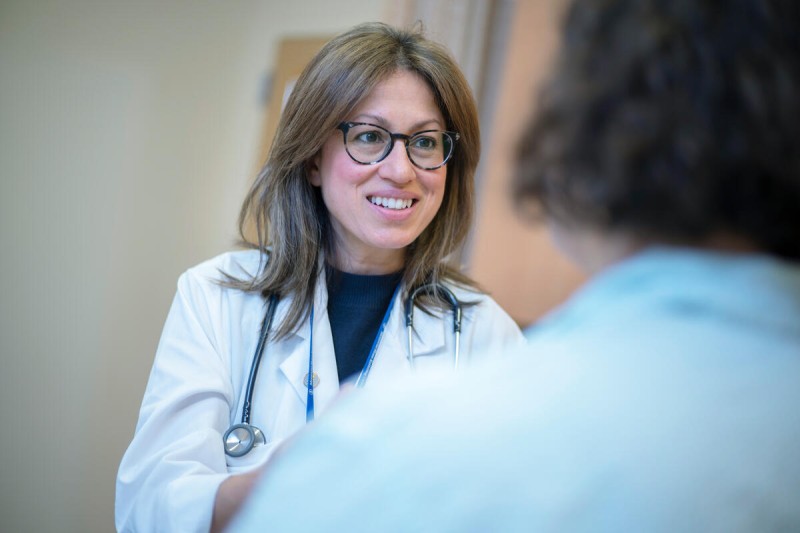
A drug that has already transformed care for metastatic HER2-positive and HER2-low breast cancer has now been approved by the U.S. Food and Drug Administration (FDA) to treat HER2-positive patients with early-stage disease. On May 15, 2026, the FDA extended approval for trastuzumab deruxtecan (T-DXd, or Enhertu®), based on two clinical trials, one of which was led by breast medical oncologist Shanu Modi, MD, at Memorial Sloan Kettering Cancer Center (MSK).
“HER2-positive breast cancer is an aggressive disease, even when it’s diagnosed at an early stage,” Dr. Modi says. “This approval will change the way that many patients with this type of breast cancer are treated and offer the chance for more patients to be cured.”
HER2-positive means the cancer cells have high levels of a protein called HER2, which fuels cancer growth.
Two important new treatment options
The latest Enhertu approvals from the FDA were for two new clinical scenarios:
- Before surgery (neoadjuvant therapy): For patients with HER2-positive breast cancer that is stage 2 or 3, T-DXd is now approved, followed by a combination of chemotherapy and targeted therapy drugs.
- After surgery (adjuvant therapy): For patients with HER2-positive breast cancer who have remaining cancer after receiving neoadjuvant treatments.
“The goal of this treatment is to prevent recurrence in patients who may have traces of disease remaining after surgery,” Dr. Modi says. “Giving T-DXd to patients with stage 2 or 3 breast cancer offers us the opportunity to significantly improve outcomes and make a profound difference in people’s lives.”
How T-DXd evolved to help more breast cancer patients
Enhertu first gained accelerated FDA approval in 2019 for patients with advanced (metastatic) breast cancer that was HER2 positive, based on a pivotal study led by Dr. Modi. But this initial approval helped only a subset of patients. The breakthrough came in 2022, when the FDA approved T-DXd for HER2-low metastatic breast cancer — tumors that have some HER2, but not enough to be classified as HER2 positive. This expansion opened the door for many more patients with metastatic disease to receive this life-changing treatment.
A standing ovation for groundbreaking results
When Dr. Modi presented the results from the global phase 3 HER2-low trial at the American Society of Clinical Oncology (ASCO) meeting in June 2022, the audience gave Dr. Modi a standing ovation. The results were simultaneously published in The New England Journal of Medicine (NEJM), cementing their significance. The data told a powerful story: Patients who received T-DXd saw their cancer held in check nearly twice as long as those on standard therapy, and they lived about 35% longer.
That landmark trial was called DESTINY-Breast04. The clinical studies supporting the latest approvals come from the DESTINY-Breast05 and DESTINY-Breast11 studies, the latter of which was led by Dr. Modi at MSK. They are part of an ongoing DESTINY series studying T-DXd in a variety of cancer types.
Strong evidence for early-stage disease
The new approval expands the use of T-DXd to include not only patients with metastatic cancer but those with earlier-stage disease. The DESTINY-Breast11 trial demonstrated dramatic benefits for HER2-positive patients with stage 2 or 3 breast cancer: 67% percent of patients treated with T-DXd achieved a complete response — meaning they had no detectable cancer remaining — compared with 56% of patients who got standard treatment.
Similarly, the DESTINY-Breast05 trial showed that for patients whose cancers did not fully respond to standard treatments given first and then went on to receive T-DXd after surgery, 92.4% had disease-free survival at three years (meaning their cancer did not come back) versus 83.7% who received more standard treatment. “This is a significant and exciting advance for a high-risk population,” Dr. Modi says.
These findings were the basis of the new FDA approvals.
Expanding access to a powerful targeted drug
Trastuzumab (Herceptin®) was the first targeted therapy developed to treat HER2-positive patients. HER2-positive cancers account for 15% to 20% of all breast cancer diagnoses. Unfortunately, many patients who initially respond to trastuzumab eventually develop resistance to the drug. Researchers developed T-DXd to treat those patients.
How T-DXd works differently
The key difference lies in how the drug delivers its treatment. While trastuzumab directly blocks growth signals sent out by HER2, T-DXd takes a more sophisticated approach: It attaches trastuzumab to a powerful payload of chemotherapy that’s delivered directly to the tumor.
Think of it like a guided missile: The trastuzumab component precisely targets the HER2-expressing cells, then releases the chemotherapy exactly where it’s needed. This targeted delivery makes T-DXd much more powerful than standard trastuzumab alone.
Understanding the side effects from T-DXd
Like most cancer treatments, T-DXd does cause side effects. The most common ones — nausea and reduced blood counts — can usually be managed with medication. However, a small number of people develop a severe condition called interstitial lung disease, which causes inflammation and sometimes scarring in the lungs that makes breathing difficult.
Patients who receive the drug are monitored for this side effect.
Using T-DXd to treat other cancer types
The promise of T-DXd extends to other cancers that express HER2, including some stomach (gastric), lung, and colorectal cancers. “We plan to continue studying this drug for its potential to significantly improve outcomes for a large population of patients with many types of cancer, not just breast cancer,” Dr. Modi says.
Funding and disclosures
Many doctors and researchers around the world have participated in the clinical trials for T-DXd.
The development of the drug has been funded by Daiichi Sankyo and AstraZeneca.
Dr. Modi’s disclosures are available on her webpage.
Key takeaways
- The FDA has approved T-DXd (Enhertu®) for some people with earlier-stage HER2-positive breast cancer.
- The approval was based on two clinical trials, one of which was led by Shanu Modi, MD, at MSK.
- The trial showed dramatic benefits for HER2-positive patients with stage 2 or 3 breast cancer.
- T-DXd works by delivering chemotherapy directly to cancer cells, helping target the tumor more precisely.

