This information explains what to expect before, during, and after your penicillin allergy test at MSK.
About your penicillin allergy test
A nurse trained in penicillin allergy testing will do your allergy test. There are 3 parts to the allergy test that you might need:
- Step 1: The skin test (also called the prick test)
- Step 2: The intradermal test
- Step 3: The challenge test (also called the oral challenge). Some patients may only need to get a challenge test.
Your healthcare provider will decide if you only need 1 part of the allergy test, or all 3 parts. The testing usually takes about 1 ½ to 2 hours.
Getting ready for your penicillin allergy test
Stop taking certain medications
Your care team may tell you to stop taking certain medications before your allergy test, such as antihistamines (allergy medications). Read Stop Taking These Medications Before Your Allergy Test. It lists common antihistamines and other medications you must stop taking before your allergy test.
Things to remember
- Wear loose, comfortable clothes the day of your allergy test. You may get some injections (shots) under your skin, so wear a short-sleeved shirt, if you can.
- Make sure to eat before your allergy test or bring a snack with you to eat at your appointment. You can eat and drink as you normally would. Eating before your allergy test will help prevent stomach upset, such as cramping, gas, and bloating.
What to expect during your penicillin allergy test
Step 1: The skin test (prick test)
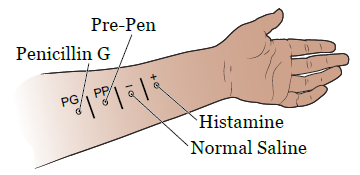
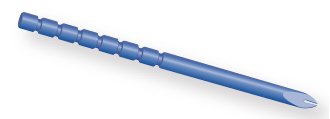
First, your nurse will put 1 drop of each medication on your forearm: histamine, normal saline, Penicillin G, and Pre-Pen (see Figure 1). Then, they will gently twist a sharp, plastic device called a duo-tip on your skin (see Figure 2). The duo tip will puncture (pierce) the skin underneath each drop, allowing the medication to go into your skin.
After 15 minutes, your nurse will check your skin to see if you had a reaction. Signs of a positive reaction are redness or a raised bump where the penicillin was placed on your skin. You should have a small bump at the histamine site, which may be itchy.
Your nurse will talk with you about your results and next steps.
Step 2: The intradermal test
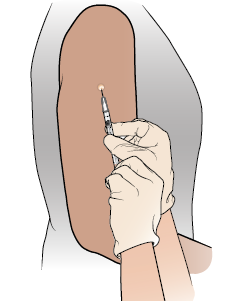
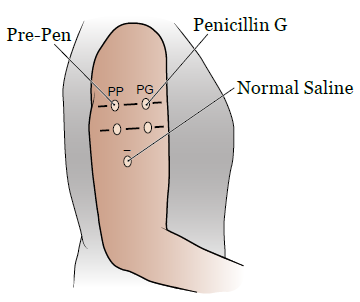
First, your nurse will inject these medications under your skin: normal saline, Penicillin G, and Pre-Pen. The medications will cause a bubble of fluid to form under your skin called a bleb (see Figure 3). Then, your nurse will outline each bleb with a pen (see Figure 4).
After 15 minutes, your nurse will check your skin to see if you had a reaction. Signs of a positive reaction are redness or swelling around the bleb.
Your nurse will talk with you about your results and next steps.
Step 3: The challenge test (oral challenge)
First, your nurse will give you a very small amount of penicillin orally (by mouth). This small amount is called a challenge dose.
Then, they will monitor (closely watch) you for 30 minutes. If you notice any of these signs, tell your nurse right away:
- Itching
- Trouble breathing
- Rash or hives
- Swelling in your face, lips, or tongue
If you don’t have a reaction to the challenge dose, your nurse will give you the full dose of penicillin. Then, they will monitor you for 60 minutes to look for any signs of an allergic reaction. If you don’t have a reaction to the full dose, this means you’re not allergic to penicillin anymore.
Your nurse will update your medical record with this information, and your testing will stop here.
What to expect after your penicillin allergy test
If you’re not allergic to penicillin anymore, you will get a card stating the results of your allergy test. You can show this card to other healthcare providers and pharmacies outside of MSK.
Delayed reaction
A delayed reaction is an allergic reaction that may happen after your penicillin allergy testing is done. It can happen a few hours or even a few days after your allergy test. Usually, a delayed reaction is not serious and goes away within 48 hours (2 days).
Signs of a delayed reaction are itching, hives, or a rash at the test site. If you have any of these signs, take a photo of it. Then, call the Allergy and Immunology office at 646-888-3814.
Learn about our Health Information Policy.