This information will help you get ready for your procedure to have fiducial (fih-DOO-shul) markers placed in your prostate by explaining what to expect before, during, and after your procedure. You will have this procedure before you start your radiation therapy.
About your prostate
Your prostate is a small, firm gland about the size of a walnut. It’s in front of your rectum, below your bladder (see Figure 1). Your prostate works with other glands in your body to make semen. It surrounds your urethra, the tube that drains urine (pee) from your bladder.
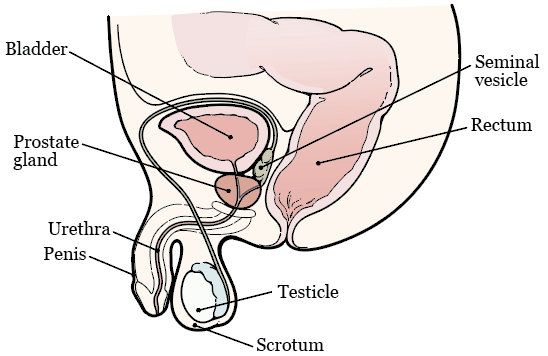
About fiducial markers
Fiducial markers are tiny gold metal objects, about the size of a grain of rice. They help your healthcare provider line up the beams of radiation. This helps to makes sure your radiation therapy is delivered the same way each time. The fiducial markers also help your healthcare provider target the tumor and avoid any healthy tissue that’s near it. The fiducial markers will stay in your prostate after your treatment. Having fiducial markers in your prostate is not harmful to you or your health.
Before your fiducial marker placement
Talk with your healthcare provider
Tell your healthcare provider if you:
- Take anticoagulants (blood thinners). These are medicines that affect the way your blood clots.
- Take steroids, such as prednisone (Deltasone®). A steroid is a medicine that helps with inflammation (swelling).
- Take any other prescription or over-the-counter medicines, including patches and creams.
- Take any dietary supplements, such as vitamin E, multivitamins, and herbal or home remedies.
- Tell your nurse if you will be more than 2 hours away from MSK during the first 24 hours after your procedure. If you have problems such as fever or heavy bleeding, we may tell you to go to MSK’s Urgent Care Center (UCC).
Buy your supplies
Buy these supplies before your procedure:
- 1 saline enema (such as a Fleet® saline enema). You can buy this at your local pharmacy without a prescription.
- Your healthcare provider may send a prescription for tamsulosin (Flomax®) 0.4 milligram (mg) tablets to your pharmacy. Pick up this medicine at least 4 days before your scheduled procedure.
Plan how you’re getting home
Some people feel lightheaded after their fiducial marker placement. It’s best to have someone take you home afterward so they can help you.
7 days before your procedure
Follow your healthcare provider’s instructions for taking your medicines
You may need to stop taking some of your medicines before your procedure. Examples include anticoagulants, aspirin, medicine that has aspirin, multivitamins, and vitamin E. Talk with your healthcare provider about which medicines are safe for you to stop taking. Follow their instructions.
For information about medicines that have aspirin and vitamin E, read How To Check if a Medicine or Supplement Has Aspirin, Other NSAIDs, Vitamin E, or Fish Oil.
4 days before your preocedure
Start taking Flomax®
Your healthcare provider may send a prescription for tamsulosin (Flomax) 0.4 milligram (mg) tablets to your pharmacy. This medicine can make it easier for you to urinate after your procedure. You will start taking Flomax 4 days before your fiducial marker placement. Take it for a total of 14 days (2 weeks).
2 days before your procedure
Stop taking nonsteroidal anti-inflammatory drugs (NSAIDs)
NSAIDs, such as ibuprofen (Advil® and Motrin®) and naproxen (Aleve®), can cause bleeding. Stop taking them 2 days before your procedure. If your healthcare provider gives you other instructions, follow those instead.
To learn more, read How To Check if a Medicine or Supplement Has Aspirin, Other NSAIDs, Vitamin E, or Fish Oil.
The day of your fiducial marker placement
Get ready at home
- Eat breakfast like usual. You should not skip this meal.
- Drink plenty of water.
- Give yourself a saline enema before your procedure. Follow the directions on the box.
Arrive at MSK
- Refer to top of page to see what MSK location you should go to.
- You should arrive 30 minutes before your procedure time
Get ready for your procedure
- Staff will review the procedure and check your vital signs before we start the procedure.
- If blood work is needed, it will be drawn before the procedure.
- A gown will be given to you in the procedure room to change into.
During your fiducial marker placement
The exact starting time of your fiducial marker placement procedure may depend on the length of the procedure scheduled before yours. Your nurse or healthcare provider will update you if there are any delays.
You will be brought to the procedure room and helped onto the procedure table. You will lie on your back and your feet will be placed in stirrups. Your healthcare provider will gently insert a probe into your rectum. They will put a lubricant on it to help it slide in easily.
Once the probe is in place, they will give you an anesthetic injection (shot) near your prostate to numb the insertion site. The probe uses ultrasound (sound waves) to make images of your prostate. Your healthcare provider will use the ultrasound to help them guide the needle. They will use the needle to place 3 fiducial markers into 3 different areas of your prostate. Once your healthcare provider has placed the fiducial markers, they will remove the probe and needle.
When the procedure is done, the staff will assess you for dizziness or lightheadedness. When it is safe you will be helped off the table to get dress.
You will need to pee before leaving your appointment.
After your fiducial marker placement
24 hours after
-
Manage any discomfort.
- It’s normal to be sore or uncomfortable after your procedure. Most people do not have pain. If you feel sore, you can take acetaminophen (Tylenol®). If that does not help, call your doctor’s office.
- Shower like normal.
For 3 days after
-
Do not have sex
- You can start having sex 3 days after your fiducial marker placement.
-
Drink plenty of water
- For 3 days, try to drink 8 to 10 cups (2 liters) of liquid each day. This will help flush out your bladder, prevent infection, and lower the amount of blood in your urine.
For 7 days after
-
Planning the next steps of your care.
- Now that the fiducial markers are in place, talk with your radiation oncology care team about you next steps.
-
Do not exercise for the next 7 days, including:
- Playing any sports.
- Working out in a gym or outside.
- Riding a bike.
- Lifting anything heavier than 10 pound (4.5 kilograms).
For up to 12 weeks after
Up to 2 weeks
-
You may see blood in your urine.
- This bleeding may come and go for the next 1 to 2 weeks.
- Call your healthcare provider if you have bright red blood or large clots in your urine.
Up to 12 weeks
-
Your semen can look rust-colored.
- Your semen can look rust-colored for up to 12 weeks. This is because there may be a little blood in it.
When to call your healthcare provider
Call your healthcare provider right away if you have any of these things.
- A fever of 101 °F (38.3 °C) or higher
- Heavy bleeding from your rectum
- Bleeding from your rectum that will not stop
- You cannot urinate
- Bright red blood or large clots in your urine
- Shaking chills
- Dizziness
- Any other problems, questions, or concerns