Surgery for Throat Cancer
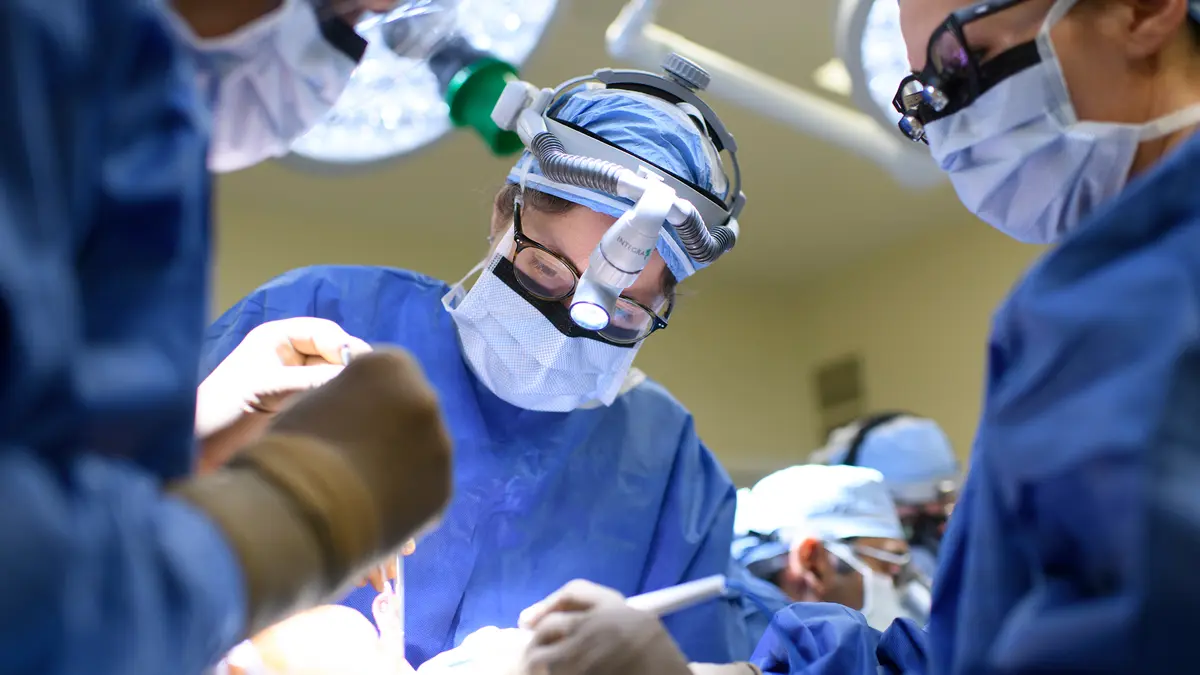
Head and neck surgeon Dr. Jennifer R. Cracchiolo (center) and an MSK surgical team rebuild a patient’s jaw.
Overview of throat cancer surgery
Surgery is the most common treatment for most people with throat cancer, including tonsil and laryngeal. Your surgeon will talk with you about which surgery is best for you, based on the:
- Type of throat cancer
- Stage
- Location of the tumor
- Tumor’s characteristics, including its genetic information
Surgeons may be able to use minimally invasive methods that do less harm to the body. You may recover faster, with fewer side effects. Surgery may sometimes be used along with other therapies.
At MSK, throat cancer surgery and throat reconstruction often are done during the same procedure.
Your surgeon also may remove lymph nodes in your neck. That’s because cancer is already in the lymph nodes or likely to spread there. This procedure lowers the chance the cancer may come back.
Talk with an MSK Care Advisor. We're here 24 hours a day, 7 days a week.
Types of surgery for throat cancer
Transoral robotic surgery (TORS)
TORS is a minimally invasive surgery. TORS treats oropharyngeal cancer and tonsil cancer. TORS uses robotic tools and a 3D camera to remove the tumor from your throat. Learn more about robotic-assisted surgery.
TORS is done through the mouth. Your surgeon will not make incisions (cuts) on the outside of your body.
Benefits of TORS include:
- A faster recovery.
- A shorter hospital stay. Many people need to stay in the hospital for only 1 to 2 days.
- Fewer speech and swallowing side effects.
- You’re less likely to need more treatments, such as radiation or chemotherapy.
MSK surgeons are experts at TORS, and know if you’re more likely to be cured with this surgery.
Transoral laser microsurgery (TLM)
TLM is a minimally invasive way to remove throat cancers. Your surgeon uses a special microscope that helps them to see the tumor more clearly. They use a special laser beam to remove the tumor.
TLM is done through the mouth. Your surgeon will not make incisions (cuts) on the outside of your body.
Benefits of TLM include:
- A faster recovery.
- Treatments often are done in 1 day as an outpatient (outside the hospital) procedure.
- Fewer speech and swallowing side effects.
- You’re less likely to need more treatments, such as radiation or chemotherapy.
MSK surgeons often do TLM for early-stage laryngeal cancer, hypopharyngeal cancer, and oropharyngeal cancer.
Laryngectomy to remove the larynx
Some people with throat cancer may need a laryngectomy. This is an open surgery to remove a part or all of the larynx (your voice box).
Your larynx is in your neck above your trachea (windpipe). It includes your vocal cords. Your larynx helps you to breathe, swallow, and speak.
Partial or total laryngectomy
MSK surgeons can often remove the tumor while taking out only part of the larynx during a laryngectomy. This is called a partial laryngectomy, a surgery that can preserve as much of the larynx as possible. This surgery may be done for smaller tumors.
In some cases, we may need to remove the whole larynx. This is called a total laryngectomy.
Your MSK care team will talk with you about which laryngectomy is best for you. The type of surgery depends on the type of throat cancer you have and its location, size, and stage.

Open surgery for throat cancer
Traditional surgery is often called open surgery. Your surgeon does a single incision (cut) large enough to operate using their tools by hand.
Open surgery can be a good option for people with large tumors or tumors that came back after treatment.
Our head and neck surgeons are very skilled in open surgery. We do many complex operations that are not always possible at other cancer centers.
Side effects of throat cancer and its treatment can cause swallowing and speech trouble. It also can be hard to move your jaw. MSK has a team of experts in rehabilitation, speech pathology, and dental oncology (cancer care). They help you cope with the side effects of treatment.
Minimally invasive throat cancer surgery
MSK surgeons are experts in surgery methods that do less harm to your body. Minimally invasive surgery does less harm to your body because it’s done with small incisions (cuts).
Minimally invasive surgery methods are laser microsurgery and robot-assisted surgery.
At MSK, we use minimally invasive surgery methods for some throat cancer operations.
Benefits of minimally invasive surgery for throat cancer include:
- Less loss of blood.
- A shorter hospital stay.
- A faster recovery.
- Less scarring.
- Less pain.
- Less risk of infection.
- Fewer complications (problems) during and after surgery.
- Less risk than regular surgery for people with other health conditions.
MSK does hundreds of minimally invasive surgeries each year. It’s one of the busiest cancer centers for these procedures.
With robotic-assisted surgery, your surgeon uses the da Vinci® Surgical System. They sit at a console and control a robot that moves the surgical tools. There are hand, finger, and foot controls.
The surgical tools remove areas with cancer.
The console has a special monitor where they can see very clear, 3D images from a special flexible tool inside your throat. Your surgeon can see and remove a tumor. MSK’s operating rooms have the latest technology, including 11 robotic platforms.
MSK has more than 70 head and neck cancer experts. We see more people with rare types of head and neck cancer than many other cancer centers. We’re experts in diagnosing and treating rare salivary gland, mouth, and thyroid cancers. That’s why 1,100 people with rare head and neck cancers come to MSK each year.
Reconstruction after throat cancer surgery
Reconstructive surgery may be needed after a large tumor is removed. Reconstructive surgery helps to rebuild the area and restore how the throat works. Your surgeon will often take tissue and blood vessels from one area of the body to the affected area. This is called a free tissue transfer.
Your surgeon may take tissue from your:
- Arm
- Leg
- Abdomen (belly)
At MSK, throat cancer surgery and throat reconstruction often are done during the same procedure. A reconstructive surgeon will do the reconstruction after your surgeon removes the throat cancer.
Learn more about microvascular reconstruction surgery using free tissue transfer.

Common questions after throat, tonsil, or laryngeal cancer surgery
Throat cancer and its treatment can affect how you talk, eat, and drink.
Our speech therapists help manage side effects including changes in:
- Speech. You may have trouble saying words, or people have trouble understanding what you’re saying.
- How well you can swallow.
- How well your tongue or jaw can move.
Your speech therapist works with physical and occupational therapists to help care for common problems after treatment. They may recommend exercises to improve your range of motion and muscle strength.
Head and neck cancer treatment can affect your digestion (how your body breaks down the food you eat). It can change your taste, how you eat, and how hungry you are.
Our clinical dietitian nutritionists can answer your questions about what you can and should eat. They can help with:
- Planning healthy meals at home.
- Advice about special diets.
- Working around food allergies.
- Managing symptoms such as weight loss or gain.
You may have radiation after surgery for throat cancer. Learn more about getting enough nutrition before, during, and after radiation treatment.
Not everyone feels pain the same way. They also do not have pain or discomfort for the same amount of time. In the first days after surgery, you may still have some pain when you go home. Most often, you’ll be taking pain medicine.
After the first week, the pain often gets much better. Most people can stop taking medicine in 3 to 4 weeks.
Some people can have soreness, tightness, or muscle aches around their incision (cut) for up to 6 months. This does not mean something is wrong. You’ll have less pain and need less pain medicine as your incision heals.
You’ll probably see your head and neck surgeon 7 to 10 days after you leave the hospital. If a reconstructive surgeon was involved in your surgery, you’ll also need to see them.
Based on how you’re healing, they’ll remove some or all of your stitches during your first follow-up visit. You’ll also have a complete head and neck exam.
If your pathology test results are ready, your surgeon will go over them with you during your first follow-up visit. This includes details about the cancer that was removed.
If you had advanced throat cancer, you may need radiation therapy, chemotherapy, or both after surgery.
You’ll fully recover in a few weeks to a few months.
How long it takes to return to your normal life depends on a few things. They include your age and your general health. Recovery time also depends on the type of throat cancer surgery you have.
As you recover:
- The swelling will slowly go away.
- Your face will start to look more natural, and scars will be less noticeable.
- You’ll be able to talk more easily and eat many of the foods you like.
- You’ll have more energy to do the activities you enjoy.
You should see your dentist every 3 to 6 months for cleanings. Talk with your advanced practice provider (APP) before visiting your dentist. They’re part of your MSK care team and can help you talk with your dentist about your care.
You may need special dental care after treatment. MSK's dental oncologists are doctors trained in dental care and cancer. They treat side effects of throat cancer therapy such as:
- Mucositis (myoo-kuh-SIGH-tuhss), or mouth sores.
- Xerostomia (zero-STOW-me-ahh), or dry mouth.
- Tooth decay.
Talk with your APP about your options if you have any throat side effects.
Trismus is also known as lockjaw. It’s when you have trouble opening your mouth all the way.
After surgery or radiation therapy to your head and neck, your jaw may feel tight. Your mouth may be hard to open.
You can do special exercises to help relax your jaw muscles. This will help your mouth and jaw move and work as they did before your treatment.
Learn more about managing trismus after surgery.
