This information explains what a minimal-fat diet is and how to follow it. It also has sample menus.
About a minimal-fat diet
After you eat, the fat from your food travels through your lymphatic (lim-FA-tik) system before entering your bloodstream. Your lymphatic system helps fight infection and drain extra fluid from your body.
Sometimes surgery or an injury can harm your lymphatic system and cause it to leak fluid. This fluid can build up in your abdomen (belly), chest, or neck. When you eat fat, your lymphatic system makes more fluid for the fat to travel through. More fluid means more leaking.
A minimal-fat diet helps by limiting how much total fat you eat. When you eat minimal (very little) fat, your lymphatic system makes less fluid. This gives the leak time to heal.
The goal of a minimal-fat diet is to eat as little fat as possible. Aim to keep your daily fat intake as close to 0 grams as you can. Daily fat intake is the amount of fat you get from everything you eat and drink in a day.
Most people follow a minimal-fat diet for about 2 weeks. Some people may need to stay on this diet longer. Your healthcare provider will tell you when you can go back to your usual diet.
Following a minimal-fat diet for more than 2 weeks
Some people may need to be on a minimal-fat diet for more than 2 weeks. If you do, talk with your healthcare provider or clinical dietitian nutritionist. They may have you take some of the following, so you get enough nutrients while you’re on this diet.
Vitamin and mineral supplements
Vitamin and mineral supplements help fill in nutrition gaps when you’re not able to eat enough or your diet is limited. They come as tablets, capsules (pills), gummies, powders, and liquids. They can be:
- A single vitamin, such as vitamin C, D, or B12.
- A single mineral, such as calcium, iron, or zinc.
- A multivitamin (a mix of both vitamins and minerals).
Ask your healthcare provider or clinical dietitian nutritionist if you need to take any supplements. Do not start taking a supplement before you talk with your healthcare provider or clinical dietitian nutritionist.
You can buy vitamin and mineral supplements at your local supermarket or pharmacy. You also can order them online.
Make sure to read the supplement’s label. Do not take more than the recommended daily amount (RDA) of any vitamin or mineral.
Oral nutrition supplements (nutrition shakes you drink)
Oral nutrition supplements give you extra calories and protein when you’re not hungry or your diet is limited. They come as liquids or powders you can mix with liquids. Examples are Boost Breeze®, Carnation Breakfast Essentials®, Ensure Clear®, or Ensure Max Protein®.
You can buy oral nutrition supplements at your local supermarket or pharmacy. If the store does not have them, ask a pharmacist or store manager to order them for you. You can also order them online.
It’s best to drink oral nutrition supplements between meals. If you drink them with a meal, they can be filling. This keeps you from eating more of your food.
Medium-chain triglycerides (MCTs)
MCTs are a type of fat that your body absorbs (takes in) differently than regular fats. After you eat, the fat from the MCTs goes right into your bloodstream instead of through your lymphatic system.
MCTs help you get extra calories while keeping your daily fat intake low. This can be helpful if:
- You need to stay on a minimal-fat diet for more than 2 weeks.
- It’s hard to get enough calories while you’re on a minimal-fat diet.
Your healthcare provider or clinical dietitian nutritionist may suggest you use an MCT oil while on a minimal-fat diet. You can add it to many foods and drinks, such as salad dressing and coffee.
You can buy MCT oil at your local pharmacy, health food store, or online.
Do not use an MCT oil unless your healthcare provider or clinical dietitian nutritionist tells you to.
Nutrition Facts label
Use this guide to help you choose the best foods and drinks while you’re on a minimal-fat diet. Make sure to check the Nutrition Facts label on packaged foods and drinks (see Figure 1).
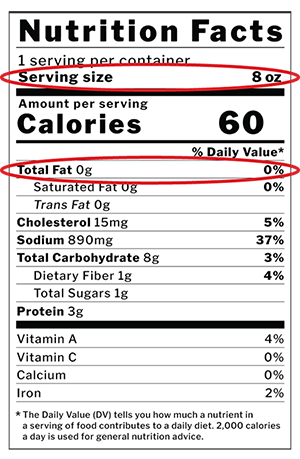
When you read the Nutrition Facts label, pay attention to:
- Serving size. This is the amount of food or drink that the numbers on the Nutrition Facts label are based on. All the calories, fat, protein, and other nutrients listed are for that exact serving size.
- Total fat. This tells you how many grams of fat are in 1 serving of the food or drink. Total fat includes all kinds of fat, such as saturated and trans fats.
Key points of a minimal-fat diet
- Eat foods with as close to 0 grams of fat as possible.
- Do not use any fat (such as butter, margarine, or oil) to cook food.
- Use nonstick pans to stop food from sticking when you cook, instead of oil or butter.
- Use fat-free condiments (such as ketchup and mustard), spices, herbs, garlic, and onions to flavor your food.
Minimal-fat diet guidelines
The tables in this section show what you can and cannot eat or drink on a minimal-fat diet. Items listed under the “Can Eat or Drink” column have 0.5 grams of fat or less in each serving.
Dairy | |
|---|---|
Can Eat or Drink
| Do Not Eat or Drink
|
Meats, Meat Substitutes, and Proteins | |
|---|---|
Can Eat or Drink
| Do Not Eat or Drink
|
Fruits | |
|---|---|
Can Eat or Drink
| Do Not Eat or Drink
|
Vegetables | |
|---|---|
Can Eat or Drink
| Do Not Eat or Drink
|
Breads, Cereals, and Grains | |
|---|---|
Can Eat or Drink
| Do Not Eat or Drink
|
Soups | |
|---|---|
Can Eat or Drink
| Do Not Eat or Drink
|
Drinks | |
|---|---|
Can Eat or Drink
| Do Not Eat or Drink
|
Oral Nutrition Supplements | |
|---|---|
Can Eat or Drink
| Do Not Eat or Drink
|
Desserts, Sweets, and Snacks | |
|---|---|
Can Eat or Drink
| Do Not Eat or Drink
|
Fats | |
|---|---|
Can Eat or Drink
| Do Not Eat or Drink
|
Condiments/Other | |
|---|---|
Can Eat or Drink
| Do Not Eat or Drink
|
Sample menus
Here are 2 sample menus to help give you meal ideas. We did not include portion sizes because everyone’s calorie and protein needs are different. Eat or drink the amounts that work for your own nutrition goals.
These sample menus include Double Milk as a drink option. Double Milk has twice the number of calories and twice the amount of protein as fat-free milk. You can find the recipe for Double Milk after the sample menus.
Menu 1
| Breakfast |
|
| Mid-morning snack |
|
| Lunch |
|
| Afternoon snack |
|
| Dinner |
|
| Evening snack |
|
Menu 2
| Breakfast |
|
| Mid-morning snack |
|
| Lunch |
|
| Afternoon snack |
|
| Dinner |
|
| Evening snack |
|
Double Milk recipe
To make Double Milk:
- Mix 1 quart of fat-free milk with 1 packet of non-fat, dry milk powder. Mix them together well.
- Put the mixture in the refrigerator until you’re ready to use it.
Contact information
If you have questions or concerns, contact your healthcare provider. A member of your care team will answer Monday through Friday, from to Outside those hours, you can leave a message or talk with another MSK provider. There is always a doctor or nurse on call. If you’re not sure how to reach your healthcare provider, call 212-639-2000.
To talk with a clinical dietitian nutritionist, ask a member of your care team for a referral.
Learn about our Health Information Policy.