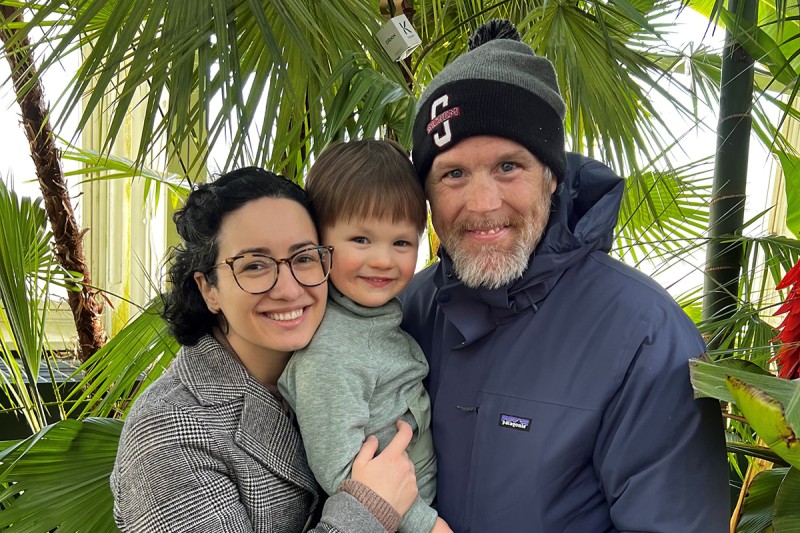
Kevin Tougher never thought a small growth in his nose would threaten his life.
A 39-year-old husband and elementary school principal, he and his wife, Maria, were getting ready to start a family. He discounted the lump as something a local ear, nose, and throat specialist would remove, and that would be it.
To his shock, a biopsy showed the growth was nasal cavity cancer, a rare type of head and neck cancer diagnosed in about 2,000 people annually. Apart from a few nosebleeds, Kevin hadn’t had the usual symptoms, which include congestion, sinus infections, and headaches.
Desperate for answers, Kevin and Maria, who live in Westchester County, New York, called Memorial Sloan Kettering Cancer Center (MSK). Within a week, they were sitting in the office of head and neck surgeon Jennifer Cracchiolo, MD. She explained that removing the tumor would likely mean taking out half to two-thirds of his nose, a procedure called rhinectomy.
“When you first hear you have cancer, your immediate reaction is ‘Just get it out, I don’t care,’ ” Kevin says. “But then you think about having a prosthetic nose at age 39, which nobody wants.”
Then Dr. Cracchiolo gave Kevin and Maria reason to hope: MSK offered a new treatment using radiation and chemotherapy that could shrink the tumor enough to make surgery unnecessary. This approach to nasal cavity cancer that could protect the nose was pioneered by MSK radiation oncologist Nancy Lee, MD, and colleagues.
“It wasn’t experimental or a clinical trial, it was something she showed could be effective against the cancer without me having to lose a huge chunk of my nose,” Kevin says. “To us, it sounded amazing, and we agreed right away.”
MSK study of nasal cavity cancer patients
In a recent study published in JAMA Oncology, Dr. Lee reported positive outcomes in 44 patients with nasal cavity cancer who chose not to have surgery but instead had radiation therapy – given alone or combined with chemotherapy. The findings were very encouraging: 84% of patients did not have the cancer recur in the five years following treatment. Most were able to preserve their nose.
“This is a hugely important for preserving quality of life in our patients,” Dr. Lee says. “We’ve come a long way in improving prosthesis and reconstruction after rhinectomy, but the disfigurement is still a big cause of distress for many people. We’re showing we can effectively control the cancer and let people keep their nose.”
Minimizing treatment for head and neck cancers
To spare patients from unpleasant side effects, Dr. Lee and MSK colleagues in surgery and medical oncology have developed a number of techniques for reducing treatment for head and neck cancers, including:
- Giving much lower doses of radiation for patients with HPV-positive cancers.
- Combination treatments that could allow some head and neck patients to avoid chemotherapy.
- Multiple approaches for throat cancer that can preserve function and appearance.
The treatment journey
Kevin’s treatment began in December 2018 and lasted seven weeks. Five days a week, he traveled from his home in Tarrytown, New York, to an MSK-affiliated facility in New Jersey to receive a type of radiation called proton therapy. (Proton therapy uses charged particles called protons to kill cancer cells. MSK now delivers proton therapy at a state-of-the art facility in Manhattan.)
Every other week, he also received chemotherapy at MSK Basking Ridge, an outpatient center a short drive from the proton facility.
He says the side effects were mainly fatigue and changes to his skin. “My face got red and started peeling like a sunburn,” Kevin says. “I lost my nose hair, beard and oddly, two strips of hair on the back of my head. Everything came back except my sense of smell.”
Life after treatment
The treatment worked. Kevin’s cancer is gone, and he kept his nose. But there was another very big step to take in his recovery.
“We decided to hold off trying for kids when the cancer came,” Kevin says. “Six months after treatment ended, I got a clear scan, and Dr. Lee reassured us it looked good, which gave us the green light to pursue our dream.”
Their son, Theo, is now 3. When Theo was a baby, Kevin’s loss of smell turned out to have a silver lining. “I became the official dirty diaper changer,” he says. This deficiency will come in handy again, as their second child is on the way.
A message of hope
Today, Kevin is seven years cancer free, raising his family, heading the elementary school, and leading an active life full of basketball, hiking, and playing the guitar. He sees his MSK medical team once a year to make sure the cancer hasn’t returned.
“I’m incredibly thankful to Dr. Lee for developing this treatment,” Kevin says, “and to Dr. Cracchiolo for being mindful and knowledgeable enough about the research to say, ‘I could solve this problem with surgery, but I think there’s a better way.’ I was dealing with very difficult news, and suddenly they showed me a brighter future.”
Key Takeaways
- Nasal cavity cancer is a rare type of head and neck cancer.
- Treatment often involves removing part or all of the nose.
- MSK has pioneered an approach that involves giving chemotherapy and radiation to make surgery unnecessary.
- A recent study shows this approach is effective at curing the cancer in many patients.
Funding and Disclosures
The research reported in JAMA Oncology was supported in part by the National Institutes of Health/National Cancer Institute Cancer Center Support Grant (P30 CA008748).
Dr. Lee reports serving as a consultant for Merck, Merck Serono, Nanobiotix, and Galera, and owning LEO SAB, J and J stock options.