Memorial Sloan Kettering Cancer Center (MSK) has always been a neighborhood hospital, focused on caring for New York City residents since welcoming its first patients in Manhattan, in 1887. Over the decades, MSK’s community has expanded to include the surrounding region, with locations on Long Island and in New Jersey and Westchester County.
But every year, thousands of people travel greater distances — from across the country and around the world — in search of hope at MSK. Despite the hardships of leaving home, people come to MSK because of its world-renowned expertise in treating both rare and common cancers. For many, the journey to MSK offers access to treatments that may not be available closer to home or, in some cases, anywhere else in the world.
In 2025, more than 11,000 people traveled from outside the New York City metropolitan area for treatment at MSK. They came from all 50 states and from more than 90 countries, representing every inhabited continent. They came on the recommendation of their local oncologist or were urged by family and friends to seek a second opinion at MSK. Many found their way through their own tenacious research into new treatments that might offer a better, longer life.
For people venturing from far away, MSK tries to make a difficult journey as easy as possible — from helping them to navigate health insurance and find accommodations to providing counseling for patients and their family members. International patients are welcomed through the International Center, where dedicated care navigators guide patients and their families through the complexities of seeking care far from home. Even in a challenging geopolitical climate, the Center is seeing an increase in international patients drawn by MSK’s global reputation as the best in cancer care.
MSK has served its immediate communities for well over a century, while also looking outward — with the goal of expanding access to the highest-quality care and with the singular vision of becoming the world’s leading authority on cancer.
Here are some of the many people who chose to travel to MSK for cancer care in 2025 — and the difference it made in their lives.
Jomar Negrón Torres

For 4-year-old Jomar Negrón Torres, travel to MSK meant access to an urgently needed stem cell transplant that was unavailable at home, in Puerto Rico. Born with a rare and life-threatening blood and bone marrow condition called Diamond Blackfan anemia, Jomar had to endure blood transfusions every two weeks to keep his hemoglobin levels stable — for his family that meant a three-hour drive to the hospital each time, and constant worry and uncertainty.
Jomar was able to travel to MSK for a stem cell transplant, thanks to Salud Sin Barreras, a partnership between MSK Kids and the Department of Pediatrics at Hospital Pediátrico Universitario, the only advanced pediatric hospital in Puerto Rico. At MSK Kids, the program is co-led by María Cancio, MD, Pediatric Hematologist-Oncologist and Bone Marrow Transplant Specialist, and Carmen Castillo, RN, Clinical Associate Director, Patient Financial Services (PFS).
After receiving a stem cell transplant at MSK Kids, Jomar is fully recovered and enjoying the freedom of just being a kid — learning how to ride a bike and playing basketball — and excited to start kindergarten in August. His local healthcare team monitors him monthly in coordination with Dr. Cancio.
“The greatest reward is witnessing a child return home healthy and able to simply embrace the joys of childhood once more,” Dr. Cancio says. “Every patient deserves the chance to benefit from the highest standard of care available globally.”
Judy Wells

For Judy Wells, 70, traveling to MSK from her hometown of Laurel, Mississippi, meant access to a new combined drug therapy that saved her life.
Within days of retiring from a long career in nursing, Judy learned she had a rare kidney cancer called high-grade urothelial carcinoma, which had already metastasized to her lymph nodes and was threatening her spine.
“It didn’t make sense,” says Judy, “I’ve always been healthy and very, very active, so it came out of nowhere.”
Surgery to remove the kidney had already been scheduled at a local hospital, when a friend insisted that Judy first seek a second opinion at MSK.
Within a week, she had an appointment with MSK urologic surgeon A. Ari Hakimi, MD, and genitourinary medical oncologist David H. Aggen, MD, PhD, who proposed that Judy postpone the surgery and switch to a new urothelial carcinoma treatment — an antibody-drug conjugate combined with an immunotherapy drug.
When she returned for follow-up scans a few months later, the results were remarkable — the tumor was gone. To rid the body of any lingering cancer cells, Dr. Hakimi removed Judy’s kidney, the ureter, and part of the bladder in a five-hour procedure. He also removed 50 lymph nodes to check for remaining cancer. There was none.
“I became very close to Dr. Aggen and Dr. Hakimi, and I still am,” Judy says. “I’ve been a nurse for 47 years, and I took care of a lot of patients, a lot of cancer patients. Being on the other side was a horrible feeling. I was so grateful and thankful for the love and care and kindness everyone at MSK showed me.”
Joey Carlsen Martinez

For 35-year-old Joey Carlsen Martinez, traveling to MSK from his home near Seattle meant a radically improved quality of life. Though Joey had already spent 13 years frequently debilitated by mysterious symptoms, no one could identify the cause of his illness until a local eye doctor biopsied a growth in his eye and discovered the genetic mutation that causes Erdheim-Chester disease (ECD), an extremely rare blood cancer.
Under the care of his home state’s only ECD specialist, Joey underwent three rounds of chemotherapy, the standard of treatment. It initially relieved some of his symptoms, but the benefits faded, leaving him with severe side effects. “I was just so incredibly sick,” says Joey. He wasn’t sure he could survive future rounds.
His desperate search for alternatives ultimately led him to MSK neuro-oncologist and early drug development specialist Eli Diamond, MD. When Joey arrived at MSK, he was nearly immobilized by pain and fatigue. He told Dr. Diamond that he wanted more out of life. “I was still bedridden 80% of the day,” he says.
Dr. Diamond proposed a novel targeted drug called ulixertinib — because Joey would be one of the first patients with this family of rare blood disorders to take the drug, Dr. Diamond created a clinical trial of one. Based on the results of that phase 1 clinical trial, which ultimately included five patients, four of whom benefitted, a phase 2 clinical trial is now underway at MSK and two other hospitals.
“Today, I have a mostly normal life,” says Joey, a stay-at-home dad who homeschools his two young daughters. “I still get tired easily, but I go grocery shopping, I cook dinner, and I take care of my family. And because I know how bad things can get, I feel so grateful for everything that I have.”
Annabel Gutherz

For Canadian singer Annabel Gutherz, 25, travel to MSK from her hometown of Montreal meant saving her voice. When a benign thyroid nodule began to develop abnormal cells, her local oncologist recommended surgery to remove one lobe of the butterfly-shaped thyroid gland — a procedure that risked damage to her vocal cords.
But her doctor also recommended that she get a second opinion at MSK. “If you want to go to the best of the best in cancer treatment for a second opinion, MSK is the place to do it,” she recalls him advising. Because thyroid surgery can damage the laryngeal nerves, which control the vocal cords, Annabel felt her future as a singer was hanging in the balance.
Annabel came to MSK to meet with Richard Wong, MD, of MSK’s Head and Neck Service, renowned for their expertise in minimally invasive surgery. Dr. Wong performed a surgical procedure that removed just the small central portion of the thyroid with the suspicious cells. Though this procedure is not commonly done, Dr. Wong told Annabel that the lesion on her thyroid was the right type and in the right place.
“My entire care team held me by the hand through every step of this journey, surrounding me with comfort,” Annabel says, “They always reminded me ‘We are here for you.’ ”
Read more about Annabel’s story.
Jason Weiner

For Jason Weiner, now 54, travel to MSK meant stopping a rare blood cancer called myelofibrosis from becoming full-blown leukemia.
When regular blood work revealed that an underlying condition, which Jason had managed with medication for decades, had progressed to myelofibrosis, he knew he was at greater risk of developing leukemia. “I wanted to stop it right away,” he says.
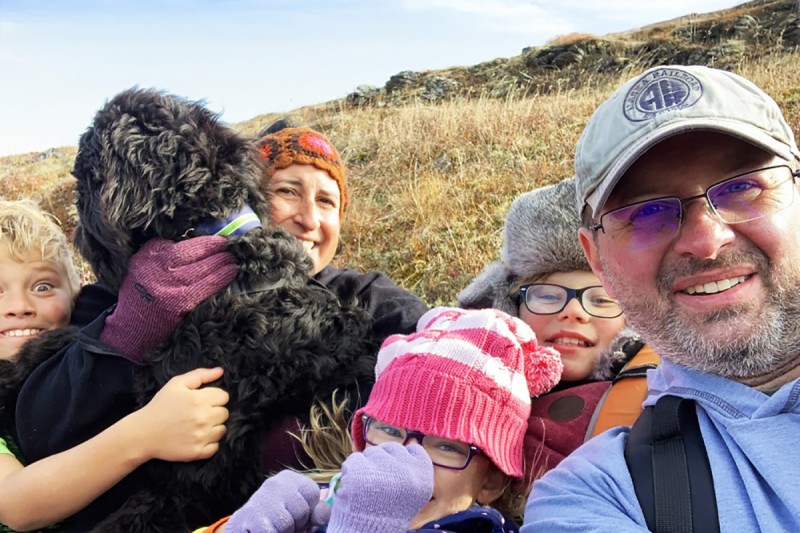
At the time of his diagnosis, Jason, his wife, and their three children were living in Alaska. His own research into the country’s top experts in myelofibrosis led him to leukemia specialists Ross Levine, MD, and Raajit Rampal, MD, PhD, at MSK, where Jason had the opportunity to enroll in a phase 3 clinical trial testing a new drug combination — pelabresib-ruxolitinib — to treat myelofibrosis.
Participating in the clinical trial meant traveling to MSK every few weeks, but the results were significant. “Within three weeks, my spleen, my blood counts, everything in my body normalized,” Jason says. “Because I wasn’t yet very sick when I started, I really gained a lot. I hope this drug will be available to more people earlier in the course of disease.”
Jason and his family recently moved to Maine, where they’ve been able to continue the active lifestyle they enjoyed in Alaska, including skiing. He continues to take the drug combination daily but has no limitations on what he can do. “This treatment really has done wonders,” he says.
Read more about Jason’s story.
Dr. Hakimi’s research is supported by the MSK donor community, including Mr. and Mrs. Thomas Tuttle.
Dr. Diamond’s research is supported by the MSK donor community, including The Applebaum Foundation.
Dr. Wong’s research is supported by the MSK donor community, including The James & Judith K. Dimon Foundation and Leerom and Karolina Segal.
Dr. Wong holds the Jatin P. Shah Chair in Head and Neck Surgery and Oncology.