Signs of throat cancer can include a sore throat, voice changes, trouble swallowing, or a lump in your throat. Throat cancer symptoms depend on the tumor’s location.
You may be reading this because you or someone you care about has learned they have throat cancer. Or maybe you’re curious about your risk of getting throat cancer. This is a good place to start.
It’s important to get to know the signs of throat cancer. Throat cancer can be easier to treat when we catch it early. But at MSK, we have treatment options for throat cancer at every stage, even when it has spread.
This guide is a good place to learn about what causes throat cancer and throat cancer prevention. You can also learn about throat cancer signs and symptoms.
This information can help you get ready to talk with your healthcare provider and understand your next steps.
Throat cancer is a type of head and neck cancer. Throat cancer starts when cells in your throat mutate (change) and grow out of control.
Throat cancer often starts in the:
There are a few types of throat cancer, based on the type of cell where the cancer started. Most are squamous cell carcinoma (SKWAY-mus sel KAR-sih-NOH-muh). Squamous cells are thin, flat cells that line your throat.
Treatment for throat cancer can include surgery, radiation, chemotherapy, immunotherapy, or targeted therapy.
Lymphoma and cancer of the minor salivary glands can also start in the throat. These are much more rare.
Signs of throat cancer can include a sore throat, voice changes, trouble swallowing, or a lump in your throat. Throat cancer symptoms depend on the tumor’s location.
A throat biopsy is the first step in diagnosing throat cancer. This procedure shows if you have throat cancer, the type, and maybe how far it has spread.
Many people have surgery to remove the tumor as part of their treatment for throat cancer. Some people also get other treatments, such as radiation, chemotherapy, immunotherapy, or targeted therapy.
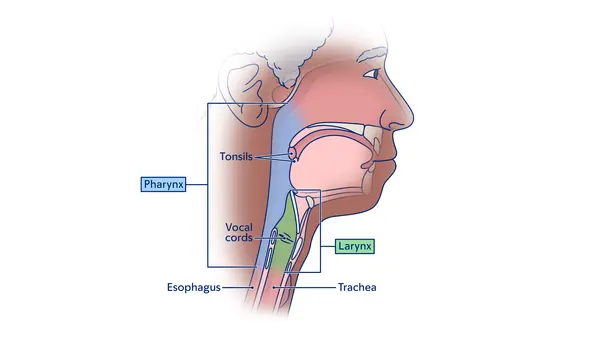
What’s inside your throat? Knowing your throat’s anatomy can help you better understand where throat cancer starts. Anatomy (un-NA-toh-mee) means the parts of a structure, such as the throat.
The throat has 2 main parts: the pharynx (FAYR-inx) and the larynx (LAYR-inx).
The pharynx (throat) is a thin muscular tube that’s about 5 inches long. It goes from the back of your nose and mouth to the trachea (windpipe). Air and food pass through the pharynx.
It has 3 main parts:
The larynx is the part of the throat between the base of the tongue and the windpipe. It’s also called the voice box, because it holds your vocal cords.
Laryngeal cancer can start in any part of the larynx. The larynx has 3 main parts:
Throat cancer can start in either the pharynx or the larynx.
In the pharynx, the most common location is the oropharynx. The main cause of oropharyngeal cancer in the United States is human papillomavirus (HPV).
Tonsil cancer is a type of oropharyngeal cancer that’s become more common.
Laryngeal cancer starts in the larynx. It’s the second most common type of head and neck cancer.
Anatomy of the throat.
The different parts of your pharynx and larynx.
A risk factor is anything that raises your chance of getting a disease, such as cancer. There are some risk factors that you cannot control. These include your age, race, or the genes you were born with.
There are other risk factors you can change. Research shows that having healthy habits can lower your risk for cancer.
A few risk factors can raise your risk for getting throat cancer. Examples are:
Tobacco, including smokeless tobacco, is a main cause of throat cancer. You’re at higher risk for throat cancer if you:
Using tobacco puts chemicals in your mouth that harm cells.
Researchers are studying if vaping (e-cigarettes) is a risk factor for cancer. Vaping may be risky for your health now and when you’re older.
Your chance of getting throat cancer is even higher if you use both tobacco and alcohol. Talk with your healthcare provider about your drinking and smoking habits, now and in the past.
Learn more about cancer and tobacco use.
Alcohol is a main cause of oral cancer. If you drink a lot of alcohol, you’re at higher risk for mouth cancer.
Your chance of getting mouth cancer is even higher if you use both tobacco and alcohol. Talk with your healthcare provider about your drinking and smoking habits, now and in the past.
Researchers aren’t sure why alcohol can cause cancer. They think it harms DNA. For example, your body breaks down the alcohol in drinks into a chemical compound called acetaldehyde. This chemical can make DNA less stable and trigger mutations (changes).
HPV is a common virus. It’s mostly known for causing cervical cancer. HPV can also lead to a type of throat cancer called HPV-positive oropharyngeal cancer.
There are many types of HPV. Some cause warts on the skin, mouth, or genitals and rarely cause cancer. Other types are linked to cancer. The two HPV types most often linked to head and neck cancer are HPV 16, and less often, HPV 18.
Most people with the high-risk types clear the virus on their own. There’s no solid evidence about who will go on to get cancer from HPV 16 or 18.
Our Tobacco Treatment Program has experts who can help you quit smoking. It’s open to people who never had cancer or a disease linked to tobacco. It also welcomes anyone who has cancer, and cancer survivors. Our program offers treatment options to help you quit, such as counseling and medicine.
There are some steps you can take to lower your risk for throat cancer. Research shows that some healthy habits can help prevent throat cancer.
When it comes to alcohol, less is best. Research shows that even 1 to 2 drinks a day can raise risks for some cancers. Alcohol is one of the most preventable causes of cancer, after smoking and being overweight. Learn about the risks of drinking alcohol.
Screening means getting routine tests to find cancer even before you have any signs or symptoms. The goal of regular screening is to find cancer at an early stage, when it’s easier to treat.
Your healthcare provider and dentist should check for signs of throat cancer. They can do this during your regular check-ups each year.
Advanced practice provider Jessica Divanno helps people during head and neck cancer and thyroid cancer survivorship.
There’s no solid scientific evidence about whether screening prevents deaths from head and neck cancer. Researchers are studying this in clinical trials, also known as research studies.
Here are MSK’s latest guidelines for head and neck cancer. They may be different from those of other groups of experts.
If you’re at average risk for head and neck cancer:
If you’re at higher risk for head and neck cancer:
MSK has more than 70 head and neck cancer experts. We see more people with rare types of head and neck cancer than many other cancer centers. We’re experts in diagnosing and treating rare salivary gland, mouth, and thyroid cancers. That’s why 1,100 people with rare head and neck cancers come to MSK each year.
Symptoms of throat cancer depend on the location of the tumor.
Talk with your healthcare provider and dentist if you have any of these throat cancer symptoms:
Early and common symptoms of throat cancer include:
Later-stage symptoms of throat cancer include:
You can get throat cancer even if you do not use tobacco or alcohol. Symptoms can also be caused by other health problems. Talk with your healthcare provider or dentist right away if you notice any of the symptoms above or throat changes.
Our experts are always finding new ways to treat throat cancer and manage side effects. Explore the latest throat cancer news from MSK.
MSK is finding new ways to treat throat cancer and keep your quality of life.