Soft Tissue Sarcoma Clinical Trials and Research

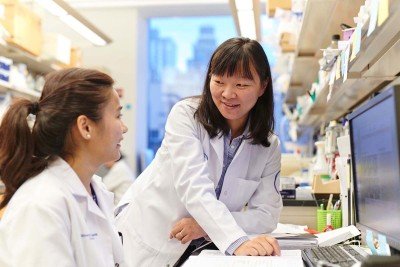
Sarcoma expert Ping Chi meets with research technician Makhzuna Khudoynazarova
Physician-scientist Ping Chi develops clinical trials to personalize treatment for people with sarcoma.

Memorial Sloan Kettering doctors are constantly working to improve treatment for people with soft tissue sarcoma through clinical trials. Participating in a clinical trial may give you access to treatments that are not widely available elsewhere. These studies may offer additional options if the cancer has returned after standard treatment.

Our experts can help determine which clinical trial is right for you. Browse our listing of clinical trials that are currently enrolling new patients.

and/or
19 Clinical Trials found
Researchers want to find the best dose of DCC-3009 to use in people with gastrointestinal stromal tumors (GIST). The people in this study have GIST that has metastasized (spread) after treatment. In addition, their cancers have a mutation (change) in the KIT or PDGFRA gene. These mutations are common in people with GIST and can cause cancer to grow.
Researchers want to find the best dose of DS-2243a to use in people with solid tumors. The people in this study have these solid tumors, which have spread beyond their original location:
In this study, researchers want to see how safe IDRX-42 is and how well it works to treat cancer. The people in this study have gastrointestinal stromal tumor (GIST) that keeps growing after treatment. In addition, their cancer has metastasized (spread) or is inoperable (cannot be taken out with surgery).
Researchers are seeking the best dose of mRNA-4203 to give with a cellular therapy in people with melanoma or sarcoma. The cellular therapy is called IMA203 and is custom-made from each patient's white blood cells.
In this study, researchers are finding the highest dose of MQ710 to use safely in people with certain types of advanced cancer. The people in this study have solid tumors that came back or grew even after treatment. In a later part of the study, the researchers will assess MQ710 plus another drug called pembrolizumab.
Researchers are evaluating PYX-201 in people with solid tumors that have spread and keep growing after treatment. The people in this study have these cancers:
Researchers want to find the best dose of ziftomenib to give with imatinib in people with advanced gastrointestinal stromal tumors (GIST). The people in this study have GIST that keeps growing after treatment.
Researchers want to find the best dose of ADCE-D01 to treat soft tissue sarcoma. In this study, we treat people with soft tissue sarcoma that is inoperable (cannot be surgically removed) or metastasized (spread).
Researchers are assessing a new type of therapy in young people with solid tumors that keep growing even after treatment. The therapy is called afamitresgene autoleucel. The people in this study have synovial sarcoma, malignant peripheral nerve sheath tumor (MPNST), neuroblastoma, or osteosarcoma. In addition, they have tested positive for the HLA-A*02 gene and their cancers make a protein called MAGE-A4. This protein plays a role in cancer growth.
Researchers want to find the best dose of DCC-3116 to give with ripretinib for people with gastrointestinal stromal tumor (GIST). The people in this study have GIST that has spread, even with treatment.