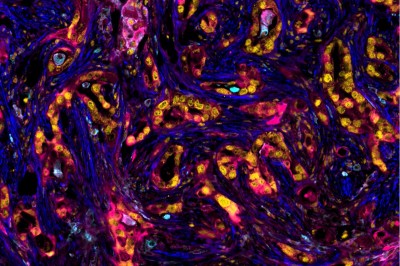
Image credit: Aveline Filliol. Study led by Zeda Zhang (see more Zhang et al., Cell, 2026).
The Geoffrey Beene Cancer Research Center is focused on achieving major advances in controlling cancer and producing better outcomes for cancer patients, with the ultimate goal of making cancer a more manageable, and perhaps one day more curable, disease.
Since its creation in the fall of 2006, the Geoffrey Beene Cancer Research Center has served as the focal point for an array of activities aimed at translating the revolutionary advances researchers have made in understanding how cancer works at the cellular level into new approaches for preventing, diagnosing, and treating the disease. It brings together top researchers and physicians from two complementary programs at Memorial Sloan Kettering Cancer Center: the Cancer Biology and Genetics Program, within the Sloan Kettering Institute (SKI), which is dedicated to the study of the genetic and biochemical events that trigger the transformation of normal cells into cancerous ones, and the Human Oncology and Pathogenesis Program within Memorial Hospital, which is dedicated to the pursuit of new insights into the molecular mechanisms of cancer from the perspective of clinical oncology.