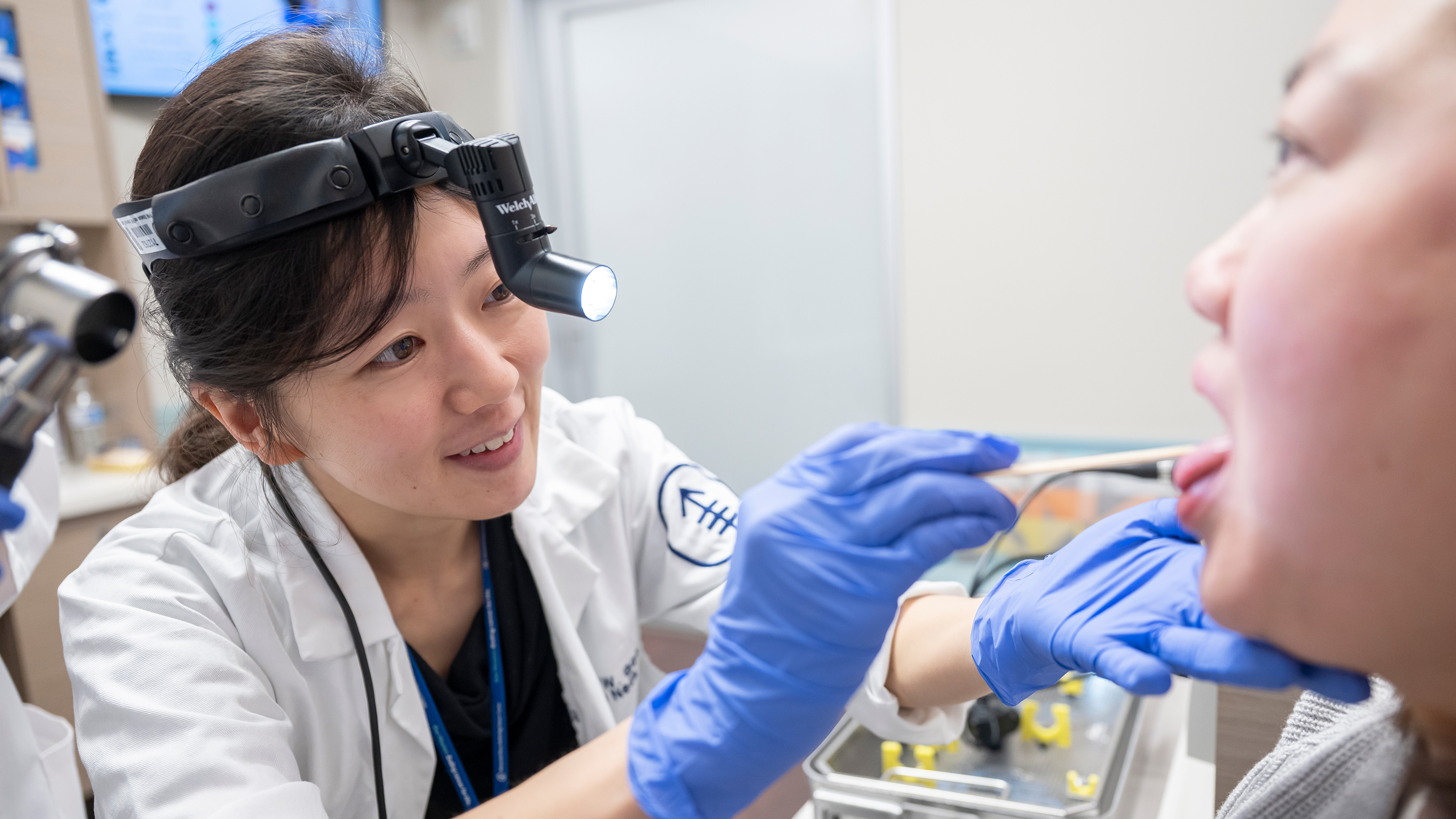
Medical oncologist Dr. Alan L. Ho, Chief of MSK's Head and Neck Oncology Service, wears a medical head lamp as he examines his patient’s mouth.
MSK's Guide To

Tongue Cancer Treatment

Overview of tongue cancer treatment

We know you want excellent treatment results. But not everyone’s goals or priorities are the same. We listen to what matters most to you. Our experts work with you on a care plan that’s best for you.

There are many options for tongue cancer treatment. You may feel overwhelmed as you explore them.  

This guide will help you better understand your options and get ready to talk with your doctors. You’ll have the information you need to make the best decisions for your care together.   

Your care team includes doctors, nurses, and other experts in oral tongue cancer. MSK’s tongue cancer experts will make a treatment plan just for you.  

Your tongue cancer treatment will target the type and stage of tongue cancer you have. It will be based on the latest research and therapies. During your treatment, you may have a few therapies for the best possible results. 

How is tongue cancer treated?

Your MSK care team will talk with you about the best therapies for you. You may have one treatment, or a few treatments together. 

Treatment for tongue cancer can include: 

  • Surgery 
  • Radiation therapy 
  • Chemotherapy 
  • Targeted therapies 
  • Immunotherapy 

We’re experts in treating all types of tongue cancer, including squamous cell tongue cancer. Almost all tongue cancers are squamous cell carcinoma (SKWAY-mus sel KAR-sih-NOH-muh). These cells line your tongue.  

Head and neck surgeon Dr. Marc A. Cohen, wearing surgical gear, in surgery with another care team member.
Surgery

Most people with tongue cancer have surgery to remove the tumor. The type of surgery depends on the type of tongue cancer you have and its location, size, and stage. 

An MSK patient is laying on a machine getting radiation therapy, with 3 people in his care team around him.
Radiation therapy

Radiation therapy uses high-energy X-rays to kill cancer cells. We use radiation therapy after tongue cancer surgery. This lowers the chance the cancer will recur (come back). 

A nurse in scrubs gives immunotherapy treatment to her patient in an MSK infusion suite.
Systemic therapies

Chemotherapy, targeted therapies, and immunotherapy are called systemic therapies. Treatments are given by mouth, intravenous (IV) infusion, or injection (shot). They spread throughout the body to treat cancer.   

How does MSK care for people with tongue cancer?

We care for every person with kindness, warmth, and respect. 

Your care team includes doctors, nurses, and other experts who focus on tongue cancer. Together they use the latest science and research to create your care plan. It will focus on what matters most to you, and the treatment that’s best for your type of tongue cancer. 

To learn which genes are helping a tumor grow, we may do genetic testing on the tumor. This genetic information lets us target your treatment to the type of tongue cancer you have. 

At MSK, we take care of the person, not just the cancer. We offer support and resources to help you and your caregivers, during and after treatment. 

Your care plan may include nutrition advice, physical therapy, exercise, and mental health support. Our rehabilitation experts help you manage the side effects of tongue cancer and its treatments. 

A speech pathologist uses a fiberoptic endoscope to examine her patient’s open mouth.

Speech pathologist Joslynn Kelty is on a team of MSK rehabilitation experts after cancer treatment.  

You’ll get the best possible cancer care at MSK. Your care team has experts in treating the type of tongue cancer you have. We offer:
  • The latest tongue cancer treatments. We’re experts in surgery for cancer in the front of the tongue (tongue cancer) and the tongue base (throat cancer). We focus on removing the tumor and keeping how well you eat, swallow, and speak. 
  • Precise radiation therapy for cancer at the front of the tongue and at the back of the tongue (throat cancer). Our radiation therapy methods can have better results and reduce side effects. 
  • Early access to new drug treatments through our research studies, known as clinical trials. 
  • Speech and swallowing therapy. Our experts manage changes in how well you swallow or say words. 
  • Dental cancer care. Surgery or other treatments may affect your tongue and other parts of your mouth. MSK has experts in dental procedures and in making prosthetics (replacement parts) to repair teeth, the jawbone, or tongue. 
  • Follow-up care. We follow-up on your care after tongue cancer treatment ends. We make sure you’re healing well and managing any side effects. 
MSK RECOMMENDS

It’s important to get enough nutrition before, during, and after head and neck cancer treatment. We have information about how to manage side effects during radiation therapy and chemotherapy. Watch this video to learn how to get enough nutrition during radiation treatment for head and neck cancer. 

Request an appointment

Talk with an MSK Care Advisor. We're here 24 hours a day, 7 days a week. 

Types of tongue cancer treatment

At MSK, all members of your care team will review your case. They’ll talk with you about which tongue cancer treatments are best for you. 

Your care team may offer you a few treatment options. They’re based on your symptoms, any other health issues, and the tongue cancer’s: 

  • Type   
  • Stage, including if it has spread   
  • Location  
  • Genetic information  

We assess all these things and then find the best treatment choice for you. For many people with tongue cancer, surgery is the best option. Your surgeon will talk with you about your options and help you to get ready. They’ll explain what kind of surgery may be best for you. 

Surgery may not be right for you because of your general health or the cancer’s location. We may recommend radiation therapy, chemotherapy, targeted therapies, or immunotherapy. You may have 1 of these treatments, or a few treatments together. 

A seated MSK doctor uses a medical head lamp and gloved hands to examine his patient while another care team member stands behind him, observing.

Head and neck surgeon Dr. Snehal G. Patel and physician assistant Annie Chang treat people with tongue cancer. 

Types of tongue cancer surgery

Surgery is the most common treatment for tongue cancer.  

If you or someone you care about has tongue cancer, we want to help you understand options for surgery. This information can help you get ready for the decisions you and your doctors will make together.  

These are common surgeries to treat tongue cancer and remove the tumor:
  • A glossectomy (glah-SEK-toh-mee) is surgery to remove tumors on the tongue. You may need part, half, or all of the tongue removed. How much your surgeon removes depends on the size of the lesion or tumor. 
  • Partial glossectomy is surgery to remove only part of the tongue. 
  • Hemiglossectomy is surgery to remove one side (half) of the tongue. 
  • A total glossectomy is surgery to remove all of the tongue. 
Surgery to rebuild the tongue

MSK plastic surgeons may rebuild the tongue with a tongue reconstruction procedure called a free flap.  

They’ll take skin and tissues from another part of your body to rebuild the tongue. Surgeons connect the blood vessels and nerves from this tissue to ones in the neck. 

Our speech and swallowing therapy experts will help you manage side effects. These include changes in speech, how well your tongue can move, and how well you can swallow. If you have these changes, we’ll help you get back to normal. 

What is neck dissection surgery?

Head and neck cancer often spreads first to the lymph nodes in the neck. A neck dissection surgery removes lymph nodes that have or may have cancer. Lymph nodes are small, bean-shaped structures that filter out waste products from your lymphatic system. 

The type of neck dissection depends on the tumor’s location. It also depends on whether cancer spread to lymph nodes or other structures in the neck. This includes nerves and blood vessels. We remove the lymph nodes that have or may have cancer. We keep structures that are not affected by cancer.  

Lymph node removal is most often done for cancers that start in the tongue or other parts of the mouth.  

Uncommon diseases like tongue cancer need special expertise. I’ve seen people come to MSK with the wrong diagnosis and treatment recommendation.
Head and neck surgeon Dr. Jennifer Cracchiolo is an expert on treating tongue cancer with surgery.

Radiation therapy for tongue cancer

Radiation therapy uses very precise high-energy beams to kill cancer cells.  

Radiation oncologists are cancer doctors with special training in using radiation to treat cancer. MSK’s tongue cancer radiation therapy team is one of the largest and most experienced in the country. 

MSK’s radiation therapy experts do everything possible to limit healthy tissue’s exposure to radiation. Our goal is to deliver radiation just to the tongue tumor while keeping nearby healthy tissue safe. We use radiation therapy after surgery to lower the chance the cancer will come back. 

Sometimes we can use methods that lower the number of treatments you’ll need. This can raise the chances of controlling and curing the cancer.  

Learn more about the different types of radiation therapy for tongue cancer

We use radiation therapy:   

  • After surgery for tongue cancer, to lower the chance the cancer will come back. 
  • To treat tongue cancer that cannot be removed by surgery. 
  • To treat tongue cancer that comes back after surgery. 

Chemotherapy and other systemic therapies for tongue cancer

Systemic therapies are drugs that travel through the body to kill cancer cells. These therapies for tongue cancer include chemotherapy, targeted therapy, and immunotherapy. 

You may have neoadjuvant (NEE-oh-A-joo-vant) therapy. This is treatment you get before tongue cancer surgery. Neoadjuvant therapy shrinks tumors so they’re easier to remove during surgery.  

You may have adjuvant (A-joo-vunt) therapy, which is treatment you get after tongue cancer surgery. It’s used to kill any cancer cells that may be left in your tongue or the rest of your body. Adjuvant therapy can lower the risk of tongue cancer coming back or spreading. 

Here are some systemic therapies for tongue cancer:  

Chemotherapy

Chemotherapy (chemo) is a treatment that uses medicine to stop or slow cancer cells from growing. Chemo puts medicines that target cancer cells into your vein. Most chemo medicines for tongue cancer can go through a standard intravenous (IV) drip. The medicine travels in your bloodstream to kill cancer cells in the body. 

There are a few kinds of chemo medicines for tongue cancer. Your care team will talk with you about the best options. 

Targeted therapy

Targeted therapies are cancer treatments that target a tumor’s gene changes (mutations or variants). It’s a personal treatment plan just for the type of cancer you have. These medicines often are given by mouth in pill form, or through an IV into your vein. 

Immunotherapy

Immunotherapy is a form of cancer treatment that boosts your immune system’s natural ability to fight cancer. Your immune system will then attack cancer cells, much the same way it attacks bacteria or viruses.  

Most other cancer treatments use drugs or radiation to target cancer cells directly. 

This medicine most often is given through an IV into your vein.  

We’ll test to see if there is a protein called PD-L1 on a tongue cancer cell. This test can help tell us if immunotherapy drugs may be the right treatment for you. 

How tumor genetic testing improves tongue cancer treatment

We may do a tumor genetic test. A tumor genetic profiling test also is called genomic testing, molecular profiling, or next-generation sequencing. The test uses a sample taken from a tumor. We also consider sending blood samples as well, to learn more about the tumor’s genes 

MSK offers genetic testing that looks for the most common mutations linked to tongue cancer. MSK-IMPACT ® is only offered at MSK. It finds genetic changes and other tumor traits that other tests can miss. We routinely test for changes in more than 500 genes. 

Genomic testing tells us which genetic changes (mutations or variants) caused tongue cancer and made it grow. The test results let us target those genes for treatment, a method called targeted therapy. This test is important if the cancer does not respond to surgery and radiation therapy.

MSK Recommends Bring these questions to your next appointment

When you learn you have tongue cancer, you’ll probably have many questions for your cancer doctor at your first visit. Talking about treatment options with your doctors can help you feel confident when making decisions about your care. 

  • What type of tongue cancer do I have, and what stage is it?
  • Did I have all the scans I need to learn the stage?
  • What genetic testing do you offer for tongue cancer?
  • What are the best treatment options for the type and stage of tongue cancer I have?
  • When can I start treatment?
  • Can I get tongue cancer treatment at MSK close to my home?
  • What are the risks and side effects of tongue cancer treatment?
  • Are there new tongue cancer drugs I can try?
  • Do you have a clinical trial that’s right for me?

Tongue cancer clinical trials

Your care team may talk with you about joining a tongue cancer clinical trial.  

Anyone can join a clinical trial from the very start of treatment, if there’s one that’s right for you. 

Researchers follow strict rules to make sure all clinical trials are safe. The MSK research team will answer your questions and help you get ready for the trial. We follow your progress and keep you safe every step of the way. 

MSK strongly encourages people from all races, genders, ages, and backgrounds to join clinical trials. It’s very important for research studies to include people from many backgrounds. It’s how our researchers can learn if a new treatment works for everyone, not just one group of people.  

What is a clinical trial?

Clinical trials are research studies to test new treatments, procedures, or devices to see how well they work. Every cancer treatment given to a person was first tested in a clinical trial.  

Clinical trials can help us learn about new tongue cancer drugs, such as: 

  • What are the ways the drug helps people? 
  • What side effects does the drug cause? 
  • What dose of the drug is safe to give? 
  • How well does the drug treat different types of tongue cancer?  
Video | :51 Why Should I Join a Clinical Trial at MSK?

Medical oncologist Dr. Anna Varghese explains how clinical trials give MSK patients access to the latest cancer treatments and discoveries.

Many patients will ask us, “Why should I participate in a clinical trial?”

The reason I work at a place like Memorial Sloan Kettering is I'm really hopeful clinical trials will help us to learn more how to take better care of you, and many other patients with cancer as well.

As an academic medical center, we have our best scientists and our best researchers, together with our clinical teams and our pharmacists and our nurses and the doctors, all with one focus of trying to provide you with the best care that we can.

Clinical trials often give us access to some of the newest science, and the newest medications, and the newest technologies, that are really at the cutting edge of cancer treatments – and our hope is to bring that to you and to more patients. And clinical trials are the ways that we can do that.

What are the benefits of joining a clinical trial?

If you join a clinical trial, you may be able to try new drugs to treat your type of tongue cancer. Our patients may get a new treatment at MSK years before it’s offered at most other places.  

Here are some ways enrolling in a clinical trial can help you get the best treatment:

Chance to try new treatments 

sometimes years before they’re available to everyone.  

Personal care and support 

from your expert care team.  

No extra cost to you 

for treatments you get during a clinical trial.  

The MSK tongue cancer team

At MSK, your care is always a team effort. Our care teams combine the skill and experience of many kinds of tongue cancer experts. They work together to give you the best cancer treatment. 

An MSK surgeon wears a medical headlamp and uses a tongue depressor to examine her patient’s throat.

Head and neck surgeon Dr. Valeria Silva Merea treats people with voice, airway, and swallowing problems. 

THE MSK DIFFERENCE

MSK has Magnet® designation for our nurses’ excellent patient care, strong leadership, and a culture that values constant improvement. Only about 1 out of every 10 hospitals in the country have Magnet status. It’s one of the highest honors a hospital can earn for nursing excellence.  

What types of MSK experts care for and treat people with tongue cancer?

Your care team has special training in how to diagnose and treat tongue cancer. Their goal is to support you during and after treatment for tongue cancer.  

We take care of the person, not just the cancer. Our social workers are here to help you and your family with the emotional, social, and physical effects of cancer. 

Your care team has doctors, nurses, and other healthcare providers who are experts in tongue cancer. They include: 

  • Maxillofacial, dental, and reconstructive surgeons (plastic surgeons) 
  • Medical oncologists (cancer doctors) 
  • Radiation oncologists (doctors who uses radiation to treat cancer)   
  • Radiologists (doctors who are experts in imaging) 
Video | 1:57 How to Prepare for Your First Appointment at MSK

Medical oncologist Dr. Devika Rao shares tips on what to expect during your first visit at MSK, and how to get ready.

We want to ensure your first visit is as productive and supportive as possible. Here are some tips on how you can best prepare.

  1. Know your medical and family history. Be ready to share your personal medical history and any significant family history of cancer or genetic conditions. This can influence treatment choices.
  2. Write down your questions. You may have many concerns. Bring a written list so we can address them all. Questions might include prognosis, treatment options, side effects, or logistics surrounding treatment. We understand that this is a new journey, so no question is trivial.
  3. Bring a support person. A friend or family member can offer emotional support, take notes, and help remember what is discussed.
  4. Be prepared for a thorough discussion. The first visit will include a detailed conversation about your diagnosis, possible treatment plans, and next steps. It may also include additional lab work or imaging. We are here to help you through every step of this process, and we’ll work together to create a care plan that fits your needs and goals.

Your team meets with a panel of experts who review and talk about your diagnosis. They discuss new ideas and the latest research. This expert panel then works together to choose your treatment plan.

Meet MSK’s tongue cancer experts 

Head and neck surgeon

A head and neck surgeon is a doctor with special training in surgery on the head and neck. This includes cancers of the tonsils, tongue, mouth, lips, larynx, nose, sinuses, salivary glands, and thyroid gland. 

Meet the team 

Radiation oncologist

A radiation oncologist is a cancer doctor with special training in using radiation therapy (RT) to treat cancer. 

Meet the team 

Head and neck medical oncologist

A head and neck medical oncologist is a cancer doctor who specializes in head and neck cancers. This includes cancers of the tonsils, tongue, mouth, lips, larynx, nose, sinuses, salivary glands, and thyroid gland.  

Meet the team 

Endocrinologist

An endocrinologist (EN-doh-krih-NAH-loh-jist) is a doctor with special training in endocrine problems. These disorders affect glands and organs that make hormones. They include diabetes, infertility, and thyroid, adrenal, and pituitary gland problems. 

Meet the team 

Dental oncologist

A dental oncologist is a general dentist with special training in managing oral problems from cancer, treating cancer, or both. 

Meet the team

Maxillofacial (face, jaw, and mouth) prosthodontist

A maxillofacial (max-ill-o-FAY-shul) prosthodontist (pros-thoh-DON-tist) has special training in treating problems of the face, jaw, and nearby soft tissue. They’re trained in making a prothesis (pros-THEE-sis), an artificial (man-made) piece that replaces a body part. It’s also called a prosthetic. 

Meet the team 

Oral and maxillofacial (face, jaw, and mouth) surgeon

An oral and maxillofacial (max-ill-o-FAY-shul) surgeon is a doctor with special training in treating many problems and injuries that affect the head, neck, mouth, jaw, and face. 

Meet the team 

Neurosurgeon 

A neurosurgeon is a doctor with special training in surgery on the central nervous system (brain, spinal cord or spine, and nerves). 

Meet the team 

Plastic and reconstructive surgeon

A plastic and reconstructive surgeon is a doctor with special training in cosmetic and reconstructive surgery. These procedures restore function and appearance. 

Meet the team 

Radiologist

A radiologist is a doctor with special training in using imaging to diagnose and treat disease. Imaging includes X-rays, sonography, ultrasound (US), computed tomography (CT), and magnetic resonance imaging (MRI).  

Meet the team 

Pathologist

A pathologist is a doctor who uses a microscope to make a diagnosis from cell and tissue samples. They analyze the samples to learn more about a health condition, such as cancer. 

Meet the team 

Social worker

A social worker is a healthcare provider with special training in helping people cope with problems in their lives. They support you emotionally by providing counseling and practical help. 

Meet the team 

I felt comfortable the entire time I was at MSK, from the moment I walked in the door, because of the atmosphere and the way they treat you. It’s very professional and empathetic. They really take care of everything you need.
After shrinking most of Charles Provenzano’s tumor, MSK doctors saved almost all of his tongue.
MSK Difference Our approach to care

If you have cancer, you need a team of experts who cares for you with kindness and respect.   

1 / 4
We want to get to know what’s important to you

You have cancer, but that does not define who you are as a person. We know you want to get back to the life you had before cancer treatment. At MSK, we listen. We’re here to support what matters most to you. 

We’ll make a personal plan just for you

Your care team builds a treatment plan just for you. It’s based on your age, risk factors, health, and preferences. 

Your treatment plan will describe therapies and services during and after treatment. We’ll make sure your plan provides excellent cancer care that fits your personal needs. 

We’re a team that works together on your care

Our Care Advisors match you with a team of doctors and other healthcare providers. Your team can include experts in rehabilitation, integrative medicine, or social work. Everyone works together to give you the support you need. 

We offer support to you and your loved ones

Our care goes far beyond cancer care. At MSK, we have experts who help improve your total health. For example, we have programs for pain management and help to quit smoking. Our Caregivers Clinic offers counseling to support your whole family. 

Tongue cancer support services and programs

A social worker sits in a chair taking notes as she smiles and talks with her patient at MSK in Manhattan.

Clinical social worker Alyssa Gallardo supports MSK patients during and after cancer treatment.   

How does MSK support people with tongue cancer?

Cancer treatment affects your body and emotions. The experience is not the same for everyone. We’ll support you during your treatment. 

But you’re also a person with a life beyond cancer. We want to help you get back to it. That’s why we have many programs and services to support you and your loved ones. 

You can connect with other people going through cancer treatment in our virtual support groups, led by a social worker.  

Or, you may need help with side effects of treatment. We have experts with special training in treating pain.  Our dental and rehabilitation experts also can keep your mouth working as it should, for eating, swallowing, and speaking. 

Your caregivers are a very important part of your care team. They need support, too. We have a Caregivers Clinic to help your loved ones cope with cancer.  

THE MSK DIFFERENCE

Many people prefer to get cancer treatment closer to home. MSK provides excellent cancer care on Long Island and in locations in Westchester County, New Jersey, and New York City. You can meet with your surgeon and have chemotherapy, radiation therapy, and genetic testing.  

Ways we support you

Tongue cancer and its treatment can change the way you speak and swallow. Our speech therapists help manage side effects including changes in: 

  • Speech. You may have trouble saying words, or people have trouble understanding what you’re saying. 
  • How well you can swallow.  
  • How well your tongue or jaw can move. 

Our rehab experts work with you after your diagnosis and for as long as needed. They make a treatment plan just for you.  

Our  Integrative Medicine and Wellness Service offers complementary, natural, and holistic treatments. They include  acupuncture, meditation, massage therapy, yoga, and exercise.    

You may want support to cope with side effects of treatment. These may include pain, fatigue (feeling very tired), nerve problems, nausea, insomnia, and stress.   

Without using prescription drugs,  integrative therapies  can help improve and control side effects of cancer treatment.  

MSK integrative medicine services are available in New York City, New Jersey, Westchester, and on Long Island. 

Pain management is an important part of cancer care. MSK was the first cancer center in the country to have a service just for  treating pain  in people with cancer. 

Our pain experts will help relieve or manage pain after surgery. They can help while you’re still in the hospital, and after you’re home. 

We have experts who manage the symptoms and side effects of cancer treatment, such as  nausea during chemotherapy. 

We offer  counseling and support  to help you  manage anxiety,  depression, anger, or loneliness. There are individual and group counseling sessions, both in person and through  telemedicine visits. Counseling is open to you and your family, separately or together. 

We also run  support groups and programs  if you want to talk with other people going through a similar experience. Our  social workers  can offer information about how to talk about your diagnosis with family members, work colleagues, and friends.  

Cancer treatment can affect your digestion (how your body breaks down the food you eat). It can change your taste, how you eat, and how hungry you are.  

 Our clinical dietitian nutritionists can help with:  

  • Planning healthy meals at home.  
  • Advice about special diets.  
  • Dealing with food allergies.  
  • Managing symptoms such as weight loss or gain, and loss of appetite (not feeling hungry).  
  • Eating healthy to help recovery. 

It’s never too late to quit smoking and using tobacco. Using tobacco products is a main cause of tongue cancer.  

Our Tobacco Treatment Program has experts who can help you quit smoking. It’s open to people who never had cancer or a disease linked to tobacco.  

It also welcomes anyone who has cancer, and cancer survivors. Our program offers treatment options to help you quit, such as counseling and medicine. 

THE MSK DIFFERENCE

MSK is a place where people of all genders and sexual orientations feel welcome and treated with respect. Our LGBTQI+ Cancer Care Program gives you the support you need during cancer care. It’s for LGBTQI+ people getting screened or treated at MSK, or in our survivorship program.  

MSK’s treatment locations

We believe cancer care needs to be as convenient as possible. We have tongue cancer treatment locations in New York City, Westchester, on Long Island, and in New Jersey. 

At our locations, you can meet with your care team and get your tongue cancer treatment. You may be able to have chemotherapy or radiation therapy, or join a clinical trial. 

MSK brings its expert care closer to you so you can get back home to what matters most.  

Expert cancer care where you need it

Many of MSK’s tongue cancer treatments and services are available at locations across New York and New Jersey.

We’ll guide you about where you can go for check-ups, procedures, or treatments, based on your diagnosis and treatments.