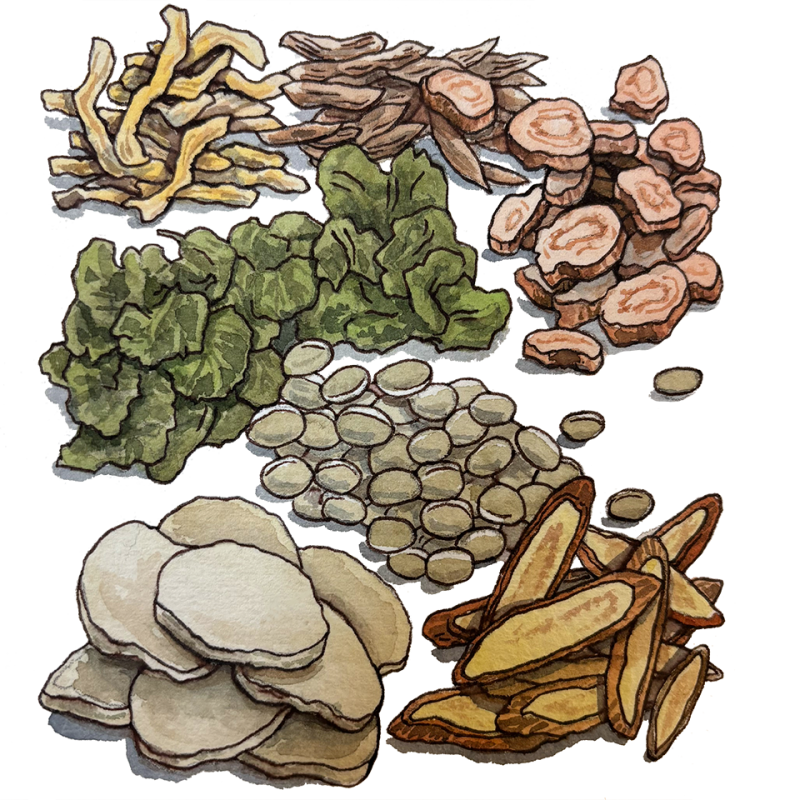
Sha Shen Mai Men Dong Tang

Purported Benefits, Side Effects & More
Sha Shen Mai Men Dong Tang

Common Names

  • Sha Shen Mai Dong Tang
  • Sha Shen Mai Dong decoction
  • Glehnia and Ophiopogon Decoction
  • Bakumondoto (TJ-29)

For Patients & Caregivers

Tell your healthcare providers about any dietary supplements you’re taking, such as herbs, vitamins, minerals, and natural or home remedies. This will help them manage your care and keep you safe.


Sha Shen Mai Men Dong Tang (SMT) is a traditional Chinese medicine (TCM) formula. It’s made up of seven different herbs.

Sha Shen Mai Men Dong Tang is used to treat:

  • Dry cough
  • Dry mouth

Talk with your healthcare providers before taking herbal formulas. They can interact with some medications and affect how they work. For more information, read the “What else do I need to know?” section below.

Side effects have not been reported.

For Healthcare Professionals

Sha Shen Mai Men Dong Tang (SMT) is a traditional Chinese medicine formula documented in the classic text Wen Bing Tiao Bian. Historically used to relieve dry cough and dry mouth, it consists of seven different herbs: Glehnia littoralis (Sha Shen or Bei Sha Shen), Ophiopogon japonicus (Mai Dong or Mai Men Dong), Polygonatum odorati (Yu Zhu), Mulberry leaf (Sang Ye), Trichosanthes root (Tian Hua Fen), Hyacinth bean (Bian Dou or Sheng Bian Dou), and licorice (Gan Cao).

Limited clinical data suggest SMT helps manage symptoms in lung cancer patients with cachexia (1) and in pediatric patients with mycoplasma pneumonia (2). Its use has also been associated with improvements in inflammatory and cardiac biomarkers in patients with COVID-19 (3).

Additionally, Sha Shen Mai Dong Gan Lu Yin, a modified SMT formula, was reported useful in controlling symptoms of primary Sjögren’s syndrome (8).

Future trials with large sample sizes and robust methodology are needed to confirm the therapeutic potential of SMT.

  • Dry cough
  • Dry mouth

Pharmacological studies revealed several bioactive components in SMT including quercetin, kaempferol, β-sitosterol, and steroidal saponins, with known immunomodulatory and anti-inflammatory properties (4) (6).

In murine models, SMT was shown to downregulate the Notch pathway and decrease terminally differentiated CD8 T-cells, resulting in improved inflammatory profiles and enhanced effector function in T-cells (9). This formula also affected significant reductions in serum levels of  interleukins IL-6, IL-1β, and tumor necrosis factor TNF-α in models of bronchitis, lung cancer and pulmonary fibrosis (6) (7) (13).

Potential mechanisms underlying SMT’s effects on Sjogren’s syndrome include regulation of Ras and cAMP-related signaling pathways; and immune function via its effects on macrophage differentiation, Toll-like receptor 4 signaling pathway and T-helper 1 cells   (5).

Adverse reactions have not been reported.

None known.

  1. He M, Luo Y, Chen L, et al. Shashen maidong decoction: the effect of TNF-α and IL-6 on lung cancer cachexia based on cancer toxicity theory. Am J Transl Res. 2021;13(6):6752-6758.
  2. Wang J, Ma X, Wei S, et al. Clinical Efficacy and Safety of Shashen Maidong Decoction in the Treatment of Pediatric Mycoplasma Pneumonia: A Systematic Review and Meta-Analysis. Front Pharmacol. 2021 Oct 12;12:765656.
  3. Lin XX, Yin YQ, Zhang WZ, et al. The Efficacy and Safety of Shashen-Maidong Decoction Combined with Western Medicine in the Treatment of Omicron Infected Individuals Over 85 Years Old: A Retrospective Study. Infect Drug Resist. 2023 Nov 28;16:7339-7348.
  4. Yang Y, Zhou Y. Shashen-Maidong decoction–mediated IFN-γ and IL-4 on the regulation of Th1/Th2 imbalance in RP rats. BioMed Res Int. 2019;2019:6012473.
  5. Jiang Y, Zhao X, Yu J, et al. Deciphering potential pharmacological mechanism of Sha-Shen-Mai-Dong decoction on primary Sjogren’s syndrome. BMC Complement Med Ther. 2021 Mar 1;21(1):79.
  6. Zhou W, Hu Y, Qiu Y, et al. Shashen Maidong Decoction’s Effects on Chronic Bronchitis: A Multi-Method Approach. Curr Pharm Des. 2025;31(38):3074-3089.
  7. Zheng Y, Yang S, Si J, et al. Shashen-Maidong Decoction inhibited cancer growth under intermittent hypoxia conditions by suppressing oxidative stress and inflammation. J Ethnopharmacol. 2022 Dec 5;299:115654.
  8. Zhang Y, Li Y, Ma R, et al. Clinical effect of Shashen Maidong Ganlu Yin in the treatment of radiation-induced dry mouth syndrome. China Modern Medicine. 2025;32(13).
  9. Xie YQ, Yan FN, Yu L, et al.  Mechanism of Shashen-Maidong herb pair in treating hepatocellular carcinoma using network pharmacology and experimental validation. J Ethnopharmacol. 2025 Jan 30;337(Pt 3):118954.
  10. Duan Q, Wang M, Cui Z, Li R, Ma J. Mechanism of Shashen Maidong Decoction in the Treatment of Radiation Pneumonitis Based on Network Pharmacology and Molecular Docking. Curr Pharm Des. 2025;31(40):3219-3233.
  11. Pan Y, Wei L, Liu H, et al. Exploring the role of diosgenin in modulating RUNX1 and HIPK2 transcription to mitigate Primary Sjögren’s Syndrome. Immunobiology. 2025 May;230(3):152910.
  12. Zhao Y, Yang S, Guo Q, et al. Shashen-Maidong Decoction improved chronic intermittent hypoxia-induced cognitive impairment through regulating glutamatergic signaling pathway. J Ethnopharmacol. 2021 Jun 28;274:114040.
  13. Huang L, Yang X, Feng Y, et al. ShaShen-MaiDong decoction attenuates bleomycin-induced pulmonary fibrosis by inhibiting TGF-β/smad3, AKT/MAPK, and YAP/TAZ pathways. J Ethnopharmacol. 2025 Jan 30;337(Pt 1):118755.
Email your questions and comments to [email protected].

Last Updated