
Surgery
Many people with rectal cancer have surgery to remove the cancer. The type of surgery depends on the type of rectal cancer, its location, and its stage.

There are many options for rectal cancer treatment. You may feel overwhelmed as you explore them.
This guide will help you better understand your options and get ready to talk with your doctors. You’ll have the information you need to make the best decisions for your care together.
Your care team includes doctors, nurses, and other experts in cancer that starts in the rectum. MSK’s rectal cancer experts will make a treatment plan just for you. Your personal rectal cancer treatment plan will target the type and stage of rectal cancer you have. It will be based on the latest research and therapies. During your treatment, you may have a few therapies for the best possible results.
Your MSK care team will talk with you about the best therapies for you. You may have one treatment, or a few treatments together.
Treatment is based on the stage of rectal cancer. Early-stage 1 and 2 rectal cancers may need fewer treatments than late-stage 3 or 4 cancers.
We test people with rectal cancer using MSK-IMPACT®. It’s only offered at MSK. It tests the tumor for the most common changes (mutations and variants) linked to rectal cancer.
Most other hospitals do not offer genetic testing as the standard of care. At MSK, the more we know about the tumor, the better we can offer targeted treatments to kill the cancer.
Treatment for rectal cancer can include:
Many people with rectal cancer have surgery to remove the cancer. The type of surgery depends on the type of rectal cancer, its location, and its stage.

Chemotherapy, targeted therapies, and immunotherapy are called systemic therapies. Treatments are given by pill or liquid, intravenous (IV) infusion, or injection (shot). They spread throughout the body to treat cancer.

Radiation therapy uses high-energy X-rays to kill cancer cells. We use radiation therapy to treat people for types of rectal cancer.
We care for every person with rectal cancer with kindness, warmth, and respect.
Your care team includes doctors, nurses, and other experts who focus on rectal cancer. Together they use the latest science and research to create your care plan. It will focus on what matters most to you, and the treatment that’s best for your type of rectal cancer.
To better understand what’s causing the tumor to grow, we may do genetic testing. This genetic information could help us offer a targeted treatment for the type of rectal cancer you have.
At MSK, we take care of the person, not just the cancer. We offer support and resources to help you and your caregivers, during and after treatment.
Your care plan may include nutrition advice, physical therapy, exercise, and mental health support. Our rehabilitation experts help you manage the side effects of rectal cancer and its treatment.

Molecular test development manager Tessara Baldi is an expert in processing test samples.
At MSK, doctors treat cancer while centering each patient’s life, goals, and what matters most beyond their diagnosis.
Whenever I see a patient in the clinic, it's really important to get a full sense of what their life is like. Who's important to them in their family? What are their goals? What do they want to achieve? And I try to make their cancer treatments fulfill those goals, as well as tackle their unique disease.
Because we have a research background, we have pretty good sense of what drugs to use and how to anticipate changes with their disease over time. But the really important thing for me is also how to make their life fun and worth living, and fulfill some of their goals that they have – to try and make this cancer not be the first thing in their life, but fade into the background so they can enjoy being around their friends and their family.
MSK's Center for Young Onset Colorectal and Gastrointestinal Cancer is the first program of its kind. Our treatment experts work together to care for the needs of young adults with these cancers. We also offer mental health counseling, fertility and sexual health medicine, nutrition, and more.
Talk with an MSK Care Advisor. We're here 24 hours a day, 7 days a week.
At MSK, all members of your care team will review your case. They’ll talk with you about which treatments are best for you.
Your care team may offer you a few treatment options. They’re based on your symptoms, any other health issues, and the rectal cancer’s:
We assess all these things and then find the best treatment choice for you.
We have treatments for early-stage rectal cancers. These are stage 1 rectal cancer treatments or stage 2 rectal cancer treatments.
We offer treatments for later-stage or advanced rectal cancers. These are stage 3 rectal cancer treatments or stage 4 rectal cancer treatments. Stage 4 rectal cancer is also called metastatic cancer.
When rectal cancer is found early, it’s often just an abnormal (not normal) growth on the inside lining of the colon. This is called a polyp. The early-stage rectal cancer may just be in the polyp.
Removing a polyp during a colonoscopy may be enough to cure the cancer. Sometimes the rectal cancer cannot be removed during a colonoscopy. Based on the tumor type, you may have other treatments, such as:
For later-stage or advanced rectal cancer, there are stage 3 or stage 4 rectal cancer treatments, and metastatic cancer treatments.
Treatment may include surgery, chemotherapy, and other therapies, based on the tumor type and the cancer’s location.
Stage 3 or stage 4 rectal cancer may have spread through the rectum. If so, you may have:
You may have 1 or more of these treatments, sometimes at the same time.

MSK colorectal surgeon Dr. Garrett Nash (center) is an expert at treating rectal cancer with surgery.
Surgery is the most common treatment for rectal cancer.
If you or someone you care about has rectal cancer, we want to help you understand options for surgery. This information can help you get ready for the decisions you and your doctors will make together.
Your surgeon will explain what kind of surgery may be best for you, based on the:
Surgeons may be able to use minimally invasive methods that do less harm to the body and improve recovery. Surgery may sometimes be used along with other therapies.
Learn more about the types of rectal cancer surgery.
MSK leads the nation in doing the most colorectal robotic surgeries. Our surgical skills with this technology come from many years of experience. MSK surgeons do more than 700 robot-assisted colorectal surgeries each year. Almost half of our surgeries for colorectal cancer are done robotically.
Systemic therapies are drugs, such as chemotherapy, that travel through the body to kill cancer cells.
You may have neoadjuvant (NEE-oh-A-joo-vant) therapy, which is treatment you get before rectal cancer surgery. Neoadjuvant therapy shrinks tumors so they’re easier to remove during surgery.
Total neoadjuvant therapy uses chemotherapy along with radiation therapy to shrink tumors before surgery.
You may have adjuvant (A-joo-vunt) therapy, which is treatment you get after rectal cancer surgery. It’s used to kill any cancer cells that may be left in your rectum or the rest of your body.
Adjuvant therapy can lower the risk of rectal cancer coming back or spreading.
Here are systemic therapies for rectal cancer:
Chemotherapy (chemo) is a treatment that uses medicine to stop or slow cancer cells from growing. Chemo puts medicines that target cancer cells into your vein. Most chemo medicines for rectal cancer can go through a standard intravenous (IV) drip. The medicine travels in your bloodstream to kill cancer cells in the body.
There are many kinds of chemo medicines for rectal cancer. Your care team will talk with you about the best options.
Targeted therapies are cancer treatments that target a tumor’s gene changes (mutations or variants). It’s a personal treatment plan just for the type of cancer you have. These medicines often are given by mouth in pill form, or through an IV into your vein.
Immunotherapy is a cancer treatment that boosts your immune system’s natural ability to fight cancer. Your immune system attacks cancer cells, much the same way it attacks bacteria or viruses.
Most other cancer treatments use drugs or radiation to target cancer cells directly.
This medicine most often is given through an IV into your vein.
When you learn you have rectal cancer, you’ll probably have many questions for your cancer doctor at your first visit. Talking about treatment options with your doctors can help you feel confident when making decisions about your care.
Radiation therapy uses high-energy X-rays to kill cancer cells. We use radiation therapy to treat people for a few types of rectal cancer.
Radiation therapy most often is used to shrink a tumor. It’s done before surgery, or to keep rectal cancer from coming back after surgery.
Some people have radiation instead of surgery. Surgery may not be right for them, because of their general health or other reasons.
Radiation therapy also can help with the symptoms of rectal cancer, such as pain. When advanced rectal cancer has spread, radiation therapy can also help if there is a blockage in the intestines. A blockage prevents food from passing through.
Learn more about radiation therapy for rectal cancer.
MSK helped pioneer watch-and-wait therapy to treat rectal cancer through long-term monitoring. About half of our patients with rectal cancer avoid surgery to have their rectums removed. People come to MSK to get a second opinion about surgery to remove the rectum.
MSK offers an online clinical prediction tool called a nomogram. This tool can help predict the result of cancer treatment at MSK. Nomograms can help you and your doctor make decisions about treatment and your follow-up care.
These nomograms are hard to use and understand without help from your doctor. You need information from your treatment, including your diagnosis and treatment details.
If you’re a patient or caregiver, we strongly recommend you use the nomogram together with your doctor.
MSK treats many people with rectal cancer, so we have a lot of data (facts) about treatment results. The predictions from MSK’s nomograms are based on this information.
Our rectal cancer nomograms are for people who had rectal cancer that did not spread. Before your treatment, or at the time of your treatment, there was no sign of:
Your doctor will help choose which nomogram is best for you, based on the treatment you had.
Use the nomogram Disease-Free Probability and Overall Survival After Treatment for Rectal Cancer
This nomogram predicts the chance you’ll:
This predicts the chance you’ll survive free of rectal cancer 5 years after total neoadjuvant (NEE-oh-A-juh-vunt) therapy. This is treatment you have before surgery.
To use this nomogram, you must have had total neoadjuvant therapy and 1 of these treatments:
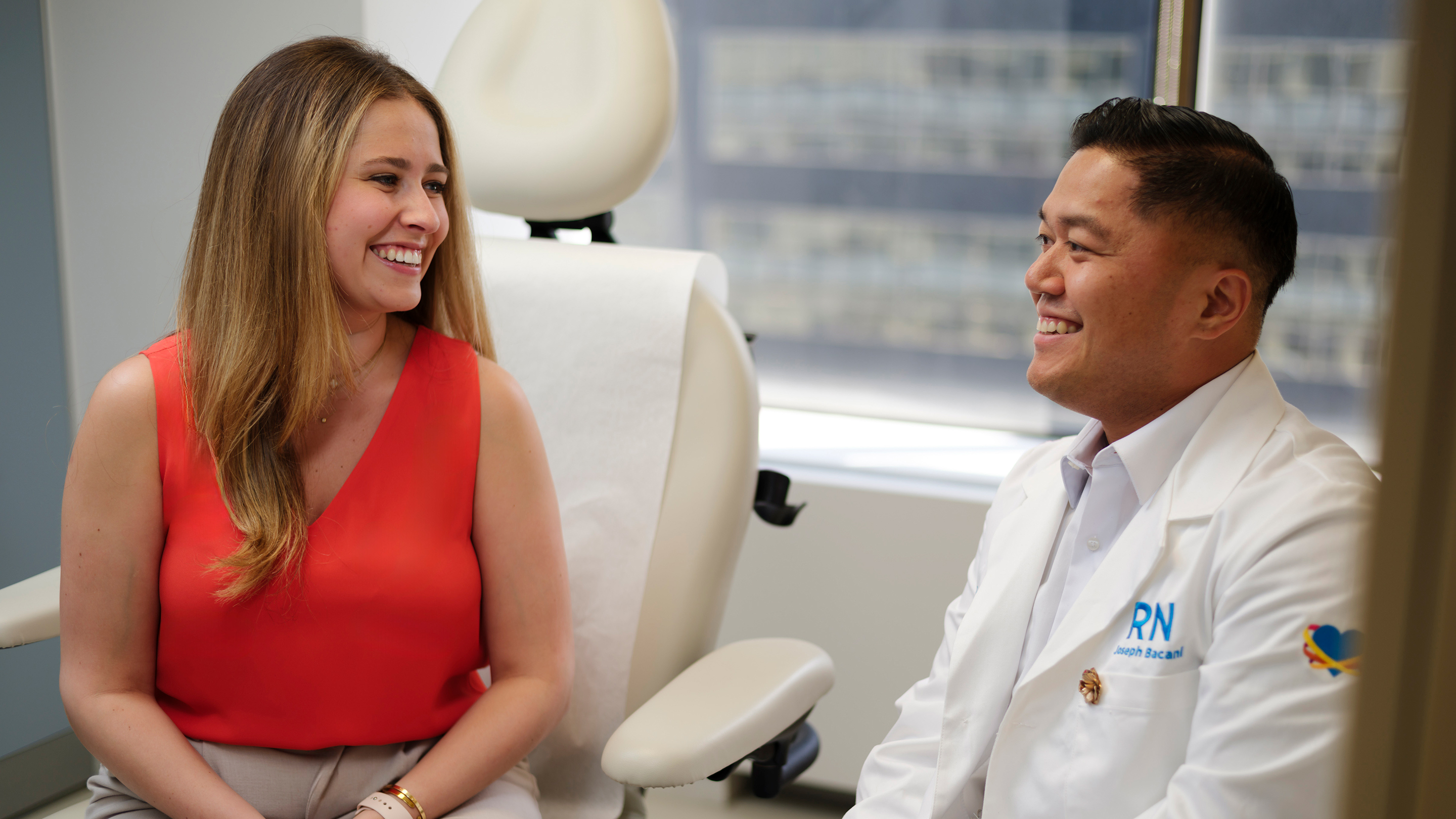
The health of your body and mind matter to us after treatment, too. MSK's follow-up care and support programs help you and your loved ones cope with cancer.
Rectal cancer most often spreads to the liver because the rectum’s blood supply links to the liver through a large blood vessel.
Metastatic rectal cancer treatment options include:
Surgery for rectal and liver tumors: We often can remove tumors in both the rectum and the liver during the same surgery. You may have chemotherapy and radiation therapy to shrink tumors before surgery. MSK surgeons operate on hundreds of people with liver metastasis each year.
Chemotherapy: Rectal cancer chemo often is done before or after surgery, or with other treatments.
Targeted therapies attack certain genes and proteins in cancer cells. Targeted therapies for advanced rectal cancer may attack the proteins VEGF or EGFR.
Immunotherapy uses your body’s own immune system to attack rectal cancer cells. Immunotherapy for rectal cancer has shown promising results.
Interventional radiology: Interventional radiology (IN-ter-VEN-shun-al) treats rectal cancer that has spread to the liver. It uses very focused energy to shrink or kill tumors. These procedures can be done before or after surgery, or instead of surgery.
Metastasis (meh-TAS-tuh-sis) means cancer cells have spread from where they first started to other places. It’s also called late-stage rectal cancer, advanced rectal cancer, or stage 4 rectal cancer.
Your treatment options depend on a few things, such as which other organs it spread to.
Rectal cancer most often spreads to the liver. It also can spread to the lungs, the lining of the abdomen (belly), the ovaries, the brain, or other organs.
Rectal cancer that has spread to other organs often needs a few different treatments. They include:
You also may be able to join a clinical trial for advanced rectal cancer.
Your care team may talk with you about joining a rectal cancer clinical trial.
Anyone can enroll in a clinical trial from the very start of treatment, if there’s one that’s right for you.
Researchers follow strict rules to make sure all clinical trials are safe. The MSK research team will answer your questions and help you get ready for the trial. We follow your progress and keep you safe every step of the way.
MSK strongly encourages people from all races, genders, ages, and backgrounds to join clinical trials. It’s very important for research studies to include people from many backgrounds. It’s how our researchers can learn if a new treatment works for everyone, not just one group of people.
Clinical trials are research studies to test new treatments, procedures, or devices to see how well they work. Every cancer treatment given to a person was first tested in a clinical trial.
Clinical trials can help us learn about a new rectal cancer drug, such as:
MSK runs one of the country’s largest cancer clinical trials programs. We have around 20 open clinical trials for rectal cancer. At each MSK site, our researchers may screen and match you to a clinical trial best for your treatment. You may have access to new treatments not yet available at most hospitals.
If you join a clinical trial, you may be able to try new drugs to treat your type of rectal cancer. Our patients may get a new treatment at MSK years before it’s offered at most other places.
Here are some ways joining a clinical trial can help you get the best treatment:
sometimes years before they’re available to everyone.
from your expert care team.
for treatments you get during a clinical trial.
Our experts are always finding new ways to treat rectal cancer and manage side effects. Explore rectal cancer news from MSK.
Gastrointestinal oncologist Dr. Deb Schrag led MSK research on locally advanced rectal cancer. She found skipping radiation and using chemotherapy alone before surgery in the pelvic area could preserve fertility.

At MSK, your care is always a team effort. Our care teams combine the skill and experience of many kinds of rectal cancer experts. They work together to give you the best cancer treatment.

MSK colorectal surgeon Dr. Martin Weiser (left), clinical nurse Nancy Evans, and physician assistant Meredith Riffle work as a team.
MSK has Magnet® designation for our nurses’ excellent patient care, strong leadership, and a culture that values constant improvement. Only about 1 out of every 10 hospitals in the country have Magnet status. It’s one of the highest honors a hospital can earn for nursing excellence.
Your care team has special training in how to diagnose and treat rectal cancer. Their goal is to support you during and after treatment for rectal cancer.
We take care of the person, not just the cancer. Our social workers are here to help you and your family with the emotional, social, and physical effects of cancer.
Your care team has doctors, nurses, and other healthcare providers who are experts in rectal cancer. They include:
Your team meets with a panel of experts who review and talk about your diagnosis. They discuss new ideas and the latest research. This expert panel then works together to choose your treatment plan.
A colorectal surgeon is a doctor with special training in surgery on the colon and rectum.
A gastrointestinal (GAS-troh-in-TES-tih-nul) medical oncologist is a cancer doctor with special training in gastrointestinal (GI) cancers. This includes colon and rectal cancers.
A gastroenterologist (GAS-troh-EN-teh-RAH-loh-jist) is a doctor with special training in treating the gastrointestinal (GI) system. This includes screening, preventing, and treating cancers in the rectum and colon.
A radiation oncologist is a cancer doctor with special training in using radiation therapy (RT) to treat cancer.
A radiologist is a doctor with special training in using imaging to diagnose and treat disease. Imaging includes X-rays, computed tomography (CT), and magnetic resonance imaging (MRI).
An advanced practice provider is a healthcare provider with special training who works alone or with your doctor to care for you. Examples are nurse practitioners (NPs) and physician assistants (PAs).
A social worker is a healthcare provider with special training in helping people cope with problems in their lives. They support you emotionally, socially, and physically by providing counseling and practical assistance.
A pathologist is a doctor who uses a microscope to make a diagnosis from cell and tissue samples. They analyze the samples to learn more about a health issue, such as cancer.
Talk with an MSK Care Advisor. We're here 24 hours a day, 7 days a week.

Social worker Hadley Maya (right) is an expert in supporting young people who are treated at MSK for colorectal cancer.
Cancer treatment affects your body and emotions. The experience is not the same for everyone. We will support you during your treatment.
But you’re also a person with a life beyond cancer. We want to help you get back to it. That’s why we have many programs and services to support you and your loved ones.
You can connect with other people going through cancer treatment in our virtual support groups, led by a social worker.
Or you may need help with side effects of treatment. We have experts with special training in treating pain.
Your caregivers are a very important part of your care team. They need support, too. We have a Caregivers Clinic to help your loved ones cope with cancer.
Our Integrative Medicine and Wellness Service offers complementary, natural, and holistic treatments. They include acupuncture, meditation, massage therapy, yoga, and exercise.
You may want support to cope with side effects of rectal cancer treatment. These may include pain, fatigue (feeling very tired), nerve problems, nausea, insomnia, and stress.
Without using prescription drugs, integrative therapies can help improve and control side effects of cancer treatment.
Integrative medicine services are available in New York City, New Jersey, Westchester, and on Long Island.
Pain management is an important part of cancer care. MSK was the first cancer center in the country to have a service just for treating pain in people with cancer.
Our pain experts will help relieve or manage pain after surgery. They can help while you’re still in the hospital, and after you’re home.
We have experts who manage the symptoms and side effects of cancer treatment, such as nausea during chemotherapy.
We offer counseling and support to help you manage anxiety, depression, anger, or loneliness. There are individual and group counseling sessions, both in person and through telemedicine visits. Counseling is open to you and your family, separately or together.
We also run support groups and programs if you want to talk with other people going through a similar experience. Our social workers can offer information about how to talk about your diagnosis with family members, work colleagues, and friends.
Cancer treatment can affect your digestion (how your body breaks down the food you eat). It can change your taste, how you eat, and how hungry you are.
Our clinical dietitian nutritionists can help with:
Cancer affects your sex life in both physical and emotional ways. It’s normal to think about how cancer treatment may affect your sex life.
Our sexual health programs can help. They have experts in the physical symptoms and emotional challenges that may affect your sex life. We can talk with you about physical changes that affect intimacy.
MSK has experts with special training in female sexual health and fertility. Perhaps you’re trying to have a child or think you may want to start a family someday. We can help you understand your options for having children.
MSK is a place where people of all genders and sexual orientations feel welcome and treated with respect. Our LGBTQI+ Cancer Care Program gives you the support you need during cancer care. It’s for LGBTQI+ people getting screened or treated at MSK, or in our survivorship program.
We believe rectal cancer care should be as convenient as possible. We have treatment locations near you in New York City, Westchester, on Long Island, and in New Jersey.
At our locations, you can meet with your care team and get your rectal cancer treatment. You may be able to have chemotherapy or radiation therapy, or join a clinical trial.
MSK brings its expert care closer to you so you can get back home to what matters most.

We’ll guide you about where you can go for check-ups, procedures, or treatments, based on your diagnosis and treatments.


