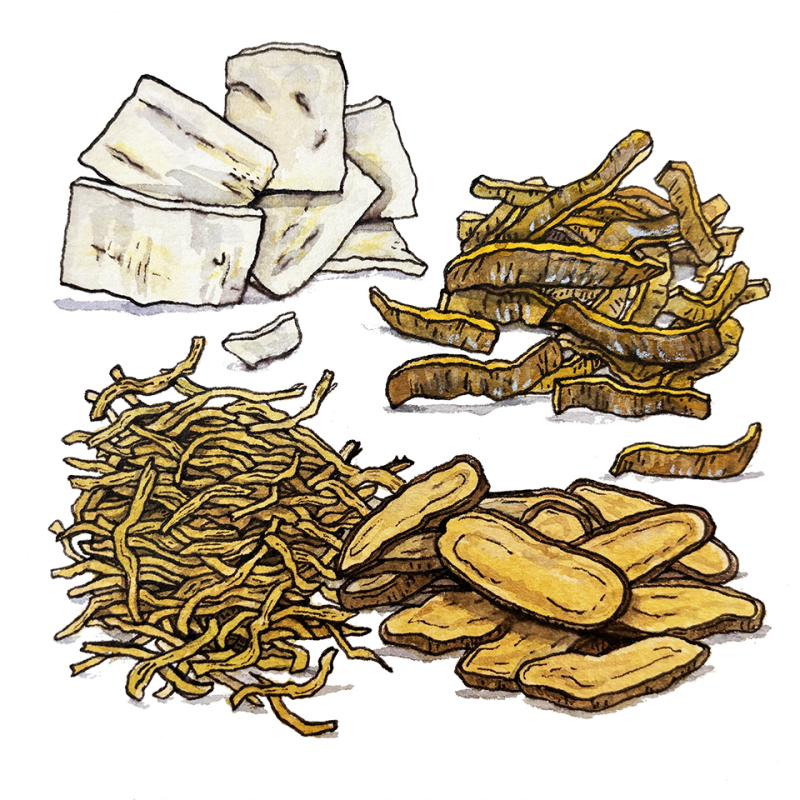
Ge Gen Huang Qin Huang Lian Tang

Purported Benefits, Side Effects & More

Common Names

  • Gegen-Qinlian Decoction
  • Kudzu-Scutellaria-Coptis Decoction
  • Coptis Scute and Pueraria Combination
  • Pueraria Scutellaria Coptis Decoction
  • Galgeunhwanggeumhwangryeon-tang
  • Kakkon Ogon Oren To

For Patients & Caregivers

Tell your healthcare providers about any dietary supplements you’re taking, such as herbs, vitamins, minerals, and natural or home remedies. This will help them manage your care and keep you safe.


Ge Gen Huang Qin Huang Lian Tang (GGHQHLT) is a traditional Chinese medicine formula. It’s made up of four herbs. 

Ge Gen Huang Qin Huang Lian Tang is used to treat:

  • Diarrhea (loose or watery bowel movements)
  • Ulcerative colitis (a type of inflammatory bowel disease that causes ulcers in the colon)
  • Diabetes mellitus

Talk with your healthcare providers before taking herbal formulas. They can interact with some medications and affect how they work. For more information, read the “What else do I need to know?” section below.

Side effects of GGHQHLT may include:

  • Nausea (feeling like you’re going to throw up)
  • Vomiting (throwing up)
  • Hypoglycemia (when your blood sugar drops to unhealthy level)

For Healthcare Professionals

Ge Gen Huang Qin Huang Lian Tang (GGHQHLT) is a traditional Chinese medicine formula with a history of use as a treatment for diarrhea. Documented in the first century classic text Shang Han Lun (Treatise on Febrile Diseases) during the Han dynasty, GGHQHLT consists of four herbs: Ge Gen (Puerariae Lobatae Radix), Huang Qin (Scutellariae Radix),  Huang Lian (Coptidis Rhizoma),and Zhi Gan Cao (Glycyrrhizae Radix et Rhizoma)

Current data indicate effectiveness of GGHQHLT in treating irinotecan-induced diarrhea  (1), infectious diarrhea  (2), and ulcerative colitis  (3), with benefits also seen in pediatric patients with diarrhea  (4).

Additional findings suggest this formula may help manage diabetes mellitus  (5)  (6).

In preclinical studies, combined use of GGHQHLT and anti-mouse PD-1 led to increased expression of interferon gamma, downregulation of PD-1, and increased interleukin-1 levels, all of which help restore T-cell functions  (7).  GGHQHLT also reduced immune-related adverse events in patients with advanced non-small cell lung cancer receiving immune-checkpoint inhibitor therapy  (8).

Larger, well-designed trials are needed to strengthen the evidence base. 

  • Diarrhea
  • Ulcerative Colitis
  • Diabetes mellitus

In mice with irinotecan-induced diarrhea, GGHQHLT had a curative effect through various targets that regulated inflammation, oxidative stress, and proliferation  (9), along with improving the inhibition of colonic tumor growth  (10).

In murine models of ulcerative colitis, GGHQHLT suppressed interleukin-6 / janus kinase 2 / signal transducer and activator of transcription 3 signaling pathway to restore Treg and Th17 cell homeostasis in colonic tissue  (11); and repaired the damaged intestinal barrier via regulating gut microbiota-related tryptophan metabolism and restoring production of indole derivatives to activate AhR-mediated IL-22 production  (12).

The antidiabetic effects of GGHQHLT are thought to be due to berberine via modulation of gut microbiota  (13).

None known.

Nausea, vomiting, and hypoglycemia have been reported (14) (15).

None reported.

  1. Lin X, Fang Y, Cheng Y, Wang Q. Chinese herbal medicine for irinotecan-induced diarrhea: A systematic review and meta-analysis. Explore (NY). Mar-Apr 2024;20(2):158-167. doi:10.1016/j.explore.2023.08.003
  2. Wang F, Wu Q, Zhang Q, et al. Gegen Qinlian Decoction Combined with Conventional Western Medicine for the Treatment of Infectious Diarrhea: A Systematic Review and Trial Sequential Analysis. Complement Med Res. 2024;31(5):461-476.
  3. Chen Y, Li R, Yuan Y, et al. Efficacy and safety of Gegen Qinlian decoction combined with mesalazine for the treatment of UC: A meta-analysis and systematic review. Medicine (Baltimore). Jul 25 2025;104(30):e42266. doi:10.1097/md.0000000000042266
  4. Wang D, Bi CR, Jiang HY, et al. Efficacy and Safety of Gegen Qinlian Decoction for Pediatric Diarrhea: A Systematic Review and Meta-Analysis. Evid Based Complement Alternat Med. 2022;2022:4887259. doi:10.1155/2022/4887259
  5. Ren L, Cheng Y, Qin F. Herbal Formula Gegen-Qinlian Decoction for Type 2 Diabetes Mellitus: A Meta-Analysis of Randomized Controlled Trials. Evid Based Complement Alternat Med. 2020;2020:3907920. doi:10.1155/2020/3907920
  6. Kang X, Jin D, Ji H, et al. The Clinical Efficacy of Gegen Qinlian Decoction in Treating Type 2 Diabetes is Positively Correlated with the Dose of Coptidis rhizoma: Three Randomized, Doubleblind, Dose-Parallel Controlled Clinical Trials. Drug Des Devel Ther. 2024;18:5573-5582. doi:10.2147/dddt.S487315
  7. Lv J, Jia Y, Li J, et al. Gegen Qinlian decoction enhances the effect of PD-1 blockade in colorectal cancer with microsatellite stability by remodelling the gut microbiota and the tumour microenvironment. Cell Death Dis. May 28 2019;10(6):415. doi:10.1038/s41419-019-1638-6
  8. Lu X, Wang A, Chen D, et al. Gegen Qinlian Tablets attenuate immune-related adverse events in NSCLC patients: A multi-center randomized controlled trial in China. Phytomedicine. Sep 2025;145:156968. doi:10.1016/j.phymed.2025.156968
  9. Wu Y, Cheng Y, Yang Y, et al. Mechanisms of Gegen Qinlian Pill to ameliorate irinotecan-induced diarrhea investigated by the combination of serum pharmacochemistry and network pharmacology. J Ethnopharmacol. Aug 10 2021;276:114200. doi:10.1016/j.jep.2021.114200
  10. Wu Y, Wang D, Yang X, Fu C, Zou L, Zhang J. Traditional Chinese medicine Gegen Qinlian decoction ameliorates irinotecan chemotherapy-induced gut toxicity in mice. Biomed Pharmacother. Jan 2019;109:2252-2261. doi:10.1016/j.biopha.2018.11.095
  11. Zhao Y, Luan H, Jiang H, et al. Gegen Qinlian decoction relieved DSS-induced ulcerative colitis in mice by modulating Th17/Treg cell homeostasis via suppressing IL-6/JAK2/STAT3 signaling. Phytomedicine. Apr 2021;84:153519. doi:10.1016/j.phymed.2021.153519
  12. Wang X, Huang S, Zhang M, et al. Gegen Qinlian decoction activates AhR/IL-22 to repair intestinal barrier by modulating gut microbiota-related tryptophan metabolism in ulcerative colitis mice. J Ethnopharmacol. Feb 10 2023;302(Pt B):115919. doi:10.1016/j.jep.2022.115919
  13. Xu X, Gao Z, Yang F, et al. Antidiabetic Effects of Gegen Qinlian Decoction via the Gut Microbiota Are Attributable to Its Key Ingredient Berberine. Genomics Proteomics Bioinformatics. Dec 2020;18(6):721-736. doi:10.1016/j.gpb.2019.09.007
  14. Zhu YG. Clinical observation on 60 cases of type 2 diabetes treated with Gegen Qinlian decoction. Chinese Journal of Ethnomedicine and Ethnopharmacy 2018;27(1):114-115.
  15. Fan YF, Cao W, Hu YXea. Therapeutic effectiveness of Gegen Qinlian decoction on newly diagnosed type 2 diabetes mellitus with insulin resistance. Modern Journal of Integrated Traditional Chinese and Western Medicine. 2017;26(2):115-117.
  16. Ma YF. Efficacy of Gegen Qinlian decoction combined with western medicine in the treatment of viral infectious diarrhea and its effect on intestinal flora and intestinal mucosal barrier function. Journal of Sichuan of Traditional Chinese Medicine. 2020;38(12):119-122.
Email your questions and comments to [email protected].

Last Updated