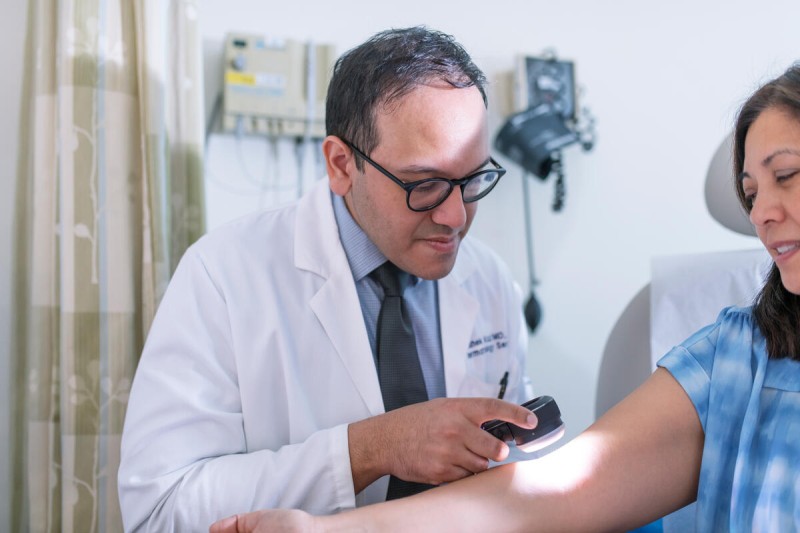
Our experts in the Dermatology Service at Memorial Sloan Kettering Cancer Center (MSK) provide care for people with all types of skin cancers and skin conditions that arise because of the side effects of cancer treatment.
Through our Multidisciplinary Skin Cancer Management Program, our team of experts work together to achieve the best clinical and cosmetic outcomes for people with skin cancer.
We combine clinical excellence, pioneering research, and a commitment to education to deliver the highest standard of care and innovation in dermatology.
Clinical Services
Dermato-oncology
We are experts in dermato-oncology, which is the diagnosis and treatment for all types of skin cancer at early or advanced stages. This includes:
Our team is highly experienced in the diagnosis and treatment of rare and complex skin cancers. This includes cutaneous lymphomas, Extramammary Paget’s Disease, Kaposi Sarcoma, angiosarcoma, and dermatofibrosarcoma protuberans (DFSP), which is a rare but aggressive type of soft-tissue sarcoma.
Oncodermatology
We also specialize in oncodermatology, which involves preventing, diagnosing, and treating side effects of cancer therapies that affect skin, hair, and nails. We offer expert care for managing and treating the following conditions:
- Rashes
- Mucositis, a painful inflammation of the mucous membranes
- Wounds
- Skin-related problems as a result of graft-versus-host disease (GVHD), a complication that can develop after stem cell transplants where donor immune cells attack the host’s tissue
- Alopecia or hair loss
Our goal is to help patients maintain their quality of life and continue cancer treatment while reducing or treating skin-related side effects.
Our Expertise
We use the latest technology to diagnose skin cancers and other skin conditions, including:
- 3D total body photography, a technology that uses multiple cameras to develop a 3D digital model of the skin on your entire body.
- Digital dermoscopy, a non-invasive imaging technique that uses cameras to capture detailed images of moles and skin lesions.
- Reflectance confocal microscopy, a non-invasive imaging technology that uses laser light to see structures in your skin at a cellular level.
Our specialists also use advanced techniques to treat skin cancer and other skin problems, making sure we achieve the best cosmetic and functional results. This includes:
- Photobiomodulation, a low-energy light therapy that helps treat skin conditions
- Laser therapy, a non-invasive treatment that uses focused light energy for different types of skin concerns.
- Photodynamic therapy, a medical treatment that uses a light-sensitive drug called a photosensitizer and light energy to kill cancerous cells or treat other skin conditions.
We are leaders in Mohs surgery and other advanced dermatological procedures to treat skin cancers and conditions. Mohs micrographic surgery is a procedure that helps precisely remove skin cancer while preserving healthy tissue. Our team also includes skilled reconstructive experts who help restore appearance and function after surgery.
We offer regular skin checks and imaging for people who are at high risk for skin cancer because of personal or family history, or because they are immunocompromised or have multiple atypical moles.
Treatment Locations
We offer treatment in locations in New York City, Westchester, Long Island, and New Jersey.
Our Faculty
New York City


Long Island (Hauppage)


New Jersey (Basking Ridge)


Westchester
New York City


Long Island (Hauppage)


New Jersey (Basking Ridge)

New York City


New York City
General Dermatology APPs


Mohs APPs


New Jersey (Basking Ridge)
General Dermatology APPs

Long Island (Hauppage)
General Dermatology APPs

Mohs APPs

Research Programs
Our research focuses on improving the early detection, diagnosis, and treatment of skin cancers and other skin conditions or problems related to cancer. Here are some recent achievements and areas we’re exploring in research:
- Our researchers pioneered the use of 3D total body photography to create a comprehensive baseline of a patient’s skin, allowing us to precisely monitor moles and lesions over time.
- We are developing artificial intelligence (AI) to help our doctors more accurately detect and diagnose skin cancer and improve patient outcomes. We’re training AI tools to identify suspicious lesions with precision so that they can help reduce the number of biopsies of benign (non-cancerous) growths.
- We’re researching the prevention and management of skin-related side effects from cancer treatments. This includes the role of dermocosmetics, which are skincare products developed under the guidance of dermatologists to treat specific skin conditions. These products help reduce interruptions to cancer treatment due to side effects.
- We’re investigating the body’s immune system and its relationship with skin cancers. Specifically, we are studying how the immune system detects and evades poxviruses so we can develop better therapies for poxviruses. We want to harness the potential of immunotherapy and poxviruses in destroying cancers such as melanoma.
Clinical Trials
During your treatment for skin cancer, your care team may ask if you want to join a clinical trial. Clinical trials are research studies that test new treatments, procedures, or devices to see how well they work. They are an important part of helping to prevent, treat, and cure cancer. Almost every cancer treatment given to patients was first tested during a clinical trial. Talk with an MSK doctor about whether joining a clinical trial is right for you.
View Dermatology Clinical Trials
Training Programs
MSK is committed to training the next generation of dermatology leaders through a range of educational programs:
Fellowships
- Micrographic Surgery and Dermatologic Oncology Fellowship: We offer a one-year, ACGME-accredited program that offers training in Mohs micrographic surgery, cutaneous oncology, and reconstructive surgery, in collaboration with Weill Cornell Medicine.
- Dermatology/Cutaneous Oncology Fellowship: This clinical research fellowship focuses on clinical and epidemiologic research in skin cancer and skin-related side effects of cancer treatment. It also offers exposure to the diverse clinical activities of the Dermatology service.
- Oncodermatology and Dermato-oncology Fellowship: This gap year research fellowship combines clinical research, mentorship, and clinical exposure. Fellows gain experience in epidemiology, imaging, outcomes research, and clinical trials.
- Dermatology Residency Rotation: The Dermatology Service at MSK participates in a shared residency with the Joan and Sanford I. Weill Department of Medicineat Weill Cornell Medical College. Residents participate in rotations at MSK, gaining hands-on experience in cutaneous oncology, Mohs surgery, and oncodermatology, with exposure to advanced diagnostic and therapeutic modalities.
Observerships
- We provide opportunities for visiting clinicians and trainees to observe MSK’s dermatology service, participate in educational conferences, and experience multidisciplinary care.